ForAllPilotsFlying beyond limits
PPL · illustrated course

PPL meteorology course: 12 illustrated chapters

The PPL meteorology course follows the syllabus in 12 chapters: 93 key points explained in a few paragraphs, often with a diagram, what to remember and, for many, the classic exam trap. The first chapter, « The atmosphere and the standard atmosphere », can be read in full on this page.

Contents

Each chapter explains, point by point, what the questions of the bank ask, with a « Remember » box and often the classic exam trap. The first chapter is free, below and in the app; the next ones are for PPL subscribers.

  1. Composition of air, layers of the atmosphere and values of the standard atmosphere (ISA).

    6 key points · 52 questions of the bank

  2. 2.Pressure, pressure systems and altimeter settings

    Subscribers

    Atmospheric pressure, isobars, anticyclones and depressions, QNH/QFE/1013 settings and pressure altitude.

    7 key points · 67 questions of the bank

  3. 3.Temperature and humidity

    Subscribers

    Heat exchanges, diurnal cycle, inversions, water vapour, saturation and dew point.

    8 key points · 25 questions of the bank

  4. 4.Stability, convection and thermals

    Subscribers

    Adiabatic cooling, stable or unstable air, convection, thermals and their end.

    6 key points · 20 questions of the bank

  5. 5.Clouds and precipitation

    Subscribers

    Formation, levels and families of clouds, from cumulus to cumulonimbus, and types of precipitation.

    8 key points · 18 questions of the bank

  6. 6.Visibility, mist and fog

    Subscribers

    Mist, haze and fog, and the four main types of fog.

    5 key points · 17 questions of the bank

  7. 7.Wind

    Subscribers

    How wind is expressed, pressure gradient, Coriolis, circulation around pressure centres, Buys-Ballot, surface wind and wind gradient.

    8 key points · 28 questions of the bank

  8. 8.Wind components on the runway

    Subscribers

    Calculating the headwind, tailwind and crosswind components from the wind and the QFU.

    4 key points · 183 questions of the bank

  9. 9.Breezes, terrain and local winds

    Subscribers

    Sea, land, slope and valley breezes, terrain effects, foehn, mountain waves, Venturi effect and regional winds.

    8 key points · 35 questions of the bank

  10. 10.Air masses, fronts and disturbances

    Subscribers

    Air masses, frontal surfaces, structure of a disturbance, warm front, warm sector, cold front, post-frontal zone and occlusion.

    10 key points · 28 questions of the bank

  11. 11.Thunderstorms, icing, turbulence and wind shear

    Subscribers

    Formation and hazards of thunderstorms, how to act, lightning, icing, turbulence and wind shear.

    10 key points · 45 questions of the bank

  12. 12.Weather messages and charts

    Subscribers

    METAR, SPECI, TAF, TEMSI, WINTEM, SIGMET, VOLMET, ATIS and SNOWTAM: reading and using weather information.

    13 key points · 85 questions of the bank
Chapter 1: The atmosphere and the standard atmosphere

Composition of air, layers of the atmosphere and values of the standard atmosphere (ISA).

What is air made of?

← Faites glisser le schéma →

Composition of dry air: 78% nitrogen, 21% oxygen, 1% other gases

© ForAllPilots

Dry air is a mixture of gases whose proportions are practically constant up to great altitudes:

  • nitrogen: about 78%;
  • oxygen: about 21%;
  • other gases (argon, carbon dioxide, etc.): about 1%.

To this mixture is added water vapour, in a very variable amount depending on temperature and region. It is invisible, but it is what produces clouds, fog and precipitation: almost all of a pilot's weather comes from it.

Remember

The two main components of air: nitrogen (78%) and oxygen (21%).

Exam trap

Neither carbon dioxide nor water vapour is one of the two main components, even though water vapour is the most important for weather.

The layers of the atmosphere

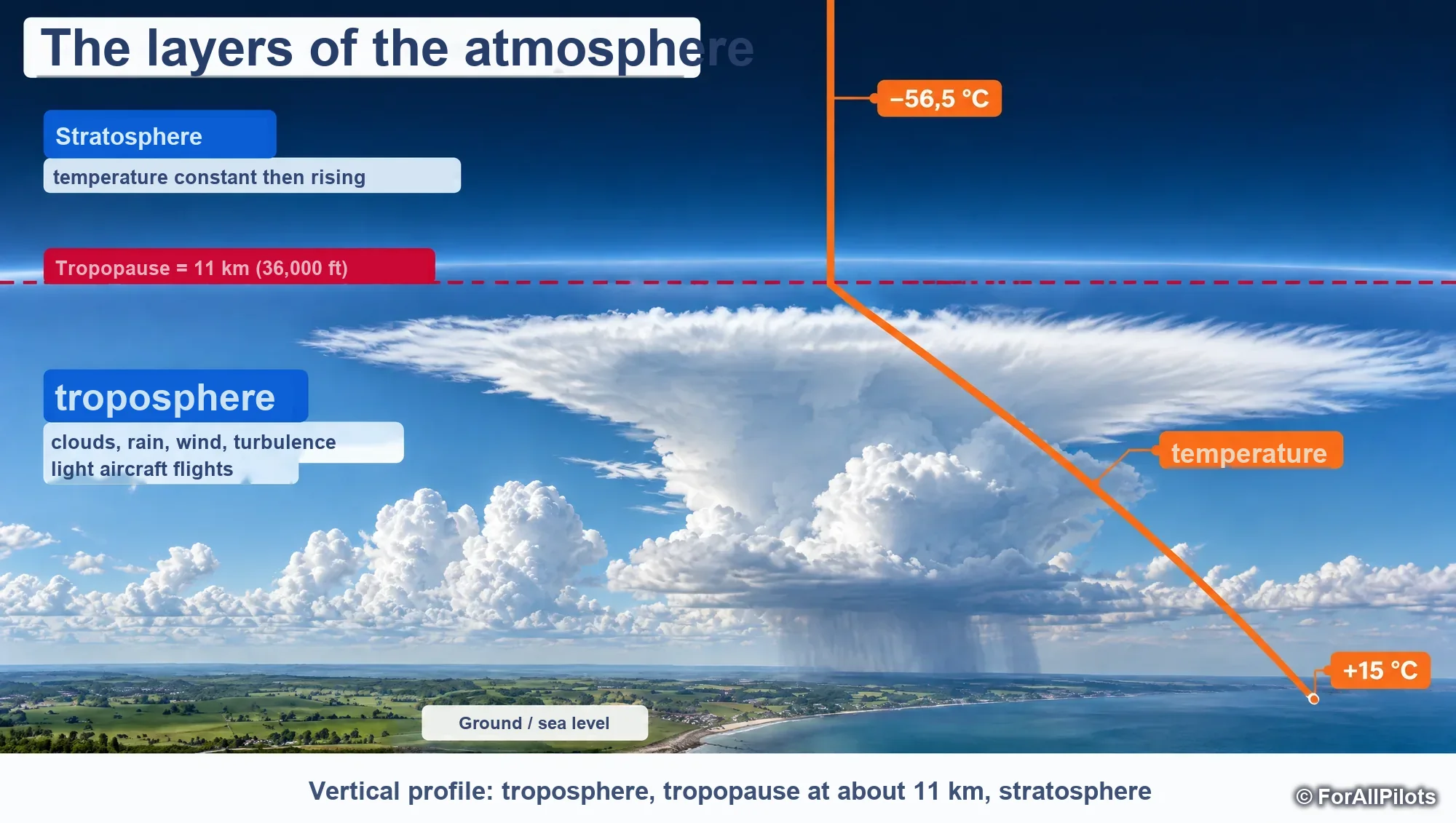
Vertical profile: troposphere, tropopause at about 11 km, stratosphere

Touchez l'image pour l'agrandir

Vertical profile: troposphere, tropopause at about 11 km, stratosphere

Starting from the ground, we find:

  • the troposphere: the layer in which temperature decreases with altitude. It contains almost all the water vapour, and therefore almost all weather phenomena. This is where most civil aircraft fly, and all light aircraft;
  • the tropopause: the upper limit of the troposphere, at about 11 km (36,000 ft) in temperate latitudes. It is lower at the poles (about 8 km) and higher at the equator (about 16 km);
  • the stratosphere: above it, the temperature stops decreasing (it remains constant, then increases).

Remember

Order from the ground: troposphere, tropopause, stratosphere. Tropopause ≈ 11,000 m in Europe.

Exam trap

The tropopause is not a thick layer: it is the boundary between the troposphere and the stratosphere. And 11,000 m, not 11,000 ft or 1,100 ft.

The standard atmosphere (ISA)

← Faites glisser le schéma →

The standard atmosphere values to know by heart

© ForAllPilots

The ICAO standard atmosphere (ISA, formerly the "standard atmosphere") is a conventional model: an ideal, dry atmosphere, identical everywhere and at all times. It serves as a reference for calibrating altimeters and comparing performance.

In this model, pressure, temperature and density (often simply called "density") depend only on altitude: not on place, time, wind or humidity.

Temperature decreases in it by 6.5 °C per 1000 m up to 11,000 m.

Remember

ISA: 15 °C and 1013.25 hPa at sea level; −6.5 °C/1000 m, i.e. ≈ −2 °C/1000 ft; −56.5 °C at 11,000 m.

Exam trap

Beware of mixed-up units: 6.5 °C per 1000 m (not per 1000 ft), 2 °C per 1000 ft (not per 1000 m), 0.65 °C per 100 m.

Calculating ISA temperature

← Faites glisser le schéma →

Temperature in the standard atmosphere according to altitude

© ForAllPilots

In the lower layers, the practical rule is simple: start from +15 °C at sea level and subtract 2 °C per 1000 ft.

  • 1000 ft: 13 °C; 3000 ft: 9 °C; 3500 ft: 8 °C;
  • 5000 ft: 5 °C; 6000 ft: 3 °C;
  • 7500 ft: 0 °C; 10,000 ft: −5 °C; 12,000 ft: −9 °C.

For an "and a half" altitude (4500 ft, 8500 ft, etc.), subtract 1 °C for the extra 500 ft: 4500 ft gives 6 °C, 8500 ft gives −2 °C.

Remember

T(ISA) = 15 − 2 × altitude in thousands of ft. ISA 0 °C isotherm: 7500 ft.

Exam trap

Do not confuse it with the "metric" gradient: 6.5 °C per 1000 m. Applied by mistake in feet, it gives absurd results.

Deviation from the standard atmosphere

← Faites glisser le schéma →

At 4000 ft, +6 °C corresponds to ISA −1 and +27 °C to ISA +20

© ForAllPilots

Real weather is never exactly standard. The deviation from ISA at the same altitude is expressed as follows:

  • ISA + 10: the temperature is 10 °C above the standard value;
  • ISA − 3: the temperature is 3 °C below it.

Example: at 4000 ft, ISA is +7 °C. If +6 °C is measured, we are at ISA − 1. If ISA + 20 is reported, the temperature is 7 + 20 = +27 °C.

The same reasoning is used to extrapolate: at 1500 ft the temperature is +10 °C; with 2 °C per 1000 ft, at 8500 ft (7000 ft higher) it will be 10 − 14 = −4 °C.

Remember

ISA deviation = measured temperature − ISA temperature at that altitude.

Exam trap

Always calculate ISA at the altitude concerned before comparing: +6 °C is only "cold" compared with the standard +7 °C at 4000 ft.

What changes as you climb

← Faites glisser le schéma →

Pressure, temperature and density decrease with altitude

© ForAllPilots

As a general rule, when climbing in the troposphere:

  • pressure decreases (there is less air above you);
  • temperature decreases (the air is heated by the ground, not directly by the sun);
  • the density of the air decreases, like pressure and temperature.

Thin air at altitude reduces engine power, propeller thrust and lift at the same true airspeed: this is why these concepts matter for performance.

Remember

When climbing: pressure ↓, temperature ↓, density ↓.

Exam trap

Density decreases "like" pressure and temperature, not "the opposite way". Exceptions (temperature inversion) exist in the real atmosphere, not in ISA.

The course goes on with chapter 2, « Pressure, pressure systems and altimeter settings ». It is read in the Course tab of the app with a PPL subscription, and each chapter ends with the questions of the bank about it. See pricing

How ForAllPilots trains you

  • Series of 20 or 30 questions

    New questions, mistakes to review or a mix of both, with the answer and its explanation straight away.

  • Flashcards

    Question on the front, explained answer on the back, filtered by subject, to learn without a timer.

  • Timed mock exam

    60 questions in 90 minutes, drawn from the whole PPL bank: a training format, not a copy of an official paper.

  • AI instructor, optional

    From €4.99 a month on top of the Private pilot or PRO offer: it quizzes you in writing and explains your mistakes. A beta tool, it does not replace an approved instructor.

PPL access comes with the Private pilot offer (BIA, PPL, microlight and helicopter): €10 a month, cancel anytime, or €69 once with the Exam Pass (18 months of access, nothing renews). Prices include all taxes.

The other PPL courses

All about the PPL exams: format, subjects and method