ForAllPilotsFlying beyond limits
PPL · illustrated course

PPL air law course: 13 illustrated chapters

The PPL air law course follows the syllabus in 13 chapters: 120 key points explained in a few paragraphs, often with a diagram, what to remember and, for many, the classic exam trap. The first chapter, « The regulatory framework: ICAO, Europe, France », can be read in full on this page.

Contents

Each chapter explains, point by point, what the questions of the bank ask, with a « Remember » box and often the classic exam trap. The first chapter is free, below and in the app; the next ones are for PPL subscribers.

  1. Who makes the rules, where they apply, aircraft nationality and UTC time.

    6 key points · 26 questions of the bank

  2. 2.Licences, ratings and medical certificate

    Subscribers

    Obtaining the PPL(A) and keeping your privileges: ages, hours, exams, SEP rating, medical.

    14 key points · 57 questions of the bank

  3. 3.The aircraft and its documents

    Subscribers

    On-board documents, certificate of registration, airworthiness, flight log, mandatory equipment.

    11 key points · 41 questions of the bank

  4. 4.Airspace and air traffic services

    Subscribers

    Services provided, units, FIR, CTR, TMA, classes A to G and P, R and D areas.

    12 key points · 112 questions of the bank

  5. 5.VMC and special VFR

    Subscribers

    Visibility and distance from cloud depending on the airspace, entering a CTR, special VFR and VFR "on top".

    9 key points · 50 questions of the bank

  6. 6.Minimum overflight heights

    Subscribers

    SERA 150 m and 300 m rule, French rules for towns and gatherings, obstacles and bodies of water.

    7 key points · 33 questions of the bank

  7. 7.Priorities and collision avoidance

    Subscribers

    See and avoid, head-on, converging tracks, overtaking, landing priorities, wake turbulence and AIRPROX.

    9 key points · 36 questions of the bank

  8. 8.Altimeter settings and cruising levels

    Subscribers

    QNH, QFE, 1013, transition altitude and transition level, semicircular rule and speed limitation.

    7 key points · 98 questions of the bank

  9. 9.The aerodrome: runways, markings, lights and signals area

    Subscribers

    Aerodrome areas, runway numbers, declared distances, displaced threshold, markings, lighting, PAPI and signals area.

    11 key points · 49 questions of the bank

  10. 10.Aerodrome traffic, clearances and signals

    Subscribers

    Traffic circuit, joining at an uncontrolled, AFIS or controlled aerodrome, radio failure and light signals.

    11 key points · 48 questions of the bank

  11. 11.Flight preparation and flight plan

    Subscribers

    Aeronautical information and weather, cases where a flight plan is mandatory, deadlines, form, activation, closure and aeronautical night.

    8 key points · 35 questions of the bank

  12. 12.Transponder, emergencies, accidents and penalties

    Subscribers

    Transponder codes, alert phases, forced landing, accidents and incidents, investigations, offences and penalties.

    8 key points · 34 questions of the bank

  13. 13.LAPL, medical, language proficiency and additional ratings

    Subscribers

    What the LAPL(A) allows, the medical certificate in detail, the FCL.055 endorsement and the night, aerobatic, towing and mountain ratings.

    7 key points · 7 questions of the bank
Chapter 1: The regulatory framework: ICAO, Europe, France

Who makes the rules, where they apply, aircraft nationality and UTC time.

Three tiers of rules

← Faites glisser le schéma →

ICAO, European Union (EASA) and France: three levels of regulation

© ForAllPilots

Air regulations are built up in three levels.

  • ICAO (International Civil Aviation Organization, created by the Chicago Convention of 1944): it publishes standards and recommended practices in 19 annexes (licensing, rules of the air, aeronautical charts, air traffic services, accident investigation, etc.). It does not publish laws or decrees.
  • European Union / EASA: directly applicable regulations: SERA (rules of the air), Part-FCL (licensing, which replaced the former JAR-FCL 1), Part-MED (medical), Part-NCO (non-commercial operations).
  • France: the DGAC (the French civil aviation authority) and the SIA (Service de l'information aéronautique, the French aeronautical information service) publish the AIP, charts and additional national rules.

Remember

ICAO = standards and recommended practices (annexes). PPL licences = Part-FCL (formerly JAR-FCL 1).

Exam trap

ICAO does not issue laws, decrees or orders: it is the States (and the EU) that make them mandatory. ICAO annexes deal, for example, with aeronautical charts, not with landing fees or the colour of aircraft.

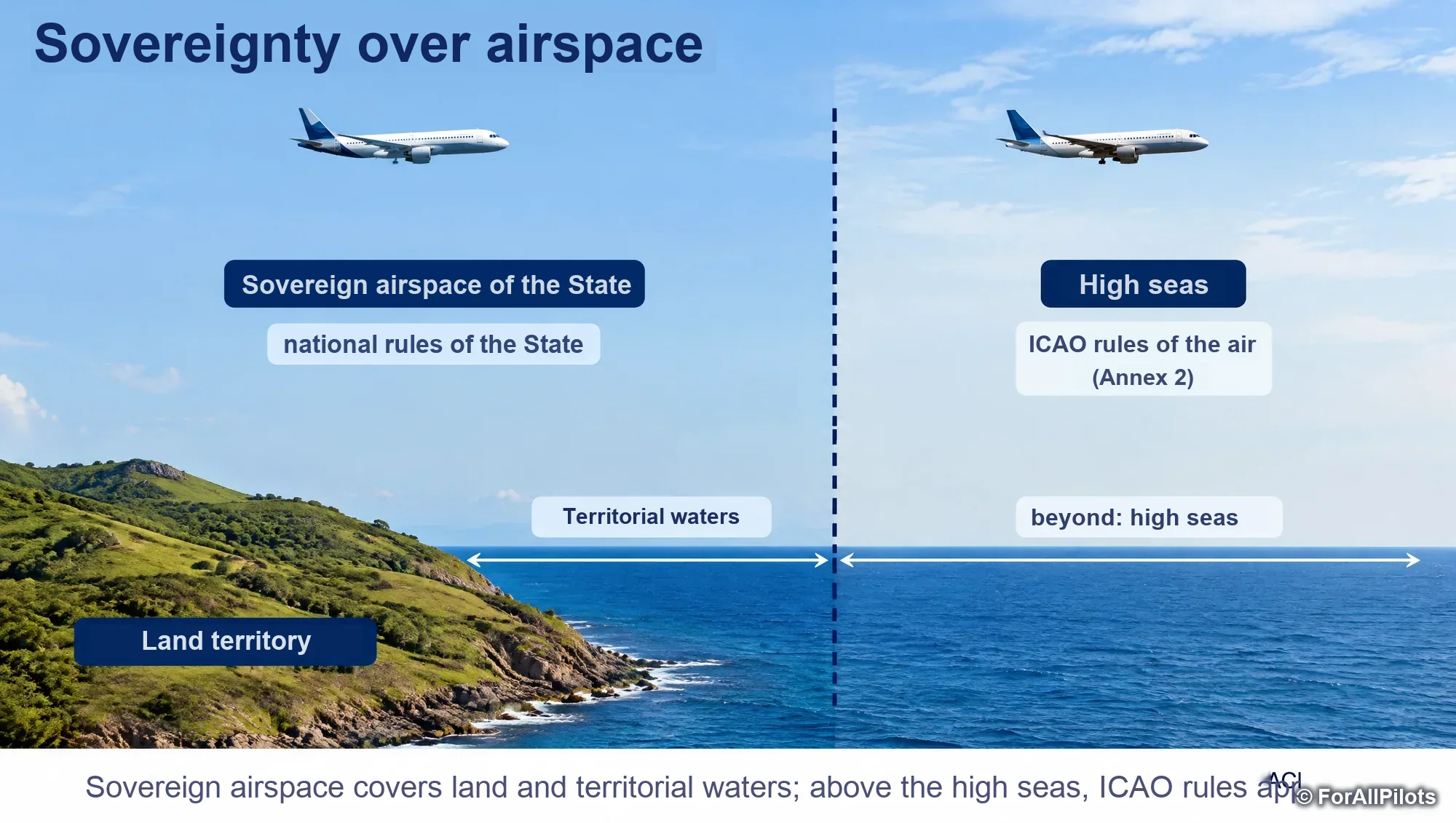
Sovereignty over airspace

Sovereign airspace covers land and territorial waters; above the high seas, ICAO rules apply

Touchez l'image pour l'agrandir

Sovereign airspace covers land and territorial waters; above the high seas, ICAO rules apply

Every State has complete and exclusive sovereignty over the airspace above its territory. Under the Chicago Convention, this territory includes:

  • the land areas;
  • the adjacent territorial waters;
  • territories placed under its protection or mandate.

The high seas belong to no one: above them, the ICAO rules of the air (Annex 2) apply, regardless of the aircraft's country of registration.

An aircraft registered in France applies the French rules of the air everywhere, as long as they do not conflict with those of the State overflown: over another country, that country's rules take precedence.

Remember

Territory = land + territorial waters (+ territories under protection or mandate). High seas = ICAO rules.

Exam trap

The high seas, even if "adjacent" to a State's coast, are not part of its territory. And above the high seas, neither the rules of the country of registration nor those of the nearest country apply.

Flying to another State

← Faites glisser le schéma →

International flight: departure and arrival at a customs aerodrome, documents on board

© ForAllPilots

The Chicago Convention sets the rules for international flight:

  • unless there is special authorisation or the flight is within the Schengen area, you land at a customs aerodrome when entering a State and you depart from a customs aerodrome;
  • the authorities of the State visited may ask for the documents and inspect the aircraft;
  • each State may prohibit or regulate cameras on board over its territory;
  • the pilot's licence must be issued or validated by the State of registry of the aircraft;
  • licences are mutually recognised if they meet at least the ICAO standards;
  • the journey log book is mandatory in international navigation.

Remember

International (outside Schengen/authorisation): land AND depart from a customs aerodrome.

Exam trap

The licence must be issued or validated by the State of registry of the aircraft, not by the pilot's State of nationality nor by "any ICAO country".

Nationality and registration marks

Nationality mark (F) followed by the registration mark (GXYZ)

Touchez l'image pour l'agrandir

Nationality mark (F) followed by the registration mark (GXYZ)

An aircraft has the nationality of the State in whose register it is entered (the State of registry). The country of manufacture, the country where it is based, and the nationality of the owner or pilot do not matter.

The State of registry assigns the mark and issues the certificate of registration. On the airframe, the nationality mark followed by the registration mark is painted: F-GXYZ (F = France).

A fireproof identification plate, fixed on board, bears the nationality and registration of the aircraft.

Example: an aircraft built in France, exported to the United States, registered in Canada and owned by a Briton is Canadian.

Remember

An aircraft's nationality = the country that registers it and issues its certificate of registration.

Exam trap

The order is always nationality THEN registration (F-GXYZ). The mark is supplied neither by the manufacturer, nor by the owner, nor by ICAO.

The reference time: UTC

← Faites glisser le schéma →

Converting French legal time to UTC

© ForAllPilots

In air traffic, all times are expressed in Coordinated Universal Time (UTC): flight plans, weather messages, NOTAMs, and the departure and arrival times in the pilot's logbook.

In mainland France, legal time is:

  • UTC + 1 h in winter;
  • UTC + 2 h in summer.

To convert from legal time to UTC, you therefore subtract 1 h (winter) or 2 h (summer). Example: on 7 February at 14:12 Paris time, it is 13:12 UTC.

Remember

Winter: UTC = legal time − 1 h. Summer: UTC = legal time − 2 h.

Exam trap

Do not add the hour instead of subtracting it: in Paris, legal time is "ahead of" UTC.

The pilot-in-command, ultimately responsible

← Faites glisser le schéma →

The responsibilities of the pilot-in-command

© ForAllPilots

Whatever the context (general aviation or air transport), the pilot-in-command (PIC) holds final authority over the conduct and safety of the flight:

  • he or she decides whether to start, continue or discontinue the flight;
  • he or she remains responsible for collision avoidance, even when receiving clearances from air traffic control;
  • he or she may deviate from the rules of the air if safety absolutely requires it.

Neither the controller, nor the operator, nor a dispatcher makes this final decision in their place.

Remember

Final decision to start a flight: the pilot-in-command.

The course goes on with chapter 2, « Licences, ratings and medical certificate ». It is read in the Course tab of the app with a PPL subscription, and each chapter ends with the questions of the bank about it. See pricing

How ForAllPilots trains you

  • Series of 20 or 30 questions

    New questions, mistakes to review or a mix of both, with the answer and its explanation straight away.

  • Flashcards

    Question on the front, explained answer on the back, filtered by subject, to learn without a timer.

  • Timed mock exam

    60 questions in 90 minutes, drawn from the whole PPL bank: a training format, not a copy of an official paper.

  • AI instructor, optional

    From €4.99 a month on top of the Private pilot or PRO offer: it quizzes you in writing and explains your mistakes. A beta tool, it does not replace an approved instructor.

PPL access comes with the Private pilot offer (BIA, PPL, microlight and helicopter): €10 a month, cancel anytime, or €69 once with the Exam Pass (18 months of access, nothing renews). Prices include all taxes.

The other PPL courses

All about the PPL exams: format, subjects and method