ForAllPilotsFlying beyond limits
PPL · illustrated course

PPL aircraft general knowledge course: 13 illustrated chapters

The PPL aircraft general knowledge course follows the syllabus in 13 chapters: 115 key points explained in a few paragraphs, often with a diagram, what to remember and, for many, the classic exam trap. The first chapter, « Airframe, structure and landing gear », can be read in full on this page.

Contents

Each chapter explains, point by point, what the questions of the bank ask, with a « Remember » box and often the classic exam trap. The first chapter is free, below and in the app; the next ones are for PPL subscribers.

  1. The families of aircraft, the vocabulary of the aeroplane and the wing, the loads on the structure and its limits.

    11 key points · 36 questions of the bank

  2. 2.Flight controls, trim tabs and high-lift devices

    Subscribers

    The three axes, the control surfaces and their secondary effects, trim tabs, flaps, slats and airbrakes.

    9 key points · 39 questions of the bank

  3. 3.Basic handling concepts related to the aircraft

    Subscribers

    Pitch attitude, angle of attack and flight path angle, effects of power, taxiing, tailwheel and tricycle undercarriages, reference speeds.

    8 key points · 29 questions of the bank

  4. 4.The piston engine and its ignition

    Subscribers

    Engine components, the four-stroke cycle, power and air density, magnetos and dual ignition.

    12 key points · 51 questions of the bank

  5. 5.Engine lubrication and cooling

    Subscribers

    The role of oil, its circuit, monitoring of pressures and temperatures, air cooling and cowl flaps.

    9 key points · 44 questions of the bank

  6. 6.Fuel, fuel system and carburettor

    Subscribers

    Aviation fuel, the fuel system and its drains, the carburettor, carburettor icing and carburettor heat.

    9 key points · 51 questions of the bank

  7. 7.Mixture strength and abnormal combustion

    Subscribers

    The air-fuel ratio, the mixture control, EGT and the fuel flow indicator, detonation and pre-ignition.

    9 key points · 38 questions of the bank

  8. 8.The propeller: fixed-pitch and constant-speed

    Subscribers

    The blade seen as a rotating wing, fine and coarse pitch, fixed-pitch propeller, constant-speed propeller and manifold pressure.

    7 key points · 37 questions of the bank

  9. 9.The aircraft electrical system

    Subscribers

    Voltage, current and capacity, battery and alternator, protection devices, electrical consumers and what to do in the event of a failure.

    7 key points · 37 questions of the bank

  10. 10.The pitot-static system and the airspeed indicator

    Subscribers

    Total and static pressure, how the airspeed indicator works, the different speeds, the colour arcs, limiting speeds and failures.

    8 key points · 69 questions of the bank

  11. 11.The altimeter, altimeter settings and the vertical speed indicator

    Subscribers

    The principle of the altimeter, the standard atmosphere, the QNH, QFE and 1013 settings, temperature errors, the vertical speed indicator and its failures.

    8 key points · 37 questions of the bank

  12. 12.Gyroscopic instruments and magnetic compass

    Subscribers

    The gyroscope and its power supply, the attitude indicator, the heading indicator, the turn indicator and the ball, the compass and its errors.

    12 key points · 64 questions of the bank

  13. 13.The glass cockpit (EFIS)

    Subscribers

    PFD, MFD, AHRS, ADC and magnetometer, failures, reversionary mode and standby instruments of a glass cockpit.

    6 key points · 6 questions of the bank
Chapter 1: Airframe, structure and landing gear

The families of aircraft, the vocabulary of the aeroplane and the wing, the loads on the structure and its limits.

Aerostats and aerodynes

← Faites glisser le schéma →

The two families of aircraft

© ForAllPilots

An aircraft is any machine able to support itself in the atmosphere. There are two main families:

  • aerostats (balloons, airships) are lighter than air: they float thanks to Archimedes' buoyancy;
  • aerodynes (aeroplanes, gliders, helicopters, microlights) are heavier than air: they support themselves by means of an aerodynamic force, lift, created by the movement of air over a fixed or rotating wing.

The aeroplane is a fixed-wing aerodyne, propelled by an engine.

Remember

Aerostat = lighter than air (Archimedes). Aerodyne = heavier than air (lift).

The main parts of the aeroplane

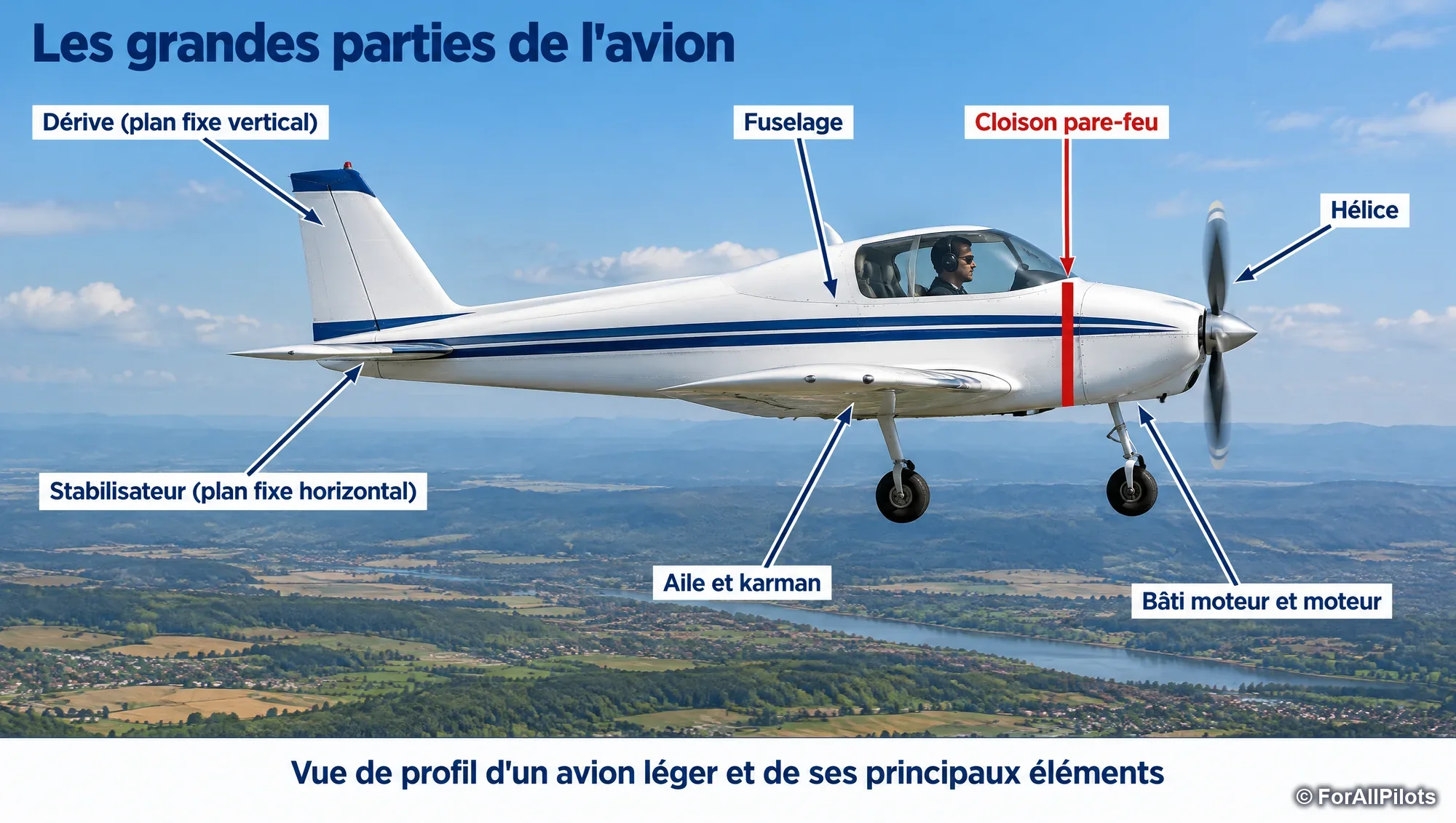
Side view of a light aeroplane and its main components

Touchez l'image pour l'agrandir

Side view of a light aeroplane and its main components

The airframe includes everything that is not the powerplant:

  • the fuselage, which carries the crew and connects the other components;
  • the wing (the wings), which creates lift;
  • the tail unit (empennage): fixed horizontal and vertical surfaces, which provide stability, and movable elevator and rudder control surfaces, which are used to fly the aircraft;
  • the landing gear.

The engine is attached to the airframe by the engine mount. A firewall separates it from the cockpit. The fairing (karman) is the streamlined fillet that joins the wing to the fuselage at the wing root.

Remember

Fixed surfaces = stability; control surfaces = control.

Exam trap

Fixed surfaces are used neither to fly the aircraft nor to reduce drag: their role is to stabilise the flight. The horizontal stabiliser provides longitudinal stability (in pitch), the fin provides directional stability.

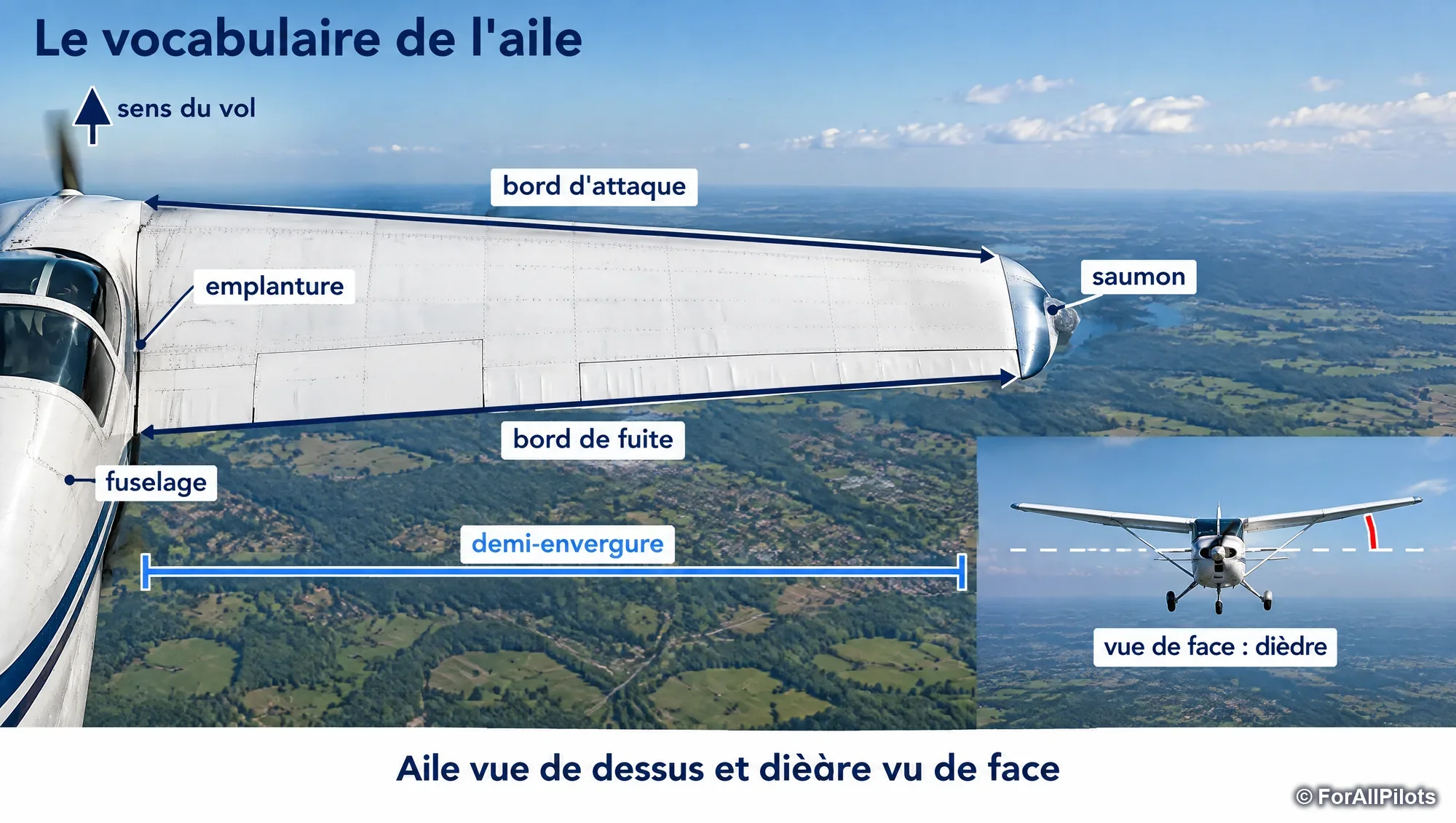
Wing vocabulary

Wing seen from above and dihedral seen from the front

Touchez l'image pour l'agrandir

Wing seen from above and dihedral seen from the front

Seen from above, the wing is attached to the fuselage at the wing root and ends at the wing tip.

  • leading edge: the front of the wing; trailing edge: the rear;
  • upper surface (extrados): the top face; lower surface (intrados): the bottom face;
  • chord: the line joining the leading edge to the trailing edge of an aerofoil;
  • wingspan b: the distance from one wing tip to the other;
  • aspect ratio: b² / S, which amounts to the wingspan divided by the mean chord.

The dihedral is the angle between the horizontal plane and the longitudinal axis of the wing (front view). A positive dihedral (wings raised) improves roll stability.

Remember

Aspect ratio = wingspan² / area = wingspan / mean chord.

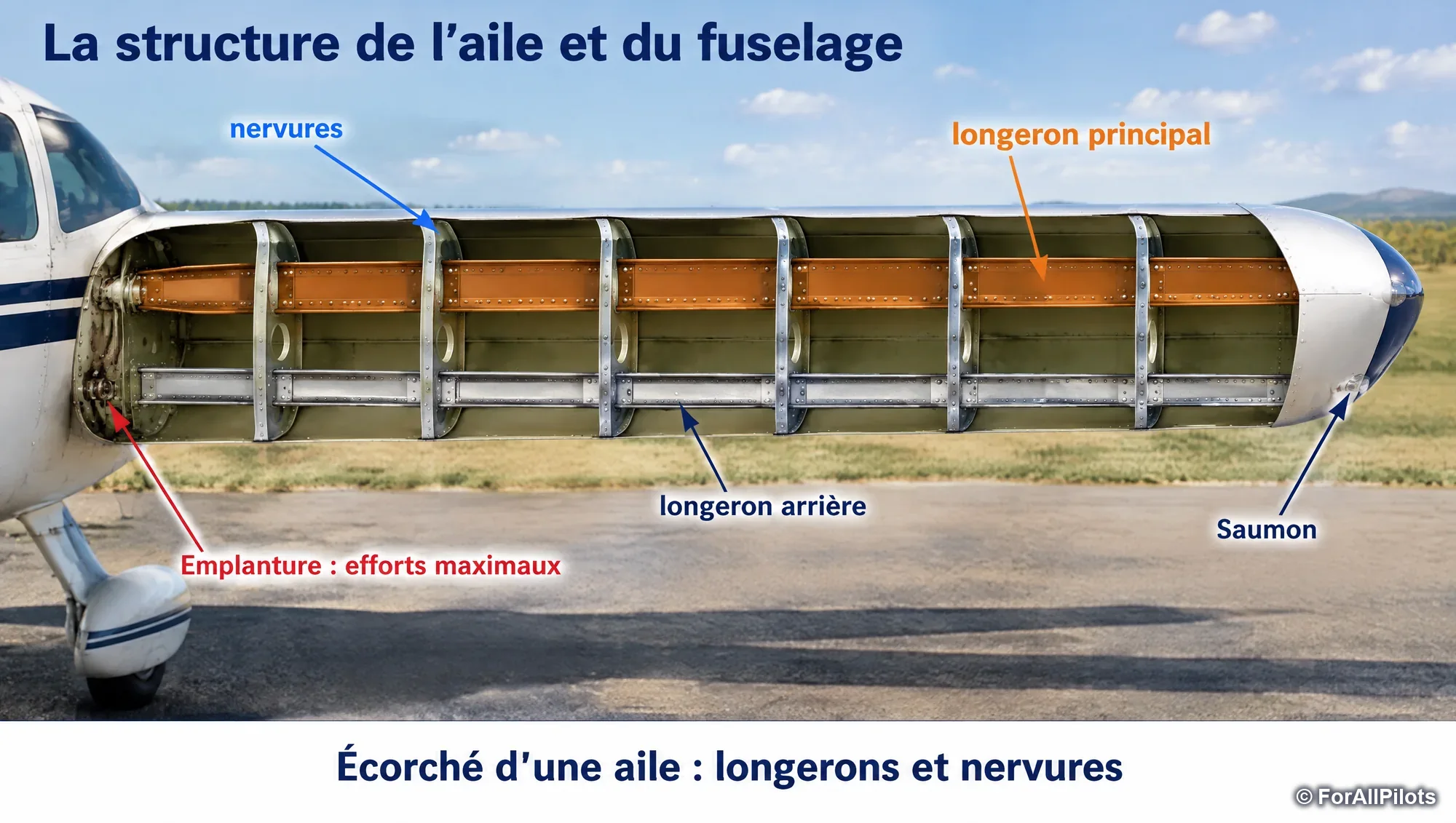
Wing and fuselage structure

Cutaway of a wing: spars and ribs

Touchez l'image pour l'agrandir

Cutaway of a wing: spars and ribs

The wing is a beam. Its main component is the spar, which runs from the wing root to the wing tip: it takes most of the bending loads due to lift.

  • the ribs give the aerofoil its shape and transmit the loads to the spar;
  • the skin closes the box and contributes to rigidity.

The fuselage is made of frames (formers), which give the cross-section its shape, and stringers, longitudinal members that connect them and stiffen the whole structure, all covered by the skin.

Exam trap

It is neither the ribs nor the skin that mainly carry the bending of the wing: it is the spars.

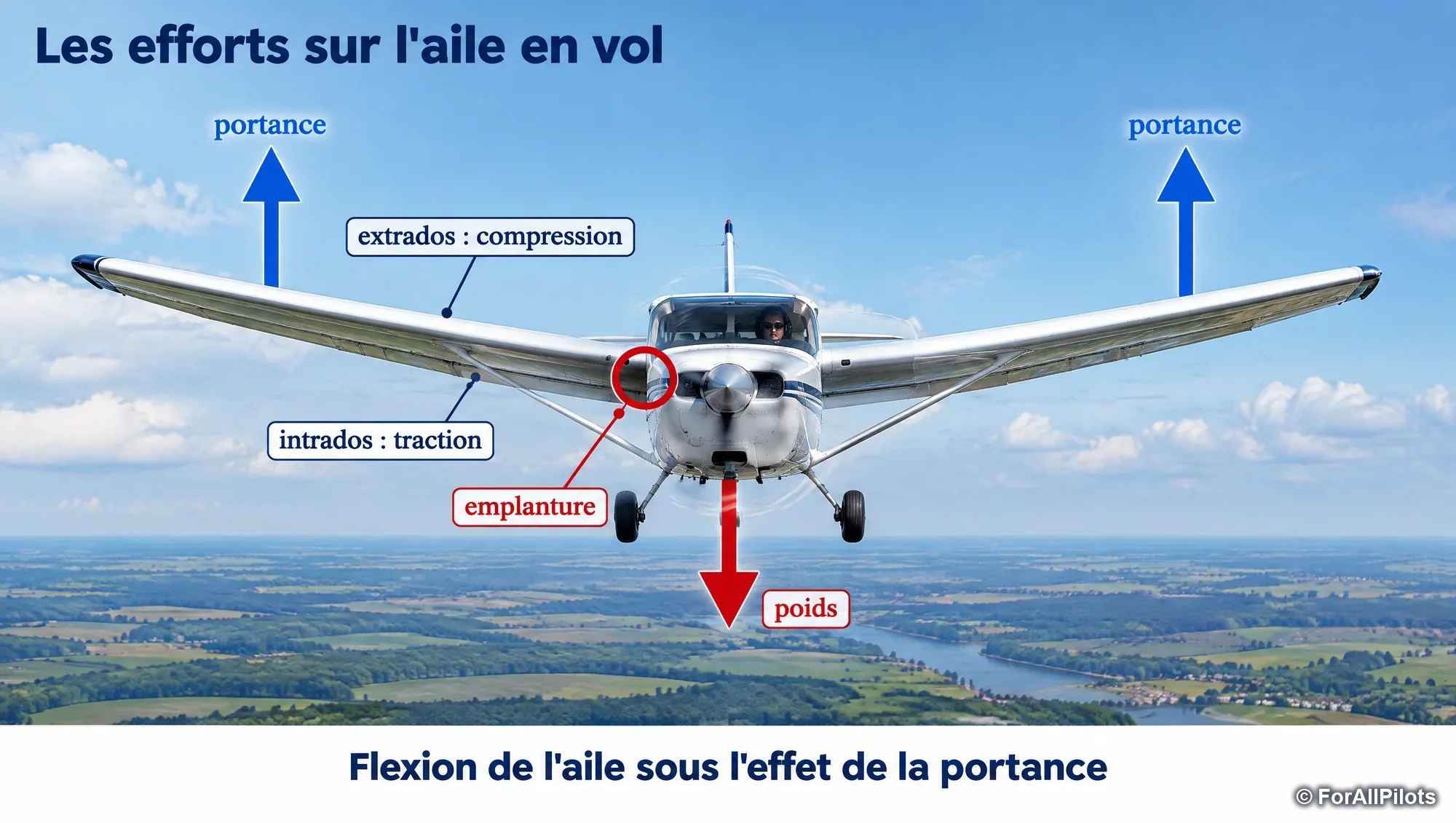
Loads on the wing in flight

Bending of the wing under the effect of lift

Touchez l'image pour l'agrandir

Bending of the wing under the effect of lift

In flight, lift pulls each wing upwards, while the weight is concentrated in the fuselage. The wing bends upwards, like a plank held at one end.

  • the upper surface is compressed (compression);
  • the lower surface is stretched (tension);
  • the load is greatest at the wing root, where the wing is attached to the fuselage.

Fuel stored in the wings weighs on the spot and counterbalances part of the lift: for the same total mass, the loads at the wing root are lower when the wing tanks are full than when the fuel is in the fuselage.

Remember

Wing in flight: bending; upper surface in compression, lower surface in tension; maximum load at the wing root.

Load factor and airframe limits

← Faites glisser le schéma →

The load factor n = lift / weight

© ForAllPilots

The load factor n is the lift / weight ratio. In level flight, n = 1; in a turn or a pull-up, lift must exceed weight and n increases (n = 2 in a turn at 60° of bank).

To protect the structure, the flight manual and the certificate of airworthiness set limits for:

  • load factor;
  • mass (maximum at take-off, at landing);
  • speed: VNE (never to be exceeded) and VNO (not to be exceeded in turbulent air).

At landing, the loads depend on the mass and the vertical speed at touchdown.

Remember

n = Fz / P. Structural limitations: load factor, maximum masses, VNE, VNO.

Exam trap

Centre of gravity limits appear in the flight manual, but they concern stability and handling, not the strength of the airframe. Engine speed is not an airframe limit either.

Turbulence and loads on the airframe

← Faites glisser le schéma →

Factors that increase loads in turbulence

© ForAllPilots

A vertical gust suddenly changes the angle of attack, and therefore the lift: the load factor varies. The load experienced is greater when:

  • the airspeed is high (same gust, greater change in lift);
  • the flaps are extended (the wing generates more lift and the flap structure is limited, often to a lower load factor);
  • the mass is low: the same change in lift acts on a lighter aeroplane, so the load factor varies more.

This is why speed is reduced below VNO in turbulent air.

Exam trap

Counter-intuitive: at low mass, the aeroplane is shaken more by the same gust, because the change in lift acts on a smaller weight.

Elastic limit

← Faites glisser le schéma →

Stress-strain curve of a material

© ForAllPilots

A material under load deforms. As long as the load stays below the elastic limit, the part returns to its original shape when the load is removed.

Beyond it, the deformation becomes permanent: the part stays bent and its strength is reduced. It cannot simply be straightened: it must be replaced.

The elastic limit must never be exceeded; the load factor and speed limits in the flight manual are set so that this does not happen.

Remember

Beyond the elastic limit: permanent deformation, reduced strength, part to be replaced.

The landing gear

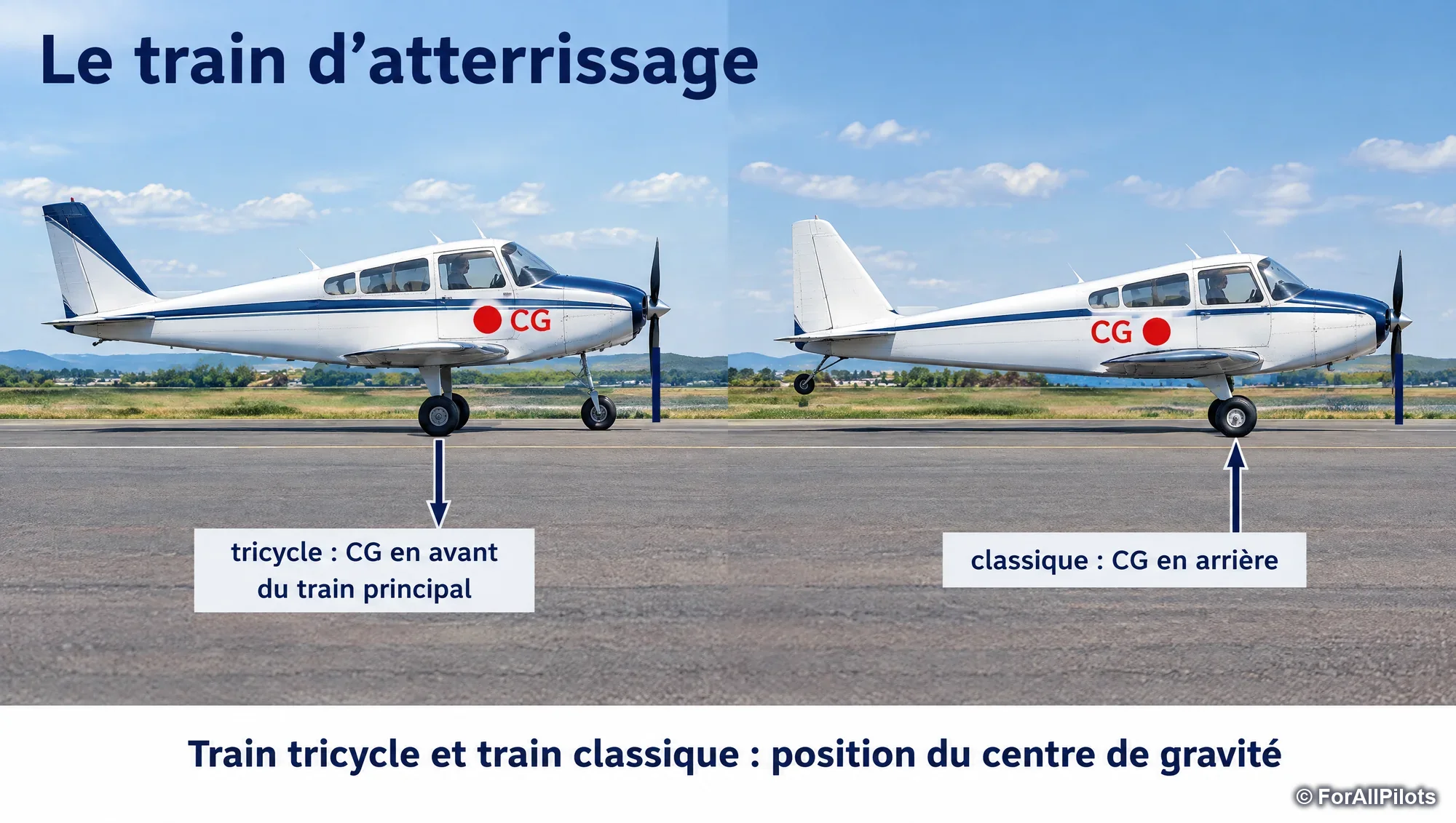
Tricycle and conventional gear: position of the centre of gravity

Touchez l'image pour l'agrandir

Tricycle and conventional gear: position of the centre of gravity

Two layouts:

  • tricycle gear (nose wheel): centre of gravity ahead of the main gear, the aircraft is stable during ground roll;
  • conventional gear (tailwheel): centre of gravity behind the main gear, any deviation from the path tends to increase, hence a risk of ground loop (swerve) during taxiing and landing.

The oleo-pneumatic shock absorber absorbs the energy of the impact on landing. The brakes act on the main wheels and are operated by the rudder pedals. A wheel fairing reduces drag but adds mass. In flight, extending the landing gear greatly increases drag without changing lift.

Exam trap

Extending the landing gear does not increase lift: it only adds drag. With power and speed unchanged, extending it therefore steepens the descent path.

When parked and during the walk-round

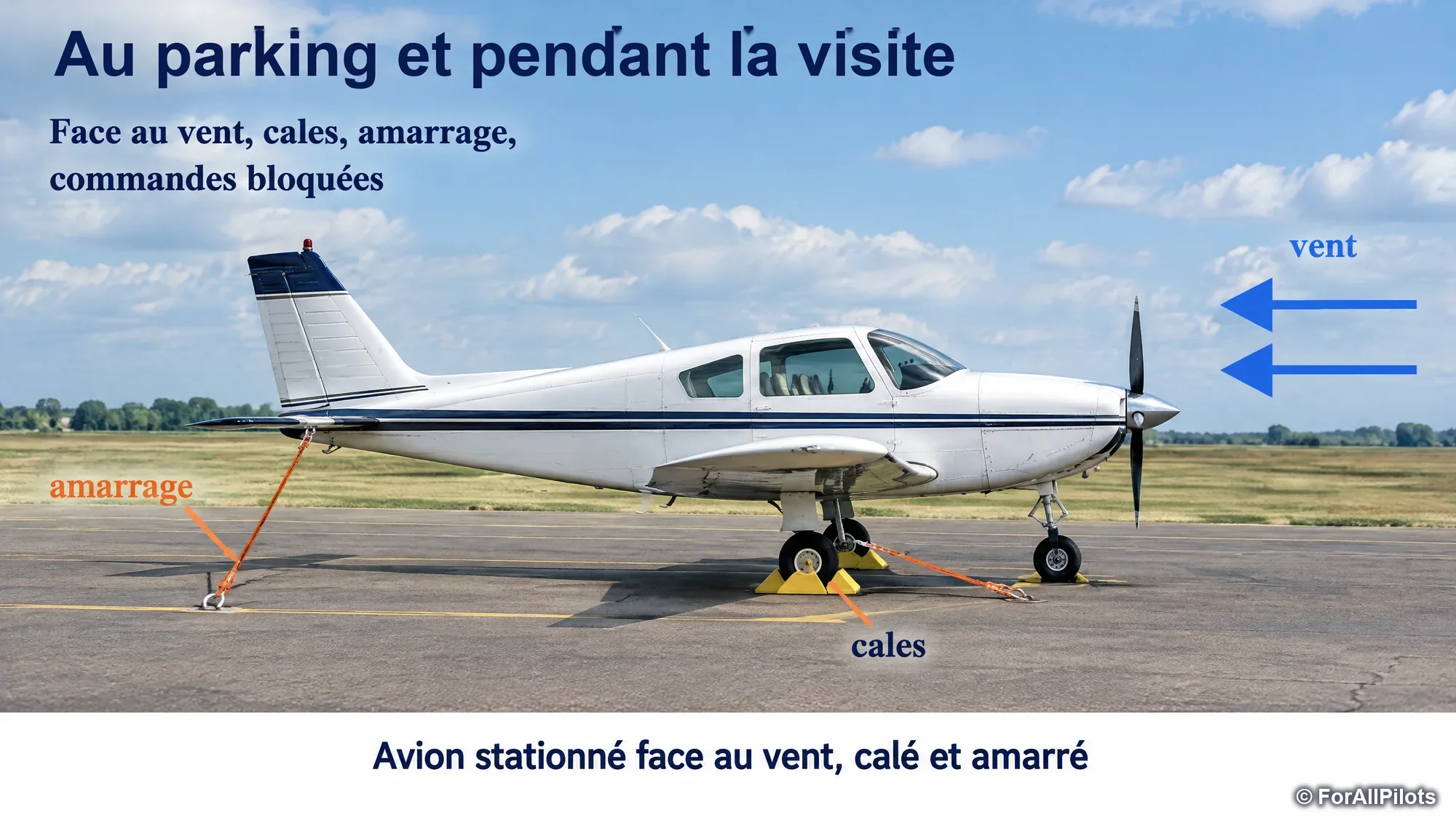
Aircraft parked into the wind, chocked and tied down

Touchez l'image pour l'agrandir

Aircraft parked into the wind, chocked and tied down

In strong wind when parked:

  • position the aircraft into the wind to avoid it being flipped over;
  • chock the wheels and, if possible, tie down the aircraft at anchor points;
  • lock the controls: a tailwind gust would slam the control surfaces against their stops and damage them.

The static wicks (small rods on the trailing edge of the wings and control surfaces) discharge the static electricity built up in flight by air friction.

Any defect, malfunction or failure noticed must be entered in the aircraft's technical log.

Exam trap

Locking the controls is not meant to prevent the aircraft from being flown or to allow people to lean on it: it protects the control surfaces against gusts.

Airframe icing protection

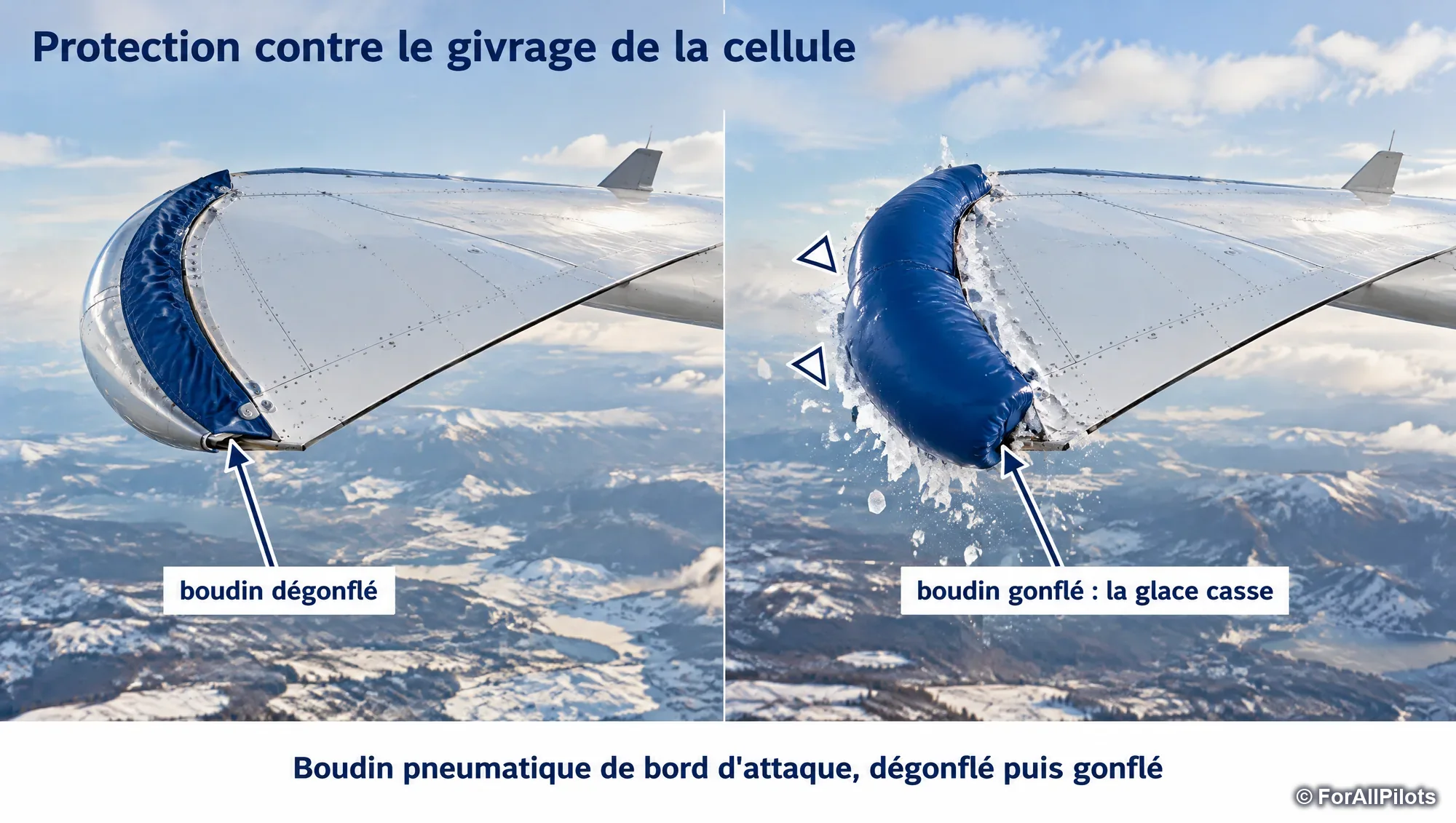
Leading-edge pneumatic boot, deflated then inflated

Touchez l'image pour l'agrandir

Leading-edge pneumatic boot, deflated then inflated

Some aircraft certified for flight in icing conditions are fitted with protection:

  • the leading-edge pneumatic boots inflate and deflate periodically to mechanically break the ice already formed (this is de-icing);
  • the windscreen can be protected by an electric heating element or by spraying anti-icing fluid;
  • the propeller and the Pitot probe have their own systems, covered in the relevant chapters.

Most training aircraft have none of these systems: flight in icing conditions is prohibited for them.

The course goes on with chapter 2, « Flight controls, trim tabs and high-lift devices ». It is read in the Course tab of the app with a PPL subscription, and each chapter ends with the questions of the bank about it. See pricing

How ForAllPilots trains you

  • Series of 20 or 30 questions

    New questions, mistakes to review or a mix of both, with the answer and its explanation straight away.

  • Flashcards

    Question on the front, explained answer on the back, filtered by subject, to learn without a timer.

  • Timed mock exam

    60 questions in 90 minutes, drawn from the whole PPL bank: a training format, not a copy of an official paper.

  • AI instructor, optional

    From €4.99 a month on top of the Private pilot or PRO offer: it quizzes you in writing and explains your mistakes. A beta tool, it does not replace an approved instructor.

PPL access comes with the Private pilot offer (BIA, PPL, microlight and helicopter): €10 a month, cancel anytime, or €69 once with the Exam Pass (18 months of access, nothing renews). Prices include all taxes.

The other PPL courses

All about the PPL exams: format, subjects and method