ForAllPilotsFlying beyond limits
PPL · illustrated course

PPL human performance course: 12 illustrated chapters

The PPL human performance course follows the syllabus in 12 chapters: 89 key points explained in a few paragraphs, often with a diagram, what to remember and, for many, the classic exam trap. The first chapter, « Atmosphere and breathing », can be read in full on this page.

Contents

Each chapter explains, point by point, what the questions of the bank ask, with a « Remember » box and often the classic exam trap. The first chapter is free, below and in the app; the next ones are for PPL subscribers.

  1. Composition of air, partial pressure of oxygen, exchanges in the lungs and oxygen transport.

    6 key points · 11 questions of the bank

  2. 2.Hypoxia, hyperventilation and carbon monoxide

    Subscribers

    Lack of oxygen, its deceptive signs, time of useful consciousness, required oxygen, hyperventilation and CO.

    8 key points · 33 questions of the bank

  3. 3.Pressure, ears, diving and accelerations

    Subscribers

    Gas expansion, barotrauma of the ear, sinuses and digestive tract, scuba diving, noise and load factor.

    8 key points · 24 questions of the bank

  4. 4.Vision

    Subscribers

    Anatomy of the eye, cones and rods, central and peripheral vision, visual defects, night vision and visual scanning.

    7 key points · 22 questions of the bank

  5. 5.Visual illusions on approach and at night

    Subscribers

    Runway size and slope, low light, the "black hole" approach, false horizon and autokinesis.

    6 key points · 9 questions of the bank

  6. 6.The inner ear and spatial disorientation

    Subscribers

    How the body orients itself, what the inner ear detects, vestibular illusions, flight without visibility and airsickness.

    7 key points · 20 questions of the bank

  7. 7.Health, alcohol, medication and fatigue

    Subscribers

    Pre-flight self-assessment, alcohol, medication, fatigue, sleep, biological rhythms and hydration.

    7 key points · 26 questions of the bank

  8. 8.The brain: information, memory and attention

    Subscribers

    Nervous system, information processing, short-term and long-term memory, attention, automatic behaviours, learning and situational awareness.

    10 key points · 27 questions of the bank

  9. 9.Stress

    Subscribers

    Definition, phases, physiological effects, stress-performance relationship, effects of intense stress and prevention.

    6 key points · 21 questions of the bank

  10. 10.Decision-making, hazardous attitudes and error

    Subscribers

    Decision-making process, hazardous attitudes, overconfidence, types of error, Reason model, threat and error management, checklists and feedback from experience.

    10 key points · 25 questions of the bank

  11. 11.Resources, communication and teamwork

    Subscribers

    CRM and SRM, communication and closed loop, the life of a team, leadership, authority gradient and lessons from famous accidents.

    6 key points · 13 questions of the bank

  12. 12.Human factors throughout flight lessons

    Subscribers

    Reading instruments, trim, balanced flight, taxiing, stabilised approach, GPS, steep descending turn and ground contact.

    8 key points · 26 questions of the bank
Chapter 1: Atmosphere and breathing

Composition of air, partial pressure of oxygen, exchanges in the lungs and oxygen transport.

What air is made of

← Faites glisser le schéma →

Air: 78% nitrogen, 21% oxygen, 1% other gases, whatever the altitude

© ForAllPilots

Dry air contains approximately 78% nitrogen (N2), 21% oxygen (O2) and 1% other gases (argon, carbon dioxide, rare gases).

These proportions remain the same at all altitudes reachable by light aircraft, and well beyond. Oxygen does not "stay" down low and nitrogen does not "rise" to the top: the atmosphere is constantly mixed.

The only gas in air that the body uses is oxygen. Nitrogen is inert for breathing (although it matters in diving).

Remember

N2 78%, O2 21%, others 1%. At FL 100, air still contains 21% oxygen.

Exam trap

"At FL 100 the proportion of oxygen is 11%": wrong. The percentage does not change; it is the pressure that drops.

Partial pressure of oxygen

← Faites glisser le schéma →

Total pressure falls with altitude; the oxygen share (21%) therefore also falls in absolute value

© ForAllPilots

As you climb, atmospheric pressure decreases: each litre of air contains fewer molecules. The share of pressure due to oxygen is called the partial pressure of oxygen (21% of total pressure).

  • at sea level: 1,013 hPa, of which about 212 hPa is O2;
  • at 10,000 ft: about 700 hPa, of which about 146 hPa is O2;
  • at 18,000 ft: about half of the pressure at ground level.

It is this drop in partial pressure that causes less oxygen to pass into the blood: it is the cause of hypoxic disorders.

Remember

Partial pressure of O2 = 21% × total pressure. Around 18,000 ft, pressure is roughly halved.

Exchanges in the lungs

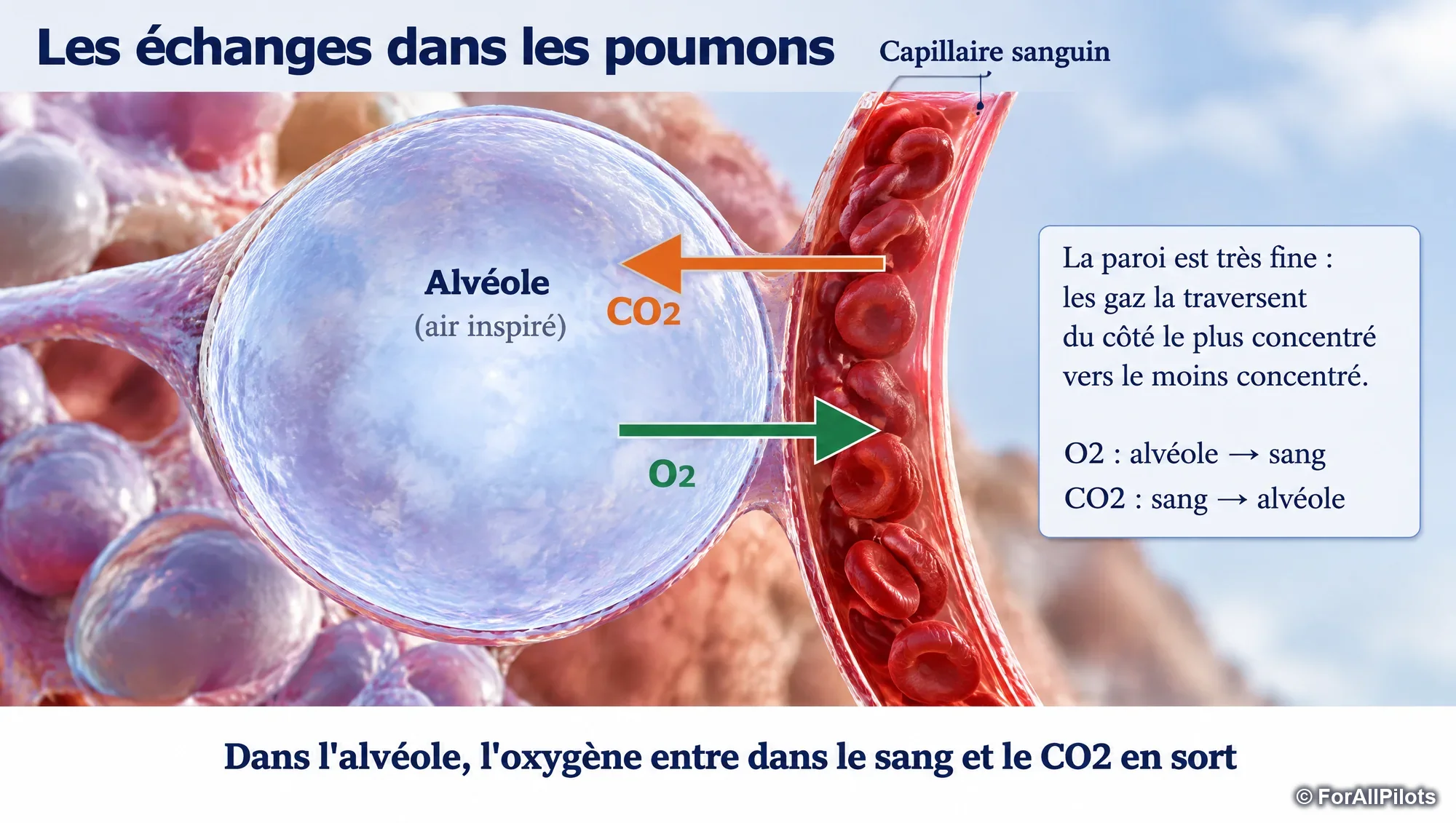
In the alveolus, oxygen enters the blood and CO2 leaves it

Touchez l'image pour l'agrandir

In the alveolus, oxygen enters the blood and CO2 leaves it

Inhaled air reaches the pulmonary alveoli, tiny sacs surrounded by capillary vessels. It is there, and only there, that gas exchange between air and blood takes place:

  • oxygen passes from the alveoli into the blood;
  • carbon dioxide (CO2) passes from the blood into the alveoli, and is then expelled on exhalation.

The transfer occurs by diffusion, from the more concentrated zone to the less concentrated one. The lower the partial pressure of oxygen in the alveolus, the less oxygen passes into the blood.

Exam trap

Do not reverse the directions: O2 alveolus → blood, CO2 blood → alveolus. Exchanges take place neither in the heart, nor in the veins, nor in the arterioles.

Oxygen transport

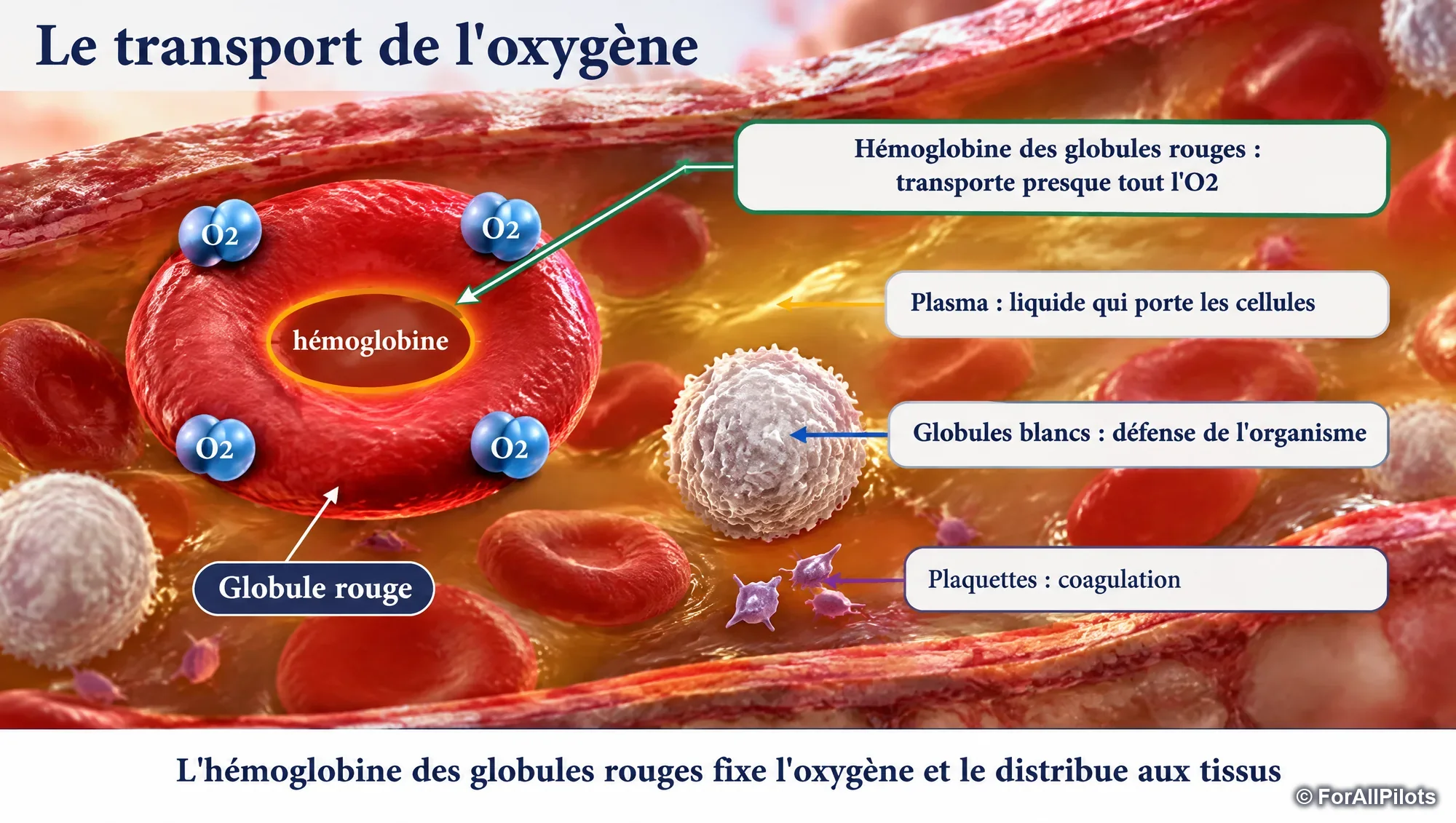
The haemoglobin in red blood cells binds oxygen and delivers it to the tissues

Touchez l'image pour l'agrandir

The haemoglobin in red blood cells binds oxygen and delivers it to the tissues

In the blood, oxygen is carried almost entirely by the haemoglobin in red blood cells. The plasma (the liquid part of blood) dissolves only a very small amount.

White blood cells serve to defend the body, platelets serve for clotting: they do not carry oxygen.

Anything that "occupies" or reduces haemoglobin (carbon monoxide, tobacco, anaemia, recent blood donation) therefore reduces the amount of oxygen delivered to the tissues, even if the air is normal.

Remember

Oxygen carrier: the haemoglobin in red blood cells.

How the body reacts at altitude

← Faites glisser le schéma →

At altitude, ventilation and heart rate increase to compensate

© ForAllPilots

Faced with the drop in partial pressure of oxygen, the body compensates:

  • breathing speeds up and becomes deeper (increased ventilation);
  • the heart rate increases to circulate the blood faster.

This compensation is sufficient at low altitudes, but it has limits. Beyond them, the drop in partial pressure of oxygen leads to the hypoxic disorders described in the next chapter. It is never a reason to climb without oxygen.

Exam trap

At altitude, ventilation AND heart rate increase. Any answer with a "decrease" in either of the two is wrong.

Ozone, a filter and not a gas to breathe

← Faites glisser le schéma →

The ozone layer lies in the stratosphere, above the troposphere where light aircraft fly

© ForAllPilots

Ozone (O3) is concentrated in the stratosphere, well above the altitudes of light aviation. This layer protects us from part of the Sun's harmful ultraviolet rays.

When breathed, ozone is toxic: it irritates the respiratory tract. It is of no use for breathing and cannot replace oxygen at altitude.

Light aircraft fly in the troposphere, where the composition of the air is as described above.

Remember

Ozone: protects against UV, but toxic to breathe.

The course goes on with chapter 2, « Hypoxia, hyperventilation and carbon monoxide ». It is read in the Course tab of the app with a PPL subscription, and each chapter ends with the questions of the bank about it. See pricing

How ForAllPilots trains you

  • Series of 20 or 30 questions

    New questions, mistakes to review or a mix of both, with the answer and its explanation straight away.

  • Flashcards

    Question on the front, explained answer on the back, filtered by subject, to learn without a timer.

  • Timed mock exam

    60 questions in 90 minutes, drawn from the whole PPL bank: a training format, not a copy of an official paper.

  • AI instructor, optional

    From €4.99 a month on top of the Private pilot or PRO offer: it quizzes you in writing and explains your mistakes. A beta tool, it does not replace an approved instructor.

PPL access comes with the Private pilot offer (BIA, PPL, microlight and helicopter): €10 a month, cancel anytime, or €69 once with the Exam Pass (18 months of access, nothing renews). Prices include all taxes.

The other PPL courses

All about the PPL exams: format, subjects and method