ForAllPilotsFlying beyond limits
ATPL · illustrated course

ATPL human performance course: 14 illustrated chapters

The ATPL human performance course follows the syllabus in 14 chapters: 126 key points explained in a few paragraphs, often with a diagram, what to remember and, for many, the classic exam trap. The first chapter, « The atmosphere, gas laws and the cabin environment », can be read in full on this page.

Contents

Each chapter explains, point by point, what the questions of the bank ask, with a « Remember » box and often the classic exam trap. The first chapter is free, below and in the app; the next ones are for ATPL subscribers.

  1. Composition of air, pressure drop with altitude, the laws of Dalton, Boyle-Mariotte, Henry and Charles, humidity, ozone and radiation.

    9 key points · 69 questions of the bank

  2. 2.Breathing, circulation and the nervous system

    Subscribers

    Respiratory system, lung volumes, alveolar exchanges, oxygen transport, blood, heart, blood pressure and regulation.

    9 key points · 85 questions of the bank

  3. 3.Hypoxia, hyperventilation and carbon monoxide

    Subscribers

    Types and thresholds of hypoxia, symptoms, time of useful consciousness, oxygen, tobacco and carbon monoxide, hyperventilation.

    10 key points · 170 questions of the bank

  4. 4.Pressurisation, decompression and barotraumas

    Subscribers

    Cabin altitude, decompression and action to take, trapped gases, middle ear and barotitis, decompression sickness, diving.

    8 key points · 105 questions of the bank

  5. 5.Accelerations, noise and vibration

    Subscribers

    Acceleration axes, effects of +Gz and −Gz, tolerance, hearing, deafness and vibration.

    7 key points · 50 questions of the bank

  6. 6.Vision

    Subscribers

    Anatomy of the eye, cones and rods, central and peripheral vision, night vision, depth, visual defects and sun protection.

    8 key points · 83 questions of the bank

  7. 7.Balance, disorientation and illusions

    Subscribers

    The orientation sensors, the vestibule and its illusions, Coriolis, airsickness, visual illusions on approach and at night.

    11 key points · 116 questions of the bank

  8. 8.Health, fitness and lifestyle

    Subscribers

    Medical fitness, alcohol, medicines and caffeine, diet and hypoglycaemia, body temperature, the heart, tropical diseases, incapacitation in flight.

    8 key points · 77 questions of the bank

  9. 9.Sleep, fatigue and circadian rhythms

    Subscribers

    Biological clock and temperature, performance by time of day, sleep cycles, sleep deprivation, reduced alertness and naps, jet lag.

    7 key points · 45 questions of the bank

  10. 10.Information processing

    Subscribers

    Perception, attention, mental resources, memories, mental models, situational awareness, behaviour levels and learning.

    10 key points · 113 questions of the bank

  11. 11.Stress, workload and motivation

    Subscribers

    Definition and triggering of stress, stressors, general adaptation syndrome, stress and performance, stress management, workload, time pressure, motivation.

    10 key points · 100 questions of the bank

  12. 12.Human error, reliability and safety culture

    Subscribers

    The role of human factors in accidents, the SHELL model, types of error, active and latent errors, reliability, checklists, safety culture and TEM.

    9 key points · 72 questions of the bank

  13. 13.Decision-making, judgement and attitudes

    Subscribers

    Definition of a decision, the DECIDE and FOR-DEC models, factors and biases, risk and commitment strategies, hazardous attitudes, personality.

    7 key points · 48 questions of the bank

  14. 14.CRM, communication, crew and automation

    Subscribers

    CRM principles, communication and feedback, professional language, assertiveness, leadership, authority gradient, synergy, conflicts and culture, automation.

    13 key points · 114 questions of the bank
Chapter 1: The atmosphere, gas laws and the cabin environment

Composition of air, pressure drop with altitude, the laws of Dalton, Boyle-Mariotte, Henry and Charles, humidity, ozone and radiation.

A constant composition

← Faites glisser le schéma →

The percentage of oxygen does not vary with altitude; its partial pressure does

© ForAllPilots

Dry air is a mixture of gases whose proportions remain constant throughout the layer in which aircraft fly (and well beyond, up to about 80 to 100 km):

  • nitrogen (N₂) ≈ 78%: the major gas, physiologically inert but able to dissolve in the tissues;
  • oxygen (O₂) ≈ 21%;
  • argon ≈ 0.93%, carbon dioxide (CO₂) ≈ 0.04%, traces of rare gases.

The two gases that matter for physiology are oxygen (consumed by the cells) and carbon dioxide (produced by them, it regulates breathing).

At 18,000 ft, as at 34,000 ft or 50,000 ft, the air therefore still contains 21% oxygen: what changes is the pressure.

Remember

N₂ 78%, O₂ 21%, Ar ≈ 1%, CO₂ ≈ 0.03-0.04%. Percentage of O₂ constant at all flight altitudes.

Exam trap

"Hypoxia occurs because the percentage of oxygen decreases with altitude" is false: it is the partial pressure of oxygen that falls. The question bank often gives 0.03% for CO₂ (an old value, now ≈ 0.04%): remember the order of magnitude.

Pressure falls fast low down, slowly high up

← Faites glisser le schéma →

Standard atmosphere pressure as a function of altitude

© ForAllPilots

Atmospheric pressure decreases approximately exponentially with altitude: each slice of air supports the weight of those above it.

  • 18,000 ft: about half the sea-level pressure (≈ 506 hPa);
  • 34,000 ft: about a quarter (≈ 250 hPa);
  • 48,000 ft: about an eighth.

The variation is therefore not proportional: for the same 5,000 ft slice, the pressure drop is greatest near the ground (≈ 170 hPa between 0 and 5,000 ft, barely 30 hPa between 45,000 and 50,000 ft).

All the physiological problems of altitude come from this drop in ambient pressure, and not from a change in the composition of the air.

Remember

P(18,000 ft) ≈ P(sea level) / 2; P(34,000 ft) ≈ P(sea level) / 4. The greatest pressure difference per altitude slice is at the bottom (0-5,000 ft).

Exam trap

Questions ask between which altitudes the pressure difference is greatest: always the lowest slice.

The International Standard Atmosphere (ISA)

← Faites glisser le schéma →

Temperature profile of the standard atmosphere and position of the ozone layer

© ForAllPilots

The ICAO standard atmosphere (ISA) sets reference values:

  • at sea level: 1,013.25 hPa, 15 °C, dry air;
  • in the troposphere, the temperature falls by about 2 °C per 1,000 ft (6.5 °C per km);
  • tropopause at 11 km (36,090 ft), where the temperature reaches − 56.5 °C, then remains constant up to 20 km;
  • in the stratosphere, the temperature rises up to the stratopause (around 47-50 km), because ozone there absorbs ultraviolet radiation.

The ozone layer lies in the stratosphere: it absorbs UVB much better than UVA (UVA, being less energetic, penetrate deeper into the skin).

Remember

ISA: 1,013.25 hPa, 15 °C, − 2 °C / 1,000 ft, tropopause 36,090 ft at − 56.5 °C. Ozone: stratosphere.

Dalton's law: partial pressure

← Faites glisser le schéma →

At 18,000 ft, total pressure and oxygen partial pressure are halved

© ForAllPilots

Dalton's law: the total pressure of a gas mixture equals the sum of the partial pressures of the gases that make it up. The partial pressure of a gas is proportional to its fraction in the mixture:

PO₂ = 0.21 × P

In a climb, the fraction stays at 21% but the total pressure falls: the partial pressure of oxygen decreases in the same proportion as atmospheric pressure. At 18,000 ft, the pressure is halved, and so is the PO₂.

Example: at 33,700 ft, P = 253 hPa, so PO₂ = 0.21 × 253 ≈ 53 hPa.

Dalton's law explains altitude hypoxia: it is the partial pressure, not the percentage, that drives oxygen into the blood.

Remember

Dalton → hypoxia. PO₂ = 21% of ambient pressure; it falls like the total pressure.

Exam trap

"Total pressure falls but partial pressures stay constant" is false: all partial pressures decrease with total pressure.

Boyle-Mariotte's law: gases expand

← Faites glisser le schéma →

The volume of a trapped gas increases as pressure decreases

© ForAllPilots

Boyle-Mariotte's law: at constant temperature, the volume of a gas is inversely proportional to its pressure (P × V = constant). It is the law usually illustrated with a balloon.

  • a 10 L balloon at sea level becomes 20 L at 18,000 ft, 30 L at about 27,000 ft and 40 L at 34,000 ft;
  • at sea level, a gas therefore occupies one third of the volume it would have at 27,000 ft.

In the body, a moist gas (saturated with water vapour, like intestinal gas at 37 °C) expands even more than a dry gas, because the water vapour pressure (≈ 63 hPa) remains constant.

Consequence: gases trapped in cavities (middle ear, sinuses, teeth, digestive tract) expand in the climb and contract in the descent: these are barotraumas.

Remember

P₁ × V₁ = P₂ × V₂. Boyle-Mariotte → trapped gases, barotraumas, digestive pain in the climb.

Exam trap

A gas saturated with water vapour expands more than the same volume of dry gas.

Henry's law: dissolved gases

← Faites glisser le schéma →

Henry's law: a drop in pressure releases dissolved gas as bubbles

© ForAllPilots

Henry's law: at constant temperature, the quantity of gas dissolved in a liquid is proportional to the partial pressure of that gas above the liquid.

Think of a bottle of fizzy drink: while closed, the gas stays dissolved; when opened, the pressure drops and bubbles appear.

In the body, the tissues and blood contain dissolved nitrogen in equilibrium with the ambient pressure. If the pressure falls sharply and quickly (decompression, cabin altitude climbing above 18,000 ft, flying after diving), the tissues become supersaturated and the nitrogen returns to the gaseous state: bubbles form.

Henry's law explains decompression sickness (aeroembolism): the bends, chokes, creeps.

Remember

Henry → decompression sickness (nitrogen bubbles).

Exam trap

Do not mix them up: Boyle-Mariotte concerns free gases trapped in cavities, Henry concerns gases dissolved in liquids.

Charles's law, the general law and diffusion

← Faites glisser le schéma →

The gas laws and their physiological consequences

© ForAllPilots

Charles's law (or Gay-Lussac's): at constant pressure, the volume of a gas is proportional to its absolute temperature (in kelvins). For each additional degree, the volume increases by 1/273 of its volume at 0 °C.

The general law of ideal gases: P × V / T = constant. It combines Boyle-Mariotte and Charles.

The law of diffusion: a gas passes from a zone of high partial pressure to a zone of low partial pressure, through a permeable membrane. It describes the passage of oxygen from the alveoli into the blood, then from the blood into the cells, and the reverse path of CO₂. The quantity exchanged depends on the partial pressure gradient.

A pressurised cabin protects against the three families of problems: hypoxia (Dalton), gas expansion (Boyle-Mariotte) and decompression (Henry).

Remember

Dalton → hypoxia; Boyle-Mariotte → barotraumas; Henry → decompression sickness; Charles: V ∝ T (1/273 per °C); PV/T = constant.

Humidity and ozone in the cabin

← Faites glisser le schéma →

Cabin humidity at cruise is far below the comfort zone

© ForAllPilots

Relative humidity is the ratio between the water vapour present and the maximum quantity the air could hold at that temperature (saturation).

Air taken in from outside at cruise is very cold, hence almost dry: in the cabin, average humidity is about 5 to 15%, compared with 40 to 60% for comfort. Below 40%, the body loses water, mainly through breathing. Consequences: dry eyes, nose and throat, irritated skin, subtle dehydration, fatigue. Thirst is a late signal: you must drink regularly before you feel thirsty.

Ozone (O₃, a molecule made of three oxygen atoms) is abundant at high altitude, especially at high latitudes. In the cabin, it causes eye and throat irritation, coughing, breathing discomfort, headaches and fatigue. It is removed by (catalytic) ozone converters on the bleed air.

Remember

Cabin humidity ≈ 5-15% → drink before you are thirsty. Ozone: catalytic converters.

Exam trap

Bends and chokes are not signs of ozone: they are signs of decompression sickness.

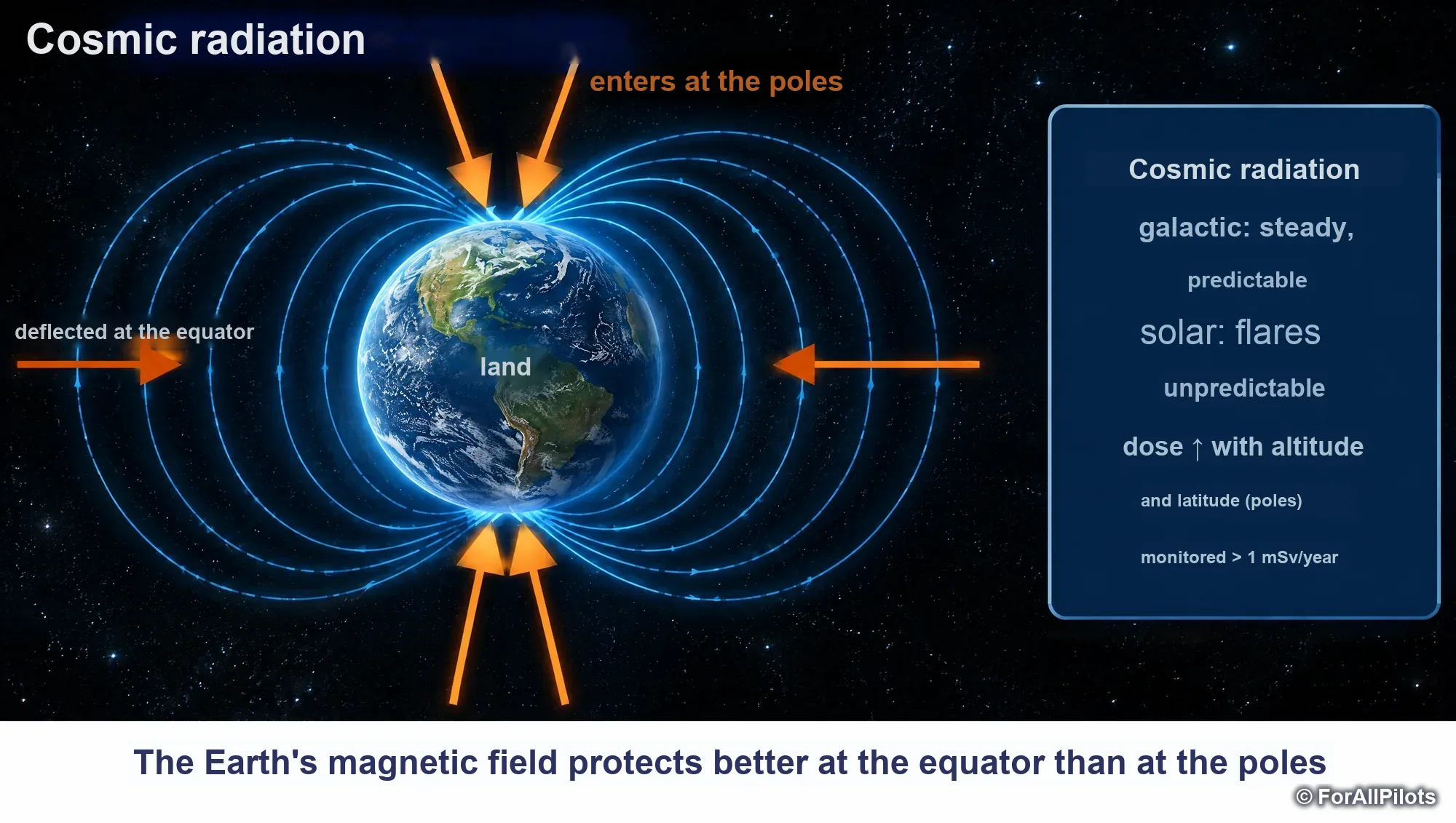
Cosmic radiation

The Earth's magnetic field protects better at the equator than at the poles

Touchez l'image pour l'agrandir

The Earth's magnetic field protects better at the equator than at the poles

Crews are exposed to two sources of ionising radiation:

  • galactic radiation (particles from space): steady and predictable;
  • solar radiation, linked to flares: irregular and unpredictable, sometimes intense.

The Earth's magnetic field deflects charged particles near the equator; they penetrate more easily near the poles. The dose therefore increases with altitude and with latitude (polar routes), as well as with flight time.

Long-term risks: cancers and, in pregnancy, congenital malformations. Under European radiation protection regulations, operators must assess and monitor the exposure of crew members likely to receive more than 1 mSv per year, adapting their schedules. For aeroplanes operated above 15,000 m (49,000 ft), ICAO (Annex 6) requires an instrument that continuously measures and displays the dose rate and the cumulative dose for each flight, and the operator keeps a record of the doses received by each crew member.

Remember

Galactic radiation: steady, increases with altitude and latitude. Solar: unpredictable flares. Instrument mandatory above 49,000 ft.

Exam trap

The galactic dose is highest at the poles (the opposite of magnetic protection), not at the equator.

The course goes on with chapter 2, « Breathing, circulation and the nervous system ». It is read in the Course tab of the app with a ATPL subscription, and each chapter ends with the questions of the bank about it. See pricing

How ForAllPilots trains you

  • Series of 20 or 30 questions

    New questions, mistakes to review or a mix of both, with the answer and its explanation straight away.

  • Flashcards

    Question on the front, explained answer on the back, filtered by subject, to learn without a timer.

  • Timed mock exam

    100 questions in 150 minutes, drawn from the whole ATPL bank: a training format, not a copy of an official paper.

  • AI instructor, optional

    From €4.99 a month on top of the Private pilot or PRO offer: it quizzes you in writing and explains your mistakes. A beta tool, it does not replace an approved instructor.

ATPL access comes with the PRO offer (which also includes Private pilot): €19.99 a month, cancel anytime, or €129 once with the Exam Pass (18 months of access, nothing renews). Prices include all taxes.

The other ATPL courses

All about the ATPL exams: format, subjects and method