ForAllPilotsFlying beyond limits
ATPL · illustrated course

ATPL VFR communications course: 12 illustrated chapters

The ATPL VFR communications course follows the syllabus in 12 chapters: 65 key points explained in a few paragraphs, often with a diagram, what to remember and, for many, the classic exam trap. The first chapter, « Definitions, services and abbreviations », can be read in full on this page.

Contents

Each chapter explains, point by point, what the questions of the bank ask, with a « Remember » box and often the classic exam trap. The first chapter is free, below and in the app; the next ones are for ATPL subscribers.

  1. Aeronautical mobile service, air-ground communications, broadcast, blind transmission, types of service and common abbreviations.

    6 key points · 22 questions of the bank

  2. 2.Radio waves and VHF propagation

    Subscribers

    Frequency and wavelength, bands, aeronautical VHF, line-of-sight range, attenuation, super-refraction and blocked frequency.

    6 key points · 23 questions of the bank

  3. 3.Transmission technique, readability and alphabet

    Subscribers

    Listen before transmitting, use the microphone correctly, the readability scale, radio check and the spelling alphabet.

    5 key points · 17 questions of the bank

  4. 4.Stating numbers, times and frequencies

    Subscribers

    Digit by digit or in thousands, altitudes, headings, QNH, wind, visibility, frequencies and times in UTC.

    5 key points · 25 questions of the bank

  5. 5.Callsigns and calls

    Subscribers

    Ground station suffixes, aircraft callsigns and abbreviated form, initial call, general call and frequency changes.

    5 key points · 26 questions of the bank

  6. 6.Standard phrases

    Subscribers

    Standardised ICAO vocabulary in French and English: replying, requesting, correcting, authorising.

    5 key points · 32 questions of the bank

  7. 7.Readbacks and reports

    Subscribers

    Why and what to read back, examples of readbacks, en-route clearances and position reports.

    5 key points · 23 questions of the bank

  8. 8.Aerodrome phraseology

    Subscribers

    Ready for departure, holding short of the runway, backtracking, take-off and rejected take-off, traffic circuit, final, go-around and vacating the runway.

    6 key points · 17 questions of the bank

  9. 9.ATIS, VOLMET and weather information

    Subscribers

    ATIS and VOLMET, wind and visibility, cloud cover and CAVOK, RVR, runway condition and information services.

    6 key points · 28 questions of the bank

  10. 10.Transponder, direction finding and altimeter settings

    Subscribers

    Transponder phraseology, special codes, QDM, QDR, QTE, bearing classes, QNH, QFE and flight level.

    5 key points · 40 questions of the bank

  11. 11.Priorities, distress and urgency

    Subscribers

    Message categories and order of priority, distress and urgency, message content, frequency, radio silence and cancellation of distress.

    6 key points · 56 questions of the bank

  12. 12.Radio communication failure

    Subscribers

    Re-establishing contact, blind transmission, receiver failure, code 7600, visual signals and conduct of the VFR flight.

    5 key points · 27 questions of the bank
Chapter 1: Definitions, services and abbreviations

Aeronautical mobile service, air-ground communications, broadcast, blind transmission, types of service and common abbreviations.

The aeronautical mobile service

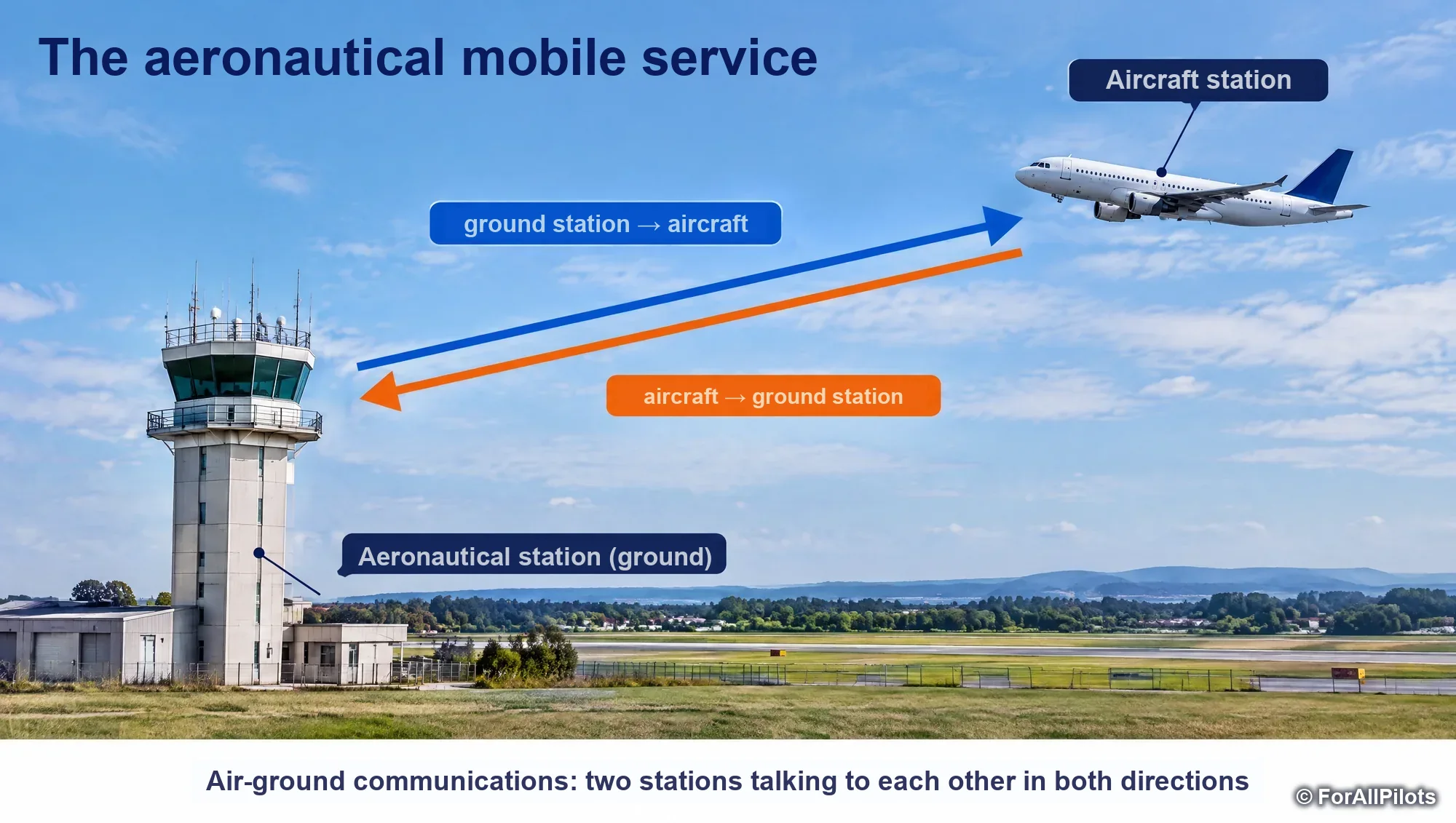
Air-ground communications: two stations talking to each other in both directions

Touchez l'image pour l'agrandir

Air-ground communications: two stations talking to each other in both directions

Radio exchanges between pilots and ground units fall under the aeronautical mobile service (ICAO Annex 10, Volume II).

  • An aeronautical station is a station of this service located on land (and sometimes on board a ship or on an offshore platform).
  • An aircraft station is the radio installed on board.
  • Air-ground communications are two-way communications between aircraft and stations or points located on the ground.

This service carries only spoken messages related to the flight: teletype or office messages go through the ground-ground network, not through radiotelephony.

Remember

Air-ground = two-way, between aircraft and ground stations. Aeronautical station = ground station (or ship, platform).

Exam trap

A teletype radio message is not among the messages carried by the aeronautical mobile service.

Broadcast and blind transmission

← Faites glisser le schéma →

Broadcast (no addressee) and blind transmission (to a station, no reply)

© ForAllPilots

Two kinds of transmission expect no reply:

  • the broadcast: transmission of information relating to air navigation that is not addressed to a specific station or stations (ATIS, VOLMET);
  • the transmission without acknowledgement of receipt, called a "blind transmission": a transmission from one station to a specific station, when two-way communication cannot be established but it is believed that the called station can receive the message.

The second is the basis of the procedure to follow in the event of radio failure.

Exam trap

Do not confuse them: a broadcast has no specific addressee; a blind transmission has one, but you cannot hear it reply.

Three levels of radio service

← Faites glisser le schéma →

The three categories of ground service

© ForAllPilots

Depending on the ground unit, the same frequency does not provide the same service:

  • air traffic control (ATC): a controller issues clearances and instructions (TOWER, APPROACH, CONTROL…);
  • flight information service (FIS; AFIS at an aerodrome): an officer provides information useful for safety, without clearances (call sign INFORMATION);
  • air/ground service: a radio operator passes on basic information (call sign RADIO in some States).

The MCQs refer to the "three main categories of aeronautical telecommunication services": air/ground, flight information, control.

Remember

ATC = clearances. FIS/AFIS = information. Air/ground = basic information.

Hours of operation

← Faites glisser le schéma →

HJ, HN and H24 over one day

© ForAllPilots

Publications (AIP, charts) indicate the operating hours of units and radio aids using abbreviations:

  • H24: continuous service, day and night;
  • HJ: from sunrise to sunset;
  • HN: from sunset to sunrise;
  • HX: no specific hours of operation;
  • HO: service available to meet operational requirements;
  • HS: service provided during scheduled flight hours.

Mnemonic: J for jour (day), N for nuit (night).

Remember

H24 continuous, HJ sunrise→sunset, HN sunset→sunrise, HX no specific hours.

Exam trap

HJ does not mean "working daytime hours" and HX does not mean "exceptional hours": HX means no specified hours at all.

Abbreviations to know

← Faites glisser le schéma →

Common ICAO abbreviations

© ForAllPilots

MCQs often ask for the meaning of ICAO abbreviations. The most common ones:

  • FIR: flight information region; CTR: control zone;
  • AFIS: aerodrome flight information service; AIS: aeronautical information service;
  • SAR: search and rescue; UTC: coordinated universal time;
  • IMC: instrument meteorological conditions;
  • RVR: runway visual range; FPL: filed flight plan;
  • SELCAL: selective calling of an aircraft by radiotelephone channels;
  • SIGMET: information on hazardous en-route weather phenomena.

Exam trap

CTA is a control area, CTR a control zone (around an aerodrome). AIS (aeronautical information) is not AFIS (aerodrome flight information).

Coordinated universal time

← Faites glisser le schéma →

Converting summer local time → UTC in France

© ForAllPilots

All times transmitted in radiotelephony are expressed in UTC (coordinated universal time), whatever the country overflown. This avoids any confusion between time zones and summer time.

In metropolitan France, legal time is UTC + 1 h in winter and UTC + 2 h in summer. At 17:24 local time in summer, it is therefore 15:24 UTC.

Time is counted from 0000 to 2359: 4:15 PM is said "one six one five".

Remember

Radiotelephony: always in UTC. France: local = UTC + 1 (winter) or UTC + 2 (summer).

The course goes on with chapter 2, « Radio waves and VHF propagation ». It is read in the Course tab of the app with a ATPL subscription, and each chapter ends with the questions of the bank about it. See pricing

How ForAllPilots trains you

  • Series of 20 or 30 questions

    New questions, mistakes to review or a mix of both, with the answer and its explanation straight away.

  • Flashcards

    Question on the front, explained answer on the back, filtered by subject, to learn without a timer.

  • Timed mock exam

    100 questions in 150 minutes, drawn from the whole ATPL bank: a training format, not a copy of an official paper.

  • AI instructor, optional

    From €4.99 a month on top of the Private pilot or PRO offer: it quizzes you in writing and explains your mistakes. A beta tool, it does not replace an approved instructor.

ATPL access comes with the PRO offer (which also includes Private pilot): €19.99 a month, cancel anytime, or €129 once with the Exam Pass (18 months of access, nothing renews). Prices include all taxes.

The other ATPL courses

All about the ATPL exams: format, subjects and method