ForAllPilotsFlying beyond limits
ATPL · illustrated course

ATPL IFR communications course: 12 illustrated chapters

The ATPL IFR communications course follows the syllabus in 12 chapters: 62 key points explained in a few paragraphs, often with a diagram, what to remember and, for many, the classic exam trap. The first chapter, « IFR definitions and abbreviations », can be read in full on this page.

Contents

Each chapter explains, point by point, what the questions of the bank ask, with a « Remember » box and often the classic exam trap. The first chapter is free, below and in the app; the next ones are for ATPL subscribers.

  1. Clearance limit, expected approach time, visual approach, waypoint, broadcast, and the abbreviations of instrument flight.

    5 key points · 35 questions of the bank

  2. 2.VHF, HF, SELCAL and CPDLC

    Subscribers

    Bands and wavelengths, VHF range with altitude, 8.33 kHz spacing, long-range HF, selective calling and controller-pilot data link.

    6 key points · 24 questions of the bank

  3. 3.Radio technique and how to say numbers

    Subscribers

    Listening before transmitting, microphone technique, readability, radio check, numbers, levels, frequencies, times and Morse identifier.

    5 key points · 34 questions of the bank

  4. 4.Call signs, ATS units and first contact

    Subscribers

    Suffixes of IFR units (DELIVERY, DEPARTURE, ARRIVAL, RADAR, CONTROL), operator call signs, the word HEAVY, first contact and general call.

    5 key points · 37 questions of the bank

  5. 5.Standard phrases in French and English

    Subscribers

    Affirm, negative, wilco, confirm, verify, check, acknowledge, recleared, cancel, disregard, I say again, words twice, speak slower, break break.

    5 key points · 56 questions of the bank

  6. 6.Clearances and read-back

    Subscribers

    Content of an IFR clearance, items to read back, level changes, climb to an altitude, take-off clearance and conditional clearance.

    6 key points · 23 questions of the bank

  7. 7.From departure to landing: reports and phraseology

    Subscribers

    Position reports, flight conditions, holding and EAT, final, go-around, rejected take-off, runway vacated and RVR.

    5 key points · 17 questions of the bank

  8. 8.Radar services, transponder and RVSM

    Subscribers

    Radar services, identification, SSR phraseology, Mode C checks, transponder failure and RVSM phraseology.

    5 key points · 18 questions of the bank

  9. 9.ATIS, VOLMET, runway condition and FIS

    Subscribers

    ATIS content and updating, VOLMET, SIGMET, CAVOK, cloud amount, braking coefficients and the flight information service.

    5 key points · 24 questions of the bank

  10. 10.Altimeter settings and direction finding

    Subscribers

    QNH, QFE and flight level, stating an altitude or a height, QDM, QDR, QTE and bearing classes.

    4 key points · 19 questions of the bank

  11. 11.Priorities, distress and urgency

    Subscribers

    Order of priority, classification of messages, MAYDAY, PAN PAN and PAN PAN MEDICAL, message content, radio silence and end of distress.

    5 key points · 48 questions of the bank

  12. 12.IFR communications failure and interception

    Subscribers

    Blind transmission, receiver failure, SERA 2025 rules (7600, 7601, 20 minutes), arrival at the destination aid, EAT and ETA, and interception.

    6 key points · 27 questions of the bank
Chapter 1: IFR definitions and abbreviations

Clearance limit, expected approach time, visual approach, waypoint, broadcast, and the abbreviations of instrument flight.

Clearance limit and expected approach time

← Faites glisser le schéma →

The clearance limit and the time of leaving the hold (EAT)

© ForAllPilots

  • Clearance limit: the point to which an air traffic control clearance is granted to an aircraft. Beyond it, a new clearance is required.
  • Expected approach time (EAT): the time at which ATC expects an arriving aircraft, following a delay, to leave the holding point to complete its approach for a landing.

In practice the EAT is read back together with the holding clearance; it also serves as a reference in the event of communication failure.

Remember

Clearance limit = the point to which the clearance is valid. EAT = expected time of leaving the hold for the approach.

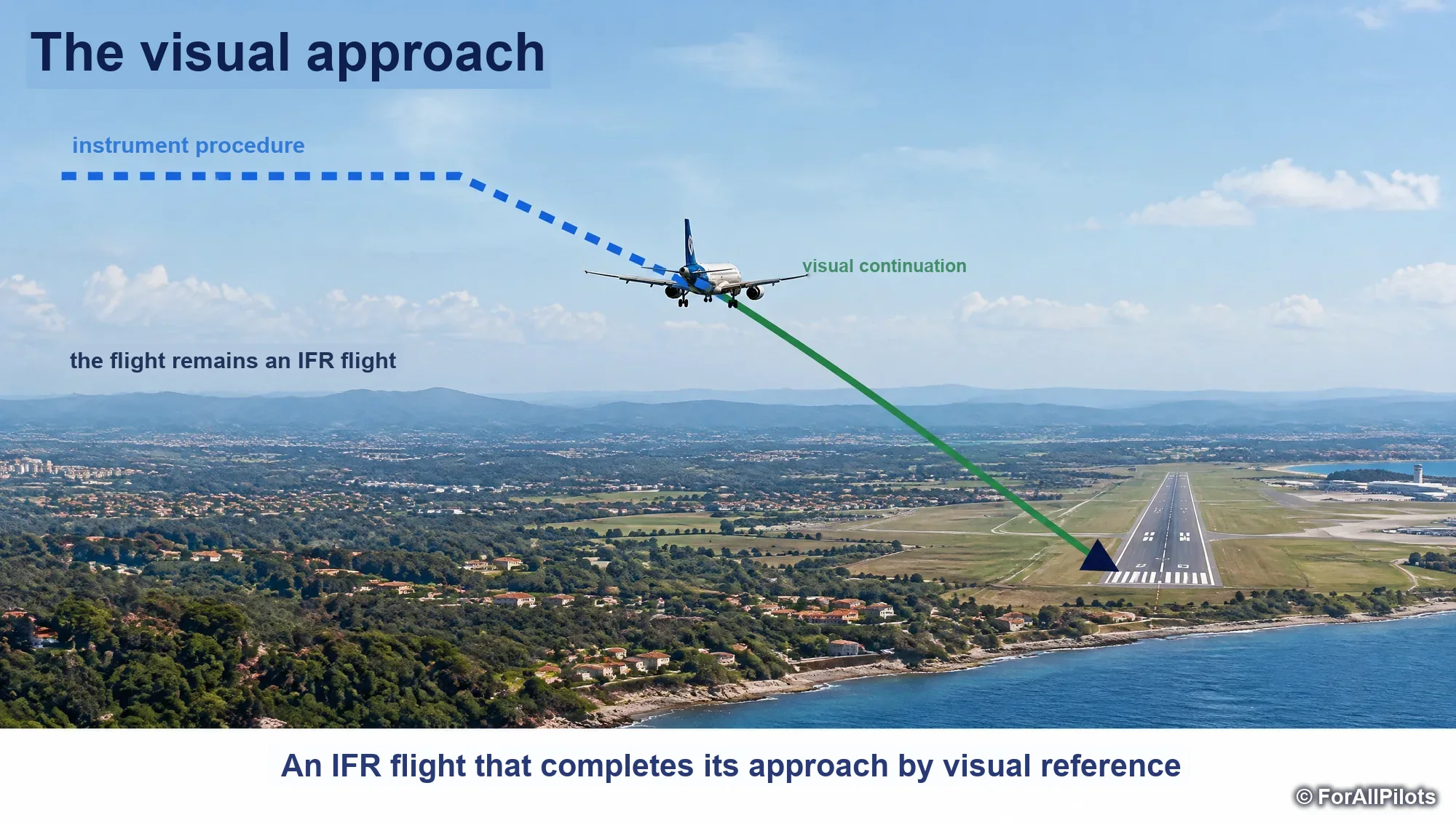
The visual approach

An IFR flight that completes its approach by visual reference

Touchez l'image pour l'agrandir

An IFR flight that completes its approach by visual reference

A visual approach is an approach flown by an IFR flight that does not complete, or discontinues, all or part of the instrument approach procedure, and continues the approach by visual reference to the ground.

The flight remains IFR: the visual approach clearance is requested by the pilot (or offered by the controller) when the pilot has the ground in sight, and where applicable the preceding traffic. The minima and conditions are set by the authority (SERA, Doc 4444).

Exam trap

A visual approach is neither a switch to VFR nor a "radar" approach: it is an IFR flight that finishes visually.

Waypoint and area navigation

← Faites glisser le schéma →

An RNAV route defined by waypoints

© ForAllPilots

  • RNAV (area navigation): a method that permits flight along any desired track within the coverage of ground- or space-based aids, or within the limits of a self-contained system.
  • Waypoint: a specified geographical position used to define an area navigation route or the track of an aircraft using RNAV. It may be "fly-by" or "fly-over".
  • INS: inertial navigation system; MLS: microwave landing system; SSR: secondary surveillance radar.

Broadcast, air-ground communication, blind transmission

← Faites glisser le schéma →

Three kinds of transmissions

© ForAllPilots

  • Air-ground communication: two-way communication between aircraft and stations or locations on the surface of the Earth.
  • Broadcast: a transmission of aeronautical information not addressed to a specific station or stations (ATIS, VOLMET).
  • Blind transmission: a transmission from one station to another when two-way communication cannot be established, but it is believed that the called station can receive the transmission.

The aeronautical mobile service does not carry teletype messages (ground-ground network).

Abbreviations and hours

← Faites glisser le schéma →

Common IFR abbreviations

© ForAllPilots

Abbreviations frequently found in IFR questions:

  • ATIS: automatic terminal information service; RVR: runway visual range;
  • SELCAL: a system that permits selective calling of individual aircraft over radiotelephony channels linking a ground station to the aircraft;
  • SAR: search and rescue; AIS: aeronautical information service; IMC: instrument meteorological conditions;
  • H24: day and night; HJ: sunrise → sunset; HN: sunset → sunrise.

Finally, sidereal describes anything relating to the stars (sidereal day ≈ 23 h 56 min).

Exam trap

HN is night (sunset → sunrise); HJ is day (sunrise → sunset).

The course goes on with chapter 2, « VHF, HF, SELCAL and CPDLC ». It is read in the Course tab of the app with a ATPL subscription, and each chapter ends with the questions of the bank about it. See pricing

How ForAllPilots trains you

  • Series of 20 or 30 questions

    New questions, mistakes to review or a mix of both, with the answer and its explanation straight away.

  • Flashcards

    Question on the front, explained answer on the back, filtered by subject, to learn without a timer.

  • Timed mock exam

    100 questions in 150 minutes, drawn from the whole ATPL bank: a training format, not a copy of an official paper.

  • AI instructor, optional

    From €4.99 a month on top of the Private pilot or PRO offer: it quizzes you in writing and explains your mistakes. A beta tool, it does not replace an approved instructor.

ATPL access comes with the PRO offer (which also includes Private pilot): €19.99 a month, cancel anytime, or €129 once with the Exam Pass (18 months of access, nothing renews). Prices include all taxes.

The other ATPL courses

All about the ATPL exams: format, subjects and method