ForAllPilotsFlying beyond limits
ATPL · illustrated course

ATPL air law course: 14 illustrated chapters

The ATPL air law course follows the syllabus in 14 chapters: 140 key points explained in a few paragraphs, often with a diagram, what to remember and, for many, the classic exam trap. The first chapter, « The Chicago Convention and ICAO », can be read in full on this page.

Contents

Each chapter explains, point by point, what the questions of the bank ask, with a « Remember » box and often the classic exam trap. The first chapter is free, below and in the app; the next ones are for ATPL subscribers.

  1. Sovereignty, the main articles of the Convention, ICAO bodies, standards and Annexes, freedoms of the air.

    10 key points · 121 questions of the bank

  2. 2.Criminal and liability conventions

    Subscribers

    Tokyo, The Hague, Montreal 1971 for unlawful acts; Warsaw, Montreal 1999 and Rome for liability; passenger rights.

    7 key points · 50 questions of the bank

  3. 3.Organisations and European regulation

    Subscribers

    IATA, ECAC, Eurocontrol, JAA and EASA; hard law and soft law; the main European regulations; occurrence reporting.

    7 key points · 29 questions of the bank

  4. 4.Airworthiness and registration

    Subscribers

    Annex 8 (certificate of airworthiness, continuing airworthiness) and Annex 7 (classification, marks, registration).

    7 key points · 67 questions of the bank

  5. 5.Licences, ratings and medical fitness

    Subscribers

    Annex 1 and Part-FCL: definitions, PPL, CPL, ATPL, IR, class and type ratings, instructors, Part-MED.

    10 key points · 111 questions of the bank

  6. 6.Rules of the air and VFR

    Subscribers

    Annex 2 and SERA: pilot-in-command, minimum heights, right-of-way, lights, signals, VMC conditions and special VFR.

    12 key points · 129 questions of the bank

  7. 7.Airspace and air traffic services

    Subscribers

    Annex 11: ATS objectives and services, units, FIR, CTA, TMA, CTR, airspace classes, ATS routes and RNP, flight information, ATIS, alerting service.

    11 key points · 160 questions of the bank

  8. 8.IFR flight: altimetry, flight plan, transponder and special situations

    Subscribers

    Altimeter settings and levels, minimum IFR altitudes, flight plan, clearances and reports, transponder, radio failure, interception, unlawful interference, ACAS.

    14 key points · 223 questions of the bank

  9. 9.ATS separation and surveillance services

    Subscribers

    Doc 4444: vertical, lateral and longitudinal separation, departures and arrivals, wake turbulence, radar, identification, vectoring, parallel approaches.

    14 key points · 176 questions of the bank

  10. 10.Departure and holding procedures

    Subscribers

    PANS-OPS: instrument departures (DER, PDG, straight, turning and omnidirectional departures), holding patterns, speeds and entries.

    6 key points · 51 questions of the bank

  11. 11.Instrument approach procedures

    Subscribers

    PANS-OPS: aircraft categories, segments and margins, MSA, reversal procedures, non-precision and precision approaches, missed approach, visual manoeuvring.

    13 key points · 149 questions of the bank

  12. 12.Aerodromes: areas, markings, signs and lighting

    Subscribers

    Annex 14: reference code, declared distances, areas, markings and signs, holding positions, lighting, PAPI, obstacle lights, runway condition.

    12 key points · 162 questions of the bank

  13. 13.Aeronautical Information

    Subscribers

    Annex 15: aeronautical information service, integrated documentation, AIP and its parts, supplements, NOTAM, SNOWTAM, ASHTAM, AIRAC and AIC.

    6 key points · 48 questions of the bank

  14. 14.Search and rescue, investigations, security and facilitation

    Subscribers

    Annex 12 (SAR and signals), Annex 13 (accidents, incidents, investigations), Annex 17 (security) and Annex 9 (facilitation).

    11 key points · 164 questions of the bank
Chapter 1: The Chicago Convention and ICAO

Sovereignty, the main articles of the Convention, ICAO bodies, standards and Annexes, freedoms of the air.

From Paris to Chicago

← Faites glisser le schéma →

Timeline: from the Paris Convention (1919) to ICAO

© ForAllPilots

The Convention on International Civil Aviation was signed in Chicago on 7 December 1944 and entered into force on 4 April 1947. It takes up the principle laid down in Paris in 1919 and creates the International Civil Aviation Organization (ICAO), responsible for ensuring its application.

Its purpose: to define the rights and obligations of States so that international civil aviation can develop in a safe and orderly manner and on the basis of equality of opportunity.

It applies only to civil aircraft. Aircraft used in military, customs and police services are State aircraft (Article 3): they may not fly over another State without special authorisation.

Remember

Chicago: signed on 7 December 1944, in force on 4 April 1947. ICAO headquarters: Montréal.

Exam trap

A search and rescue aircraft, an air ambulance or an airliner chartered by a government is not necessarily a State aircraft: only military, customs and police services count.

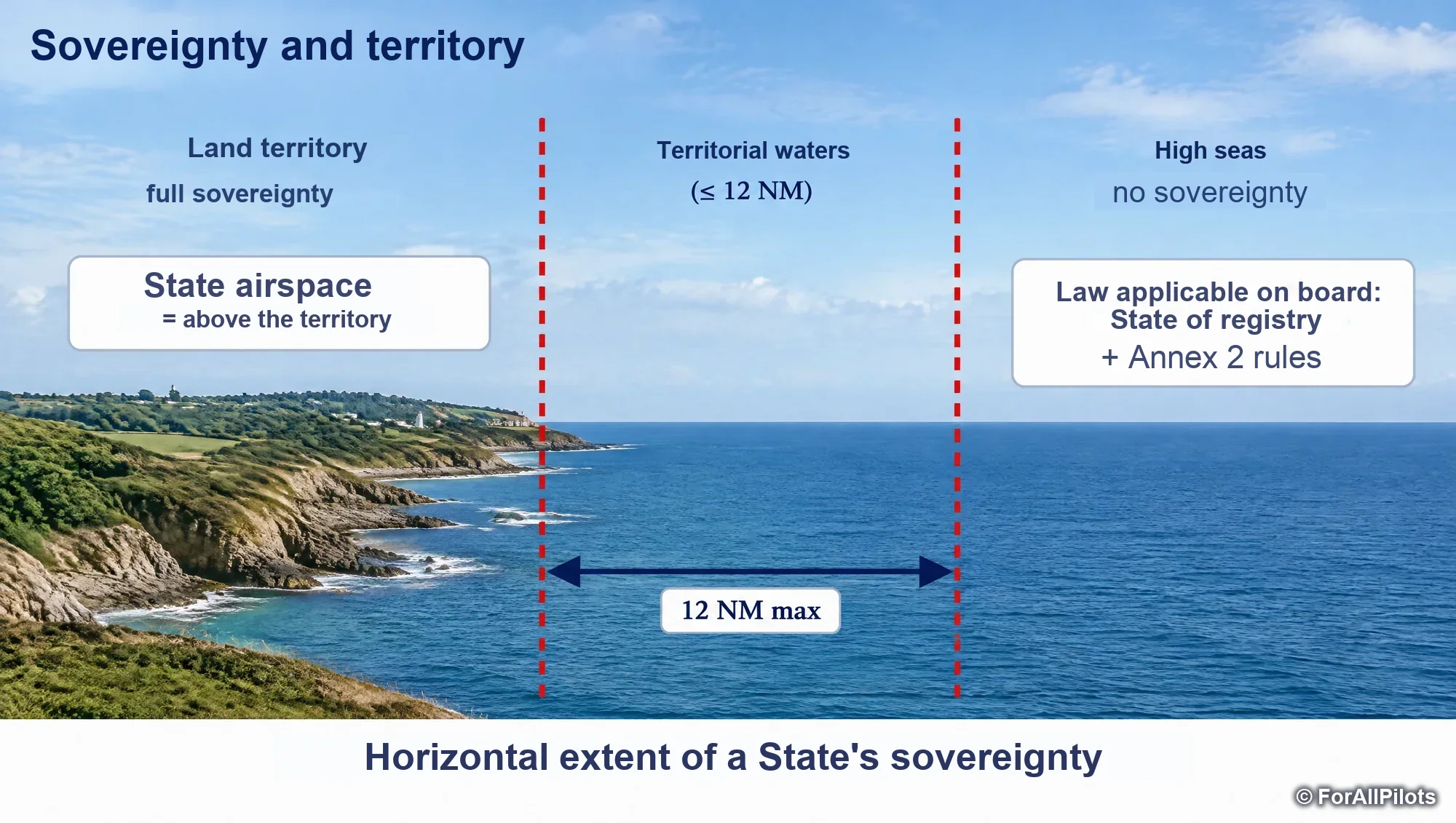
Sovereignty and territory

Horizontal extent of a State's sovereignty

Touchez l'image pour l'agrandir

Horizontal extent of a State's sovereignty

Article 1: every State has complete and exclusive sovereignty over the airspace above its territory. Flying over a State without its consent is a breach of that sovereignty.

Article 2: the territory comprises the land areas and adjacent territorial waters under the sovereignty, suzerainty, protection or mandate of that State. The breadth of the territorial waters is set by each coastal State, within a limit of 12 NM.

Over the high seas, the rules of the air that apply are those of the Convention (Annex 2, with no possibility of deviation) and activities on board are governed by the law of the State of Registry.

Remember

Territory = land + territorial waters (12 NM at most). High seas: law of the State of Registry, ICAO rules of the air.

The articles to know

← Faites glisser le schéma →

The most useful articles of the Chicago Convention

© ForAllPilots

A few articles come up again and again in the exam:

  • Art. 3 bis: no use of weapons against a civil aircraft in flight; an interception must not endanger the lives of those on board;
  • Art. 5: non-scheduled flights may overfly or make stops without prior permission (the State may require routes to be followed or a permit for flights over inaccessible regions);
  • Art. 6: a scheduled service requires authorisation;
  • Art. 7: each State may reserve cabotage to its own carriers;
  • Art. 8: pilotless aircraft: special authorisation;
  • Art. 9: prohibited areas for military necessity or public safety;
  • Art. 17-19: an aircraft has the nationality of the State of Registry and may be registered in only one State;
  • Art. 36: a State may prohibit the use of cameras on board over its territory.

Exam trap

A non-scheduled flight does not need prior permission to overfly or to make a non-traffic stop: it is the scheduled service (Article 6) that requires one.

Documents on board and advance notice

← Faites glisser le schéma →

The documents required on board by Article 29

© ForAllPilots

Article 29 requires every aircraft engaged in international navigation to carry:

  • the certificate of registration;
  • the certificate of airworthiness;
  • the licences of each crew member;
  • the journey log book;
  • the radio station licence, if the aircraft is equipped with a radio;
  • the passenger list and the cargo manifest, if it carries passengers or cargo.

For a non-scheduled flight that crosses a State or lands there for non-commercial reasons, the State accepts the flight plan as sufficient advance notice if it is received at least 2 hours before arrival.

Entry and departure documents are accepted if typed or legibly handwritten in ink.

Remember

Advance notice of a non-scheduled flight with no commercial traffic: flight plan received at least 2 h before arrival.

The organisation of ICAO

← Faites glisser le schéma →

The bodies of ICAO

© ForAllPilots

ICAO, headquartered in Montréal, serves as the worldwide forum of States: it develops standards, conducts audits and helps States implement the Convention.

  • Assembly: all contracting States, meeting at least once every 3 years; it elects the Council and votes the budget.
  • Council: permanent body, responsible to the Assembly, made up of 36 States elected for 3 years; its president is elected for 3 years. It adopts the standards (Annexes) and presents the annual reports.
  • Air Navigation Commission (ANC): 19 members appointed by the Council; it studies, develops and proposes the SARPs.
  • Secretariat: permanent services, headed by the Secretary General.

Remember

Assembly ≥ 1 time / 3 years • Council: 36 States, permanent, president elected for 3 years • ANC: 19 members.

Exam trap

It is the Air Navigation Commission that develops and finalises the SARPs, but it is the Council that adopts them.

Standards, recommended practices and differences

← Faites glisser le schéma →

Hierarchy of ICAO texts

© ForAllPilots

The Annexes contain the SARPs (standards and recommended practices):

  • a standard ("shall") is mandatory for States that have not notified a difference;
  • a recommended practice ("should") is desirable.

Article 38: a State that cannot comply with a standard must notify the difference to ICAO immediately; after an amendment is adopted, it has 60 days. Differences are published in the AIP (GEN 1.7).

The Annexes apply in a State only after being introduced into its national law, except over the high seas. Hierarchy: Convention, Annexes (SARPs), PANS (Doc 4444 PANS-ATM, Doc 8168 PANS-OPS), regional SUPPs (Doc 7030), then manuals and circulars.

Remember

Difference from a standard: immediate notification (Art. 38); 60 days after the adoption of an amendment; publication in GEN 1.7.

The 19 Annexes

← Faites glisser le schéma →

The 19 Annexes to the Chicago Convention

© ForAllPilots

The Convention now has 19 Annexes. Questions often ask "which Annex deals with…". Remember these first:

  • 1 personnel licensing • 2 rules of the air • 6 operation of aircraft;
  • 7 nationality and registration marks • 8 airworthiness;
  • 9 facilitation • 11 air traffic services;
  • 12 search and rescue • 13 accident investigation;
  • 14 aerodromes (including visual aids) • 15 aeronautical information;
  • 16 environment (noise) • 17 security • 18 dangerous goods.

Annex 7 contains only standards (no recommended practices).

Exam trap

The "air navigation services" meant in the questions are those of Annex 11 (ATS). Ground visual aids (lighting) are in Annex 14, not in Annex 10.

Technical freedoms: 1st and 2nd

← Faites glisser le schéma →

The two freedoms of the Transit Agreement

© ForAllPilots

Two agreements signed in Chicago in 1944 define the freedoms of the air.

The Transit Agreement ("two freedoms") exchanges technical rights between contracting States for scheduled services:

  • 1st freedom: fly over the territory of another State without landing;
  • 2nd freedom: land for non-traffic purposes (technical stop: fuel, maintenance), without embarking or disembarking traffic.

These two freedoms allow no commercial activity in the State overflown or visited.

Remember

1st freedom = overflight. 2nd freedom = technical stop (non-commercial).

Commercial freedoms: 3rd to 9th

← Faites glisser le schéma →

Commercial freedoms of the Transport Agreement

© ForAllPilots

The Transport Agreement ("five freedoms") adds the commercial rights, A being the State of registry:

  • 3rd: put down in B traffic taken on in A;
  • 4th: take on in B traffic destined for A;
  • 5th: carry traffic between B and C on a flight that departs from or returns to A.

Freedoms 6 to 9 are called "so-called" freedoms: never recognised by a multilateral treaty. The 6th combines the 4th and 3rd (C to A then A to B); the 7th links B and C without passing through A; the 8th and 9th are cabotage (domestic traffic within B).

In the European Union, regulation 1008/2008 allows Community carriers to operate intra-EU routes freely, cabotage included.

Exam trap

Cabotage (traffic between two points in the same State) is not a Chicago "freedom": Article 7 allows each State to reserve it for its own carriers.

European agreements and denunciation

← Faites glisser le schéma →

Regional agreements and denunciation of the Convention

© ForAllPilots

The Paris Agreements (1956), concluded within ECAC, allow certain non-scheduled commercial flights between European States without prior authorisation.

A State may denounce the Chicago Convention 3 years after the Convention came into force; the denunciation takes effect one year after its notification.

Finally, the Convention defines cabotage (Article 7) as commercial carriage between two points in the same State: it therefore concerns domestic flights.

The course goes on with chapter 2, « Criminal and liability conventions ». It is read in the Course tab of the app with a ATPL subscription, and each chapter ends with the questions of the bank about it. See pricing

How ForAllPilots trains you

  • Series of 20 or 30 questions

    New questions, mistakes to review or a mix of both, with the answer and its explanation straight away.

  • Flashcards

    Question on the front, explained answer on the back, filtered by subject, to learn without a timer.

  • Timed mock exam

    100 questions in 150 minutes, drawn from the whole ATPL bank: a training format, not a copy of an official paper.

  • AI instructor, optional

    From €4.99 a month on top of the Private pilot or PRO offer: it quizzes you in writing and explains your mistakes. A beta tool, it does not replace an approved instructor.

ATPL access comes with the PRO offer (which also includes Private pilot): €19.99 a month, cancel anytime, or €129 once with the Exam Pass (18 months of access, nothing renews). Prices include all taxes.

The other ATPL courses

All about the ATPL exams: format, subjects and method