BIA, PPL & ATPL revision
ATPL: Revising Operational Procedures
By ForAllPilots · Published · 4 min read
Reviewed and approved by the site's editor before publication. Our method (FR)
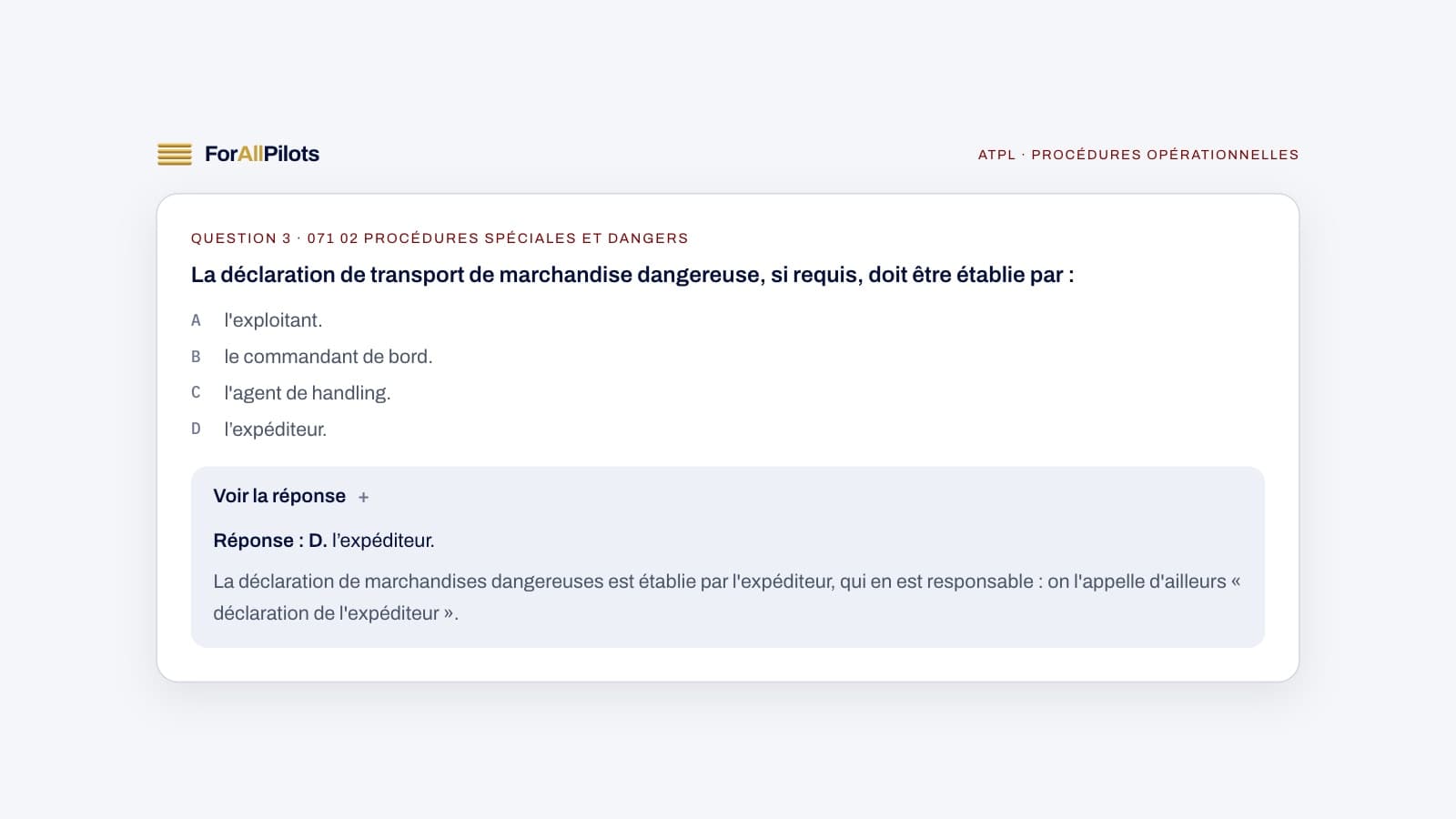
Operational Procedures is an ATPL theoretical subject that brings together some very practical topics: operations in degraded conditions, icing, wake turbulence, dangerous goods transport, security, and human factors as applied to operations. It can feel like a bit of a catch-all subject, but each topic actually follows a precise operational logic that needs to be understood rather than learned by rote.
What the subject covers
Operational Procedures covers the full set of rules governing the day-to-day operation of a transport aircraft, beyond pure flying skills. It includes icing and airframe contamination, wake turbulence and its associated separation, low-visibility operations, dangerous goods transport, onboard security, en-route fuel management, and cabin emergency procedures such as fire or depressurisation.
This diversity can make the subject feel like it lacks a common thread. In reality, every topic answers the same underlying question: how does the operator limit risk in a given situation through a written procedure rather than improvisation. Keeping this framework in mind helps you understand why a given procedure exists, rather than treating it as an arbitrary rule to be memorised.
The subject also overlaps with notions covered elsewhere: Human Performance for the factors that lead to errors, Meteorology for icing, and Mass and Balance for fuel. This is no coincidence: Operational Procedures applies this knowledge to real operational situations, which makes it a fairly cross-cutting subject within the syllabus.
The concepts most often confused
The first trap concerns the different types of icing and their distinct consequences: airframe icing, engine icing and ground icing are not handled in the same way, and candidates often mix up de-icing procedures with anti-icing procedures, which are applied at different times and with different products.
Wake turbulence is another classic source of confusion: candidates tend to learn a general rule on separation without understanding that aircraft categories and runway configurations change the underlying logic. The same applies to dangerous goods, where hazard categories, labels and transport conditions are often memorised in isolation, with no links drawn between them, which makes MCQs with closely similar options hard to untangle.
Finally, cabin emergency procedures are sometimes confused with one another, particularly fire versus smoke, or slow versus rapid decompression, even though the actions expected of the crew differ significantly. Taking the time to compare these procedures against each other, rather than learning them one by one, reduces these mistakes on exam day.
Common mistakes candidates make
The first mistake is treating this subject as a list to be learned by heart. Operational Procedures does not lend itself well to pure cramming, because the questions often test understanding of a situation rather than the ability to recall a sentence. A candidate who knows the rule but not the reasoning behind it gets caught out as soon as the question slightly changes the context.
The second common mistake is neglecting topics perceived as minor, such as security or dangerous goods transport, in favour of icing or wake turbulence, which are seen as more technical. Yet these topics come up regularly and can be revised quickly once the underlying logic is understood.
Finally, many candidates revise this subject in isolation, without connecting it to others. Yet a question on en-route fuel can draw on Mass and Balance concepts, and a question on fatigue during a stopover can overlap with Human Performance. Revising by making these connections strengthens understanding and helps avoid isolated memory gaps.
A progressive revision plan
Start by mapping the subject into major blocks: icing and degraded weather conditions, separation and wake turbulence, dangerous goods, security, cabin emergency procedures, and fuel management. Work through one block at a time, first reading through the general logic before tackling the details and exceptions.
For each block, use flashcards to fix the vocabulary and precise definitions in place, then follow up with MCQ sets targeted on that topic. This alternation lets you quickly check whether a concept has been mastered or needs further review. Only move on to the next block once your results on the current topic are consistently solid.
Once you've worked through the blocks separately, mix them together in broader sets to get used to switching from one topic to another, just as the real exam will require. Finish your preparation with timed mock exams under conditions close to the real test, to work on your time management as much as your knowledge. Then review your results to identify any topics that remain weak and go back over them before the big day.
Training effectively with the right tools
On ForAllPilots, the exam-format question bank for ATPL preparation covers Operational Procedures with sets organised by topic, which fits well with a block-by-block revision approach. Keep in mind that roughly one question in ten in this bank was drafted with the help of AI, just as is the case for the other licences on the site.
Flashcards are particularly useful for this subject, since a good part of the content relies on precise definitions and categories, such as dangerous goods classes or types of icing. The free glossary can serve as a quick reference point whenever a term escapes you during revision, without having to interrupt an MCQ session.
If a point remains unclear after several rounds of revision, the AI Instructor lets you ask a precise question in writing and get a targeted explanation, any time of day. This is useful for clarifying the logic behind a procedure rather than guessing based on a phrase learned by rote. Timed mock exams remain the best way to check, before the real test, that this knowledge holds up under time pressure.