BIA, PPL & ATPL revision
ATPL: revising the Mass and Balance subject
By ForAllPilots · Published · 4 min read
Reviewed and approved by the site's editor before publication. Our method (FR)
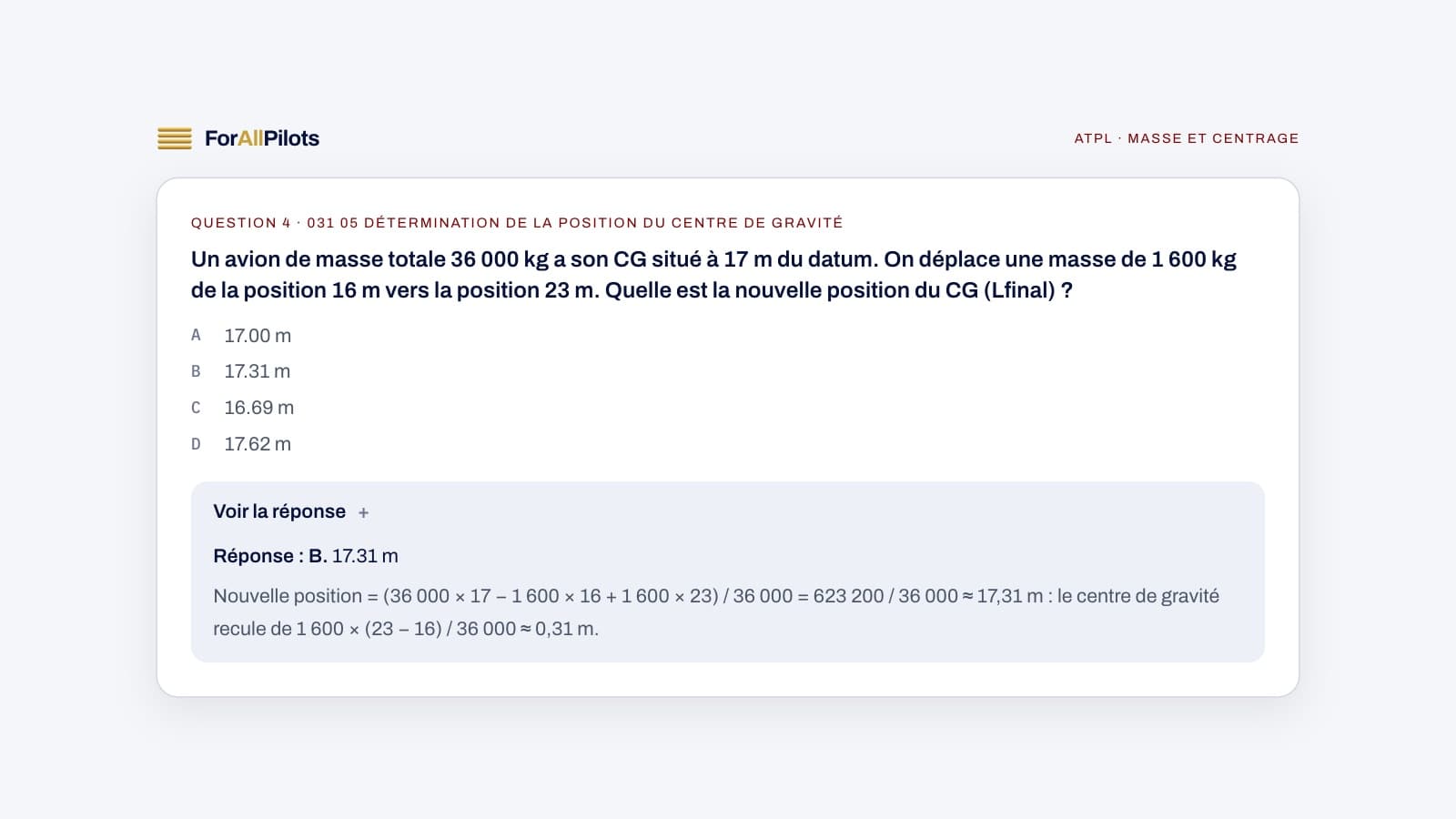
Mass and Balance is a short subject in the ATPL theoretical exams, but it carries real weight on exam day because it leaves no room for approximation. It requires understanding the logic of weight distribution rather than memorising formulas. Here's how to structure your revision, avoid the classic pitfalls, and practise effectively.
What the subject covers
Mass and Balance deals with how an aircraft's mass is distributed and how this affects its behaviour in flight. It covers the different mass definitions (empty mass, basic empty mass, zero fuel mass, take-off mass, landing mass), the structural limits associated with each, and the concept of the centre of gravity — the point around which the aircraft balances.
It also includes calculating the mass and balance load sheet, which involves adding up the masses of the aircraft, crew, cargo, passengers and fuel, then checking that the resulting centre of gravity stays within an acceptable range, expressed as a percentage of the mean aerodynamic chord.
Finally, this subject addresses the influence of centre of gravity position on performance and stability: a centre of gravity too far forward increases stability but penalises performance, while one too far aft does the opposite and can make the aircraft unstable. It also covers special cases such as in-flight fuel transfer or load shifting.
Common sources of confusion
The first confusion concerns the various regulatory mass definitions. Dry operating mass, basic mass, zero fuel mass and maximum take-off mass do not refer to the same thing, and each limit serves a different purpose: structural, performance, or both. Mixing up these definitions leads to applying the wrong limit in a calculation.
A second confusion concerns the sign of the moment arms. A moment arm is positive or negative depending on its position relative to the reference point (often the datum), which changes the sign of the moment — and a sign error throws off the entire balance calculation without the result necessarily looking wrong at first glance.
Finally, many candidates confuse the effects of a forward versus an aft centre of gravity. Remember that stability and manoeuvrability move in opposite directions: whatever improves one degrades the other. This is a relationship to understand, not to memorise in isolation — otherwise it's quickly forgotten under exam pressure.
Mistakes that cost points
The first mistake is rushing into the calculation without reading the whole question. Mass and Balance exercises often provide several tables or charts, and a single piece of information tucked away at the end of the question (a fuel transfer, an extra cargo hold) changes the final result if it's overlooked.
The second mistake is neglecting units. Mass in kilograms or pounds, moment arms in metres or inches, moments in derived units: a forgotten conversion ruins a calculation that was otherwise correct. It's best to get into the habit of systematically writing down the unit next to every intermediate value.
The third mistake is failing to check whether the result makes sense. A centre of gravity that falls well outside the envelope should raise a red flag before you commit to an answer: in most cases, such a discrepancy points to a calculation error rather than a real situation. This checking habit saves time and avoids submitting an absurd answer.
A progressive revision plan
Start with the definitions: each type of mass, the centre of gravity, the mean aerodynamic chord, and the concept of the centre of gravity envelope. Without this foundation, calculations remain purely mechanical, and you'll lose your footing as soon as a question changes format.
Then move on to simple load sheet calculations, with a small number of items to add together. The goal at this stage is to master the method: list the masses, assign each moment arm, calculate the moments, then divide the sum of the moments by the sum of the masses to obtain the centre of gravity.
Gradually build up to more complex cases: in-flight fuel transfer, compartment loading with specific limits, using a centre of gravity chart. Finish with timed exercises that mix several concepts together, to get used to the pace of the exam and to quickly spot the useful data in a dense question.
How to train on ForAllPilots
On the app, the ATPL question bank's MCQ sets let you work on Mass and Balance by sub-topic, so you can practise specifically on load sheets, centre of gravity, or special cases without spreading yourself across the whole subject. The flashcards are useful for fixing definitions and cause-and-effect relationships in your mind, such as the impact of a forward centre of gravity on stability.
Timed mock exams reproduce real exam conditions and help you manage your time on calculations requiring several steps. Your detailed results by sub-topic show whether a recurring mistake stems from confused definitions or a flawed calculation method.
If a point remains unclear despite the explanations, the AI Instructor lets you ask a precise written question — for example, about the meaning of a negative moment arm — and get an explanation tailored to that specific sticking point. The free glossary rounds out the toolkit, letting you quickly look up a definition without interrupting a practice session.