BIA, PPL & ATPL revision
PPL: Revising Operational Procedures
By ForAllPilots · Published · 4 min read
Reviewed and approved by the site's editor before publication. Our method (FR)
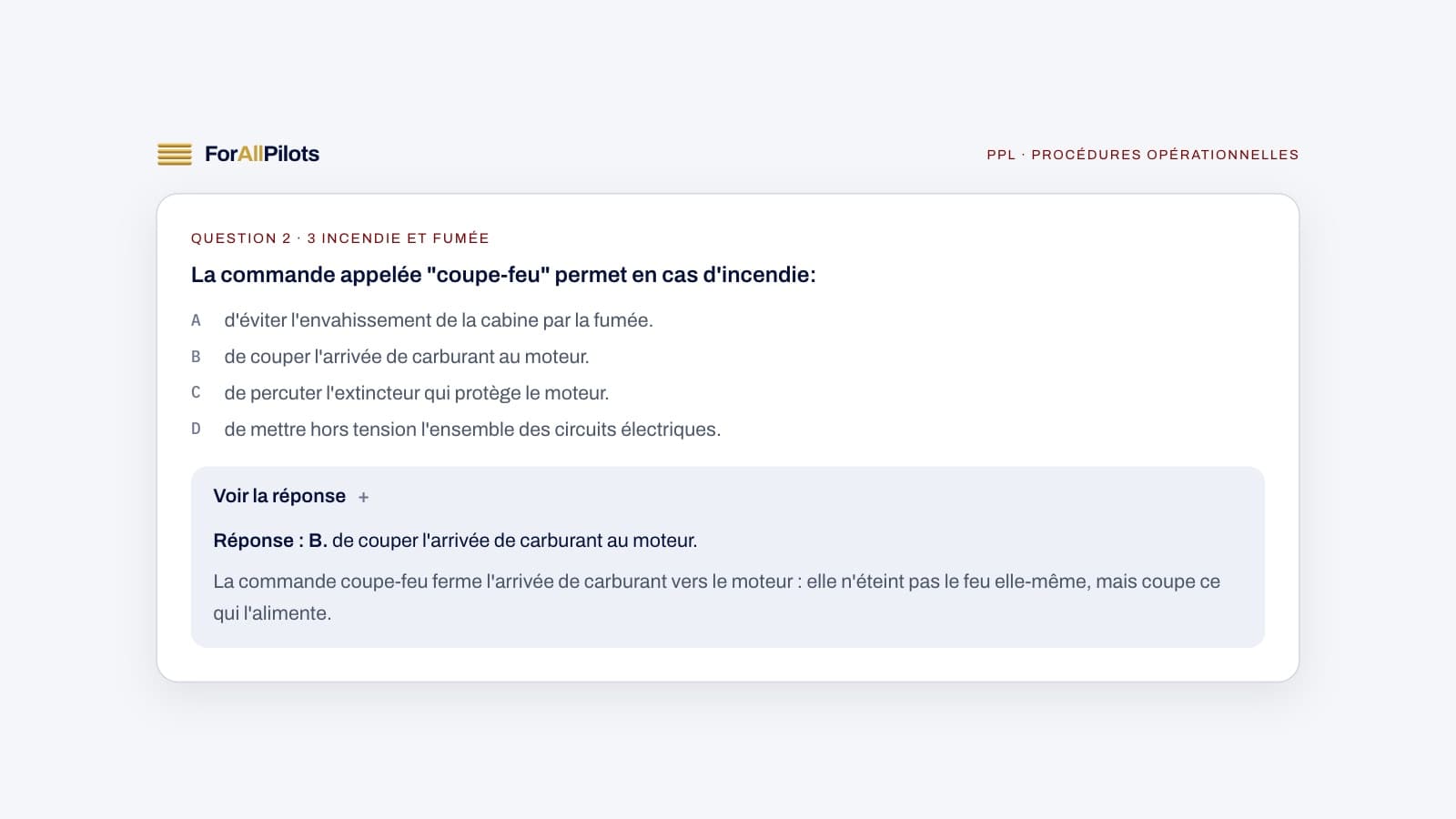
Operational Procedures is a PPL theoretical subject that describes how a pilot behaves during each phase of flight, from taxiing to the aerodrome traffic circuit. It looks simple because it seems like common sense, but it actually requires knowing precise rules and not mixing them up. Here's how to structure your revision effectively.
What this subject covers
Operational Procedures cover the full set of standardised actions a pilot applies from the start to the end of a flight: pre-taxi checks, ground movement, departure, climb, cruise, approach, aerodrome traffic circuit, landing and after-flight procedures. It also includes procedures relating to communications, traffic conflict avoidance, joining a circuit, and degraded situations such as a rejected takeoff or a go-around.
This subject differs from regulations in that it describes the “how” rather than the legal “why”: it focuses on the practical conduct of a flight, the order of actions, and the priorities to be respected. It still overlaps considerably with other subjects, particularly aircraft general knowledge and navigation, since procedures rely on aircraft systems and on flight preparation.
A point that's often underestimated concerns the phraseology associated with certain procedures, as well as the visual signals used at an uncontrolled aerodrome. These elements come up regularly in exam-prep question banks, because they require knowing a precise convention rather than applying logical reasoning.
The concepts most often confused
The first classic mix-up concerns the standard aerodrome traffic circuit and joining procedures. Many candidates know the general shape of the circuit but hesitate over the order of joining steps depending on whether they arrive via base leg, downwind, or by overflying the aerodrome. You need to memorise a precise sequence, not just a general mental picture of the circuit.
The second mix-up concerns normal procedures versus emergency or degraded procedures. A go-around, a rejected takeoff, or an in-flight engine failure don't follow the same sequence of actions, and the wording used to describe them can look similar in exam questions. It's useful to always identify the situation described first before selecting the associated procedure.
Another common source of error comes from mixing up the rules that apply at a controlled aerodrome with those of an uncontrolled aerodrome. Runway priorities, radio calls and expected actions aren't the same in both cases, and a question that doesn't specify the context can mislead you if you apply the wrong reading grid.
Frequent training mistakes
The first mistake is learning procedures as an isolated list, without linking them to a concrete flight situation. A procedure makes sense because it serves a safety objective or maintains order in traffic: keeping that objective in mind helps you find the right answer even when the question is phrased differently from what you memorised.
The second mistake is neglecting the precise vocabulary of flight phases. Terms like initial climb, base leg, downwind or final refer to very specific moments, and a question can hinge on this precision. Reading too quickly and guessing the general meaning often leads to a wrong answer even when the procedure itself was known.
Finally, many candidates revise this subject in isolation, without linking it to navigation or aircraft general knowledge. Yet an operational procedure often relies on a specific aircraft system or an element of flight preparation. Working on these subjects in parallel reinforces memorisation on both sides.
A progressive revision plan
Start with an overview of how a flight unfolds, from taxiing to engine shutdown, to place each procedure in its context rather than learning it in isolation. Use the glossary to clarify the vocabulary of flight phases and radio calls before going into the detail of action sequences.
Next, focus on the aerodrome traffic circuit and its joining variants, as this is an area with a high density of questions and confusion. Then work on degraded procedures, particularly go-arounds and rejected takeoffs, systematically comparing them with the corresponding normal procedure to clearly spot what changes.
Finish your preparation with mixed sets covering all flight phases, to train yourself to quickly identify the context of a question before choosing an answer. A timed mock exam at the end of your preparation lets you check that you manage both time and content well, under conditions close to those of the real test.
How to train effectively on ForAllPilots
MCQ sets let you work on the subject in short, targeted sessions, repeating the themes where you make the most mistakes. Flashcards are particularly well suited to procedures, as they help you memorise action sequences or precise definitions through spaced repetition, without having to wait for a full MCQ session.
Timed mock exams put you in real exam conditions, adding time management on top of answer accuracy. Afterwards, review your results to identify the sub-topics where you keep making mistakes, whether that's the aerodrome traffic circuit, degraded procedures, or phraseology.
If a procedure remains unclear even after several rounds of MCQs, the AI Instructor lets you ask the precise question that's holding you back and get a written explanation, any time of day. The glossary is also a handy reflex for quickly checking a term before continuing a session, rather than guessing its meaning.