BIA, PPL & ATPL revision
ATPL: revising Flight Preparation and Monitoring
By ForAllPilots · Published · 4 min read
Reviewed and approved by the site's editor before publication. Our method (FR)
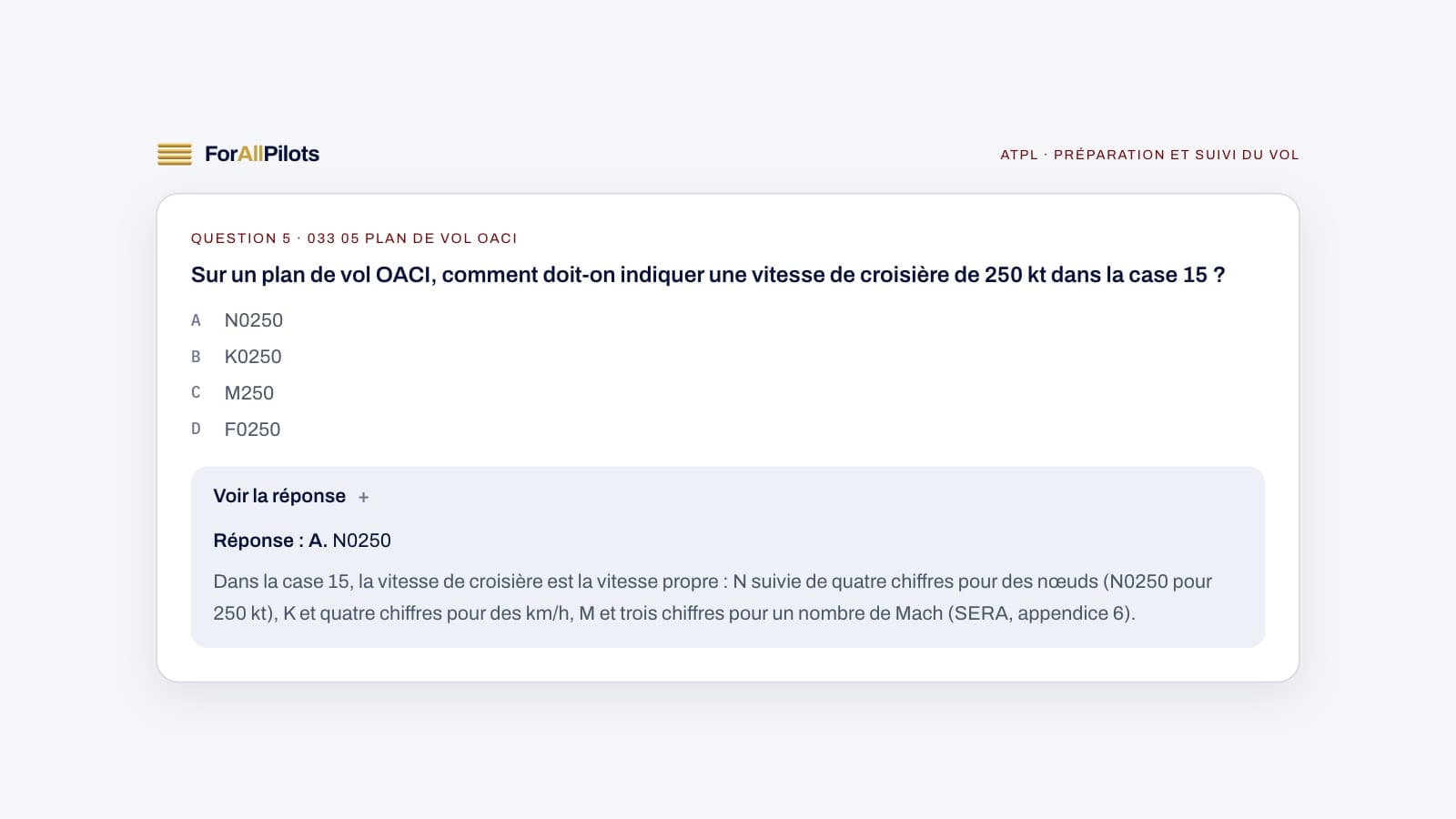
Flight Preparation and Monitoring is an ATPL theoretical subject that ties together topics covered elsewhere: navigation, performance, mass and balance, and regulations. It requires less learning of new formulas than knowing how to bring them together, in the order a commander actually uses them. Here's how to structure your revision and train effectively.
What this subject covers
Flight Preparation and Monitoring covers everything needed to build a consistent flight file before departure, and then to monitor it once airborne. This ranges from calculating the fuel required for each flight phase, to the regulatory margins that must be respected, to the choice of alternate aerodromes and the consideration of forecast conditions en route and at destination.
This subject also covers in-flight monitoring: comparing what is actually happening with what was planned, detecting a discrepancy in fuel consumption or time, and knowing when that discrepancy should trigger a decision, such as a diversion or a review of the originally planned alternate.
It also covers the operational limitations linked to the type of operation, the applicable minima depending on the case, and the documentation that must accompany the flight. All of this forms a logical sequence rather than a list of isolated rules, which explains why it's often studied after the subjects that supply its raw material.
Many candidates see it as a synthesis subject. That's partly true, but it also introduces its own specific rules, particularly on fuel reserves and the criteria for choosing an alternate, which need to be learned in their own right rather than inferred from other subjects.
The concepts most often mixed up
The first pitfall concerns the different categories of fuel reserves. Trip fuel reserve, final reserve fuel, additional fuel and discretionary fuel each follow a different logic, and candidates easily mix them up under stress, especially when a question combines several scenarios in the same stem.
The second source of confusion concerns alternate criteria. Knowing when a takeoff alternate, en-route alternate or destination alternate is required, and according to which criteria it's chosen, requires distinguishing between situations that look similar on paper but follow different regulatory logics.
A third classic pitfall concerns the link between planning and actual in-flight monitoring. A candidate who has a good grasp of the initial calculation can still get the course of action wrong when the in-flight situation diverges from the plan, particularly regarding the point at which a decision must be made rather than simply noted.
Finally, candidates sometimes confuse the requirements that apply depending on the type of operation. A rule valid in one context isn't necessarily valid in another, and questions in this subject are specifically designed to test this contextual awareness.
Common mistakes on exam day
The most common mistake is treating each question as an isolated calculation, without asking which stage of the flight it corresponds to. Systematically placing the question within the flight's timeline — before departure or en route — helps you choose the right rule among several that seem similar.
Another frequent mistake is overlooking questions that ask you to justify a choice rather than produce a figure. This subject tests reasoning as much as calculation, and a numerically correct answer obtained through flawed logic guarantees nothing for neighbouring questions on the same topic.
Candidates also waste time trying to recalculate everything from scratch instead of quickly identifying which rule or criterion applies. Reading the question carefully, first identifying the type of operation and the flight phase involved, helps avoid starting from a wrong assumption.
Finally, many underestimate this subject because it seems familiar after revising navigation and performance. This feeling of “already seen” can lead candidates to revise it too quickly, when in fact it has its own subtleties that deserve dedicated study time.
A progressive revision plan
Start by consolidating the foundations that feed into this subject: the main principles of navigation, performance, and mass and balance need to be solid before tackling flight preparation as a whole, otherwise every calculation becomes an extra obstacle rather than a logical application.
Next, work specifically on the rules specific to this subject: categories of fuel reserves, alternate criteria, required documentation. This is the time to use targeted MCQ sets to spot areas that are still unclear, and flashcards to memorise the definitions and thresholds that come up repeatedly.
Then, practise on cases that combine several concepts at once, as most questions in this subject actually do. This is where gaps between similar concepts come to light, letting you fine-tune your understanding rather than just your memorisation.
Finish your preparation with timed mock exams, under conditions close to the real test. They help you manage your time on sometimes lengthy questions, and the results page lets you see whether certain mistakes keep recurring on the same type of situation.
How to train with ForAllPilots
On ForAllPilots, the Flight Preparation and Monitoring subject has its own bank of exam-format practice questions, so you can train concept by concept before moving on to more combined exercises. The flashcards help you fix the vocabulary and definitions in place — a real asset in a subject where precise terms matter as much as the calculations.
Timed mock exams replicate exam conditions and help you split your time between calculation questions and those requiring regulatory reasoning. The detailed results then show you where to focus your next study sessions, instead of revising blindly.
If a concept remains unclear despite several re-reads, the AI Instructor lets you ask your question in writing, whenever suits you, and get an explanation tailored to exactly what's tripping you up. The glossary, which is free, remains handy for quickly clarifying a term before going back to a set of MCQs.
Keep in mind that these questions are written to help you train for the exam format, not to reproduce actual exam questions. The goal is to understand the subject's underlying logic, not to memorise answers — and that will serve you well far beyond exam day.