BIA, PPL & ATPL revision
ATPL: Revising Radio Navigation
By ForAllPilots · Published · 4 min read
Reviewed and approved by the site's editor before publication. Our method (FR)
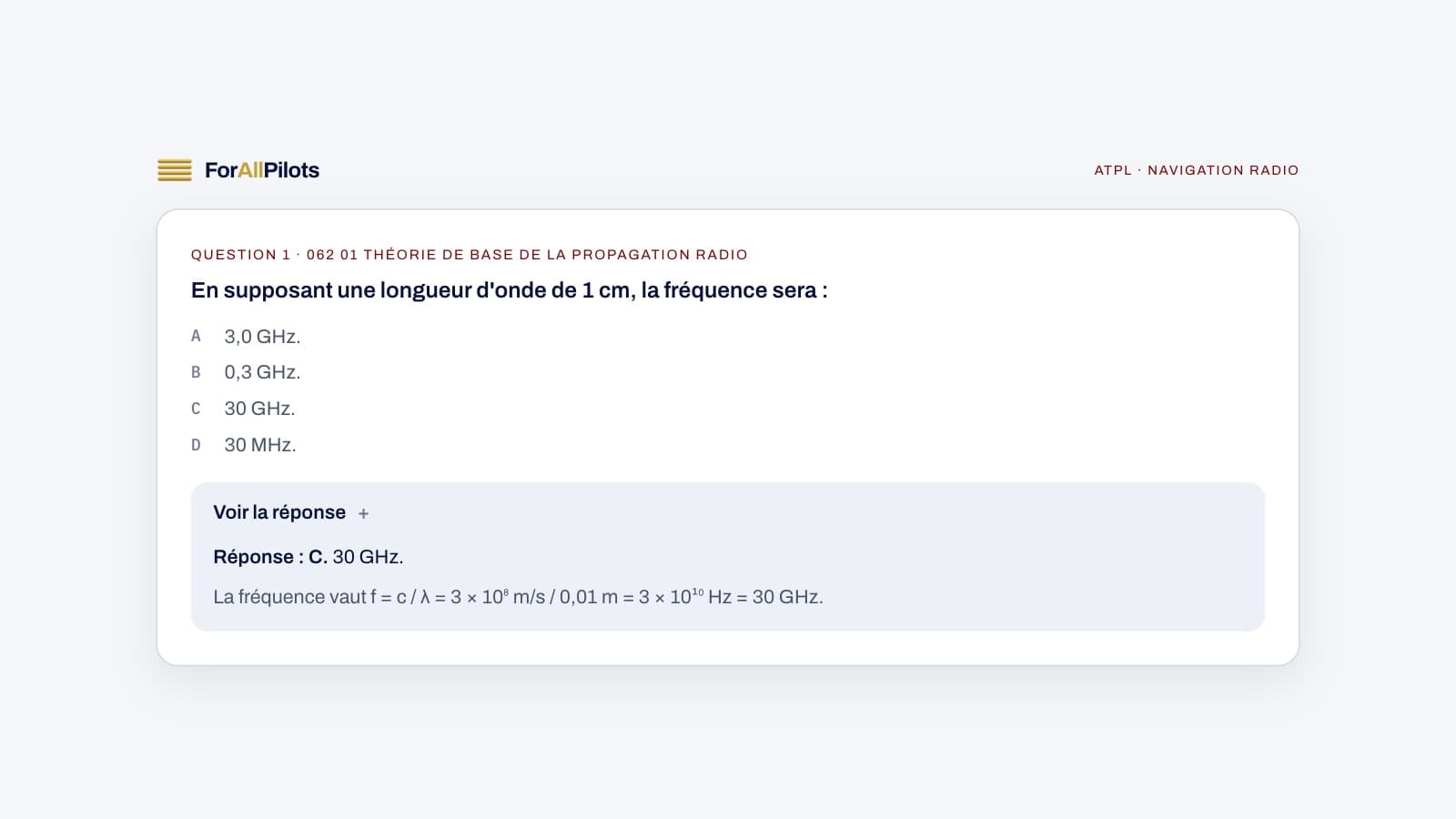
Radio Navigation is an ATPL theoretical subject that builds on what you've already seen in general navigation, but from a different angle: it's about understanding how an aircraft determines its position and guides itself using radio-based equipment. It blends wave physics, geometry and instrument reading, which makes it a technical subject — but one that's perfectly manageable with the right method.
What the subject covers
Radio Navigation covers the full range of means that allow a crew to determine their position, heading or distance relative to a ground-based or satellite reference, without relying solely on visual navigation. It deals with classic systems such as the VOR, NDB, DME and ILS, their underlying physical principles, their range and their limitations, as well as more recent systems such as GNSS and area navigation concepts (RNAV, RNP).
It also requires understanding how these systems work together during a given phase of flight: departure, cruise, approach. The same system can serve different purposes depending on the context, and it's often this link between theory and application — rather than the complexity of each individual concept — that makes the subject challenging.
Finally, the subject covers the errors and limitations specific to each system: wave propagation, site effects, shadow zones, and degraded accuracy in certain configurations. These points often come up in exam questions as scenario-based situations, where you need to identify the cause of a reading anomaly rather than simply recite a definition.
The concepts most often confused
The first classic confusion is between the VOR and the NDB. The VOR gives a precise magnetic bearing by comparing two signals, whereas the NDB works on a simpler, less accurate wave-direction principle, sensitive to atmospheric disturbances and terrain. Many candidates mix up their accuracy and range characteristics when answering quickly under MCQ conditions.
A second common confusion involves the difference between DME distance and actual ground distance. The DME measures a slant range, i.e. a direct line-of-sight distance to the station, which can differ significantly from the actual horizontal distance when the aircraft is close to the station at altitude. This nuance, simple once understood, is often a source of error if it hasn't been practised with a concrete example.
Finally, candidates sometimes confuse the geometric accuracy of a GNSS system with its operational accuracy, or mix up the concepts of RNAV and RNP, which do not refer to the same performance requirement. Going back over these pairs of concepts two at a time, rather than learning them separately, helps make the distinction stick.
Common mistakes on exam day
The first mistake is learning the definitions of each system without ever practising on applied cases. Radio Navigation rarely asks purely theoretical questions: it presents a flight situation, an instrument reading, a bearing to interpret, and requires you to draw on several concepts at once. Revising theory alone, without ever working through scenario-based exercises, can give a misleading sense of mastery.
The second mistake is neglecting the limitations and errors specific to each system, even though these are a regular source of exam questions. Knowing that an NDB is sensitive to night effect, or that a VOR can be affected by terrain, isn't something you learn by rote in isolation — it's understood by linking the physical cause to its operational consequence.
Finally, many candidates manage their time poorly because they spend too long on a geometry or angle-calculation question, at the expense of the rest of the exam. Practising under timed conditions helps you spot this type of question in advance and learn to move on without getting stuck.
A step-by-step revision plan
Start by laying the groundwork: the physical principles of each system, followed by their accuracy, range and usage characteristics. Don't move on until you can explain, in your own words, the difference between the VOR, NDB, DME and ILS, and what sets their operation apart. This first stage works well with flashcards, which force you to reformulate a concept rather than just re-reading it.
Next, work through MCQ sets targeted by system, to identify your weak points system by system rather than overall. Use your results to spot the concepts that keep coming up as errors, and go back over them before moving on, rather than piling up practice sets without analysing what's tripping you up.
As a third step, deliberately mix the systems together within the same sets, to get used to switching between them the way the real exam does. Finish your preparation with timed mock exams covering the whole subject, under conditions close to the real exam, to check your pacing as much as your knowledge.
How to train effectively
On ForAllPilots, Radio Navigation is practised through MCQ sets organised by system, letting you progress concept by concept before mixing them together. Flashcards are useful for fixing the definitions and technical characteristics of each system in your memory — an area where precise recall matters just as much as understanding.
The glossary, which is free, is a handy resource for quickly clarifying a technical term without derailing your revision session for long. Timed mock exams replicate real exam conditions and help you assess your pacing across the whole subject, not just on the concepts you already know well.
If a concept remains unclear after several attempts, the AI Instructor lets you ask your question in writing, at any time, and get a rephrased explanation until it clicks. It's a good complement to MCQs for unblocking a specific point without waiting for a class slot or a group revision session.
Finally, keep a regular eye on your results by system: it's often there, more than in your overall impression, that you can see which concepts still need work before the exam.