BIA, PPL & ATPL revision
PPL: Revising VFR Communications
By ForAllPilots · Published · 4 min read
Reviewed and approved by the site's editor before publication. Our method (FR)
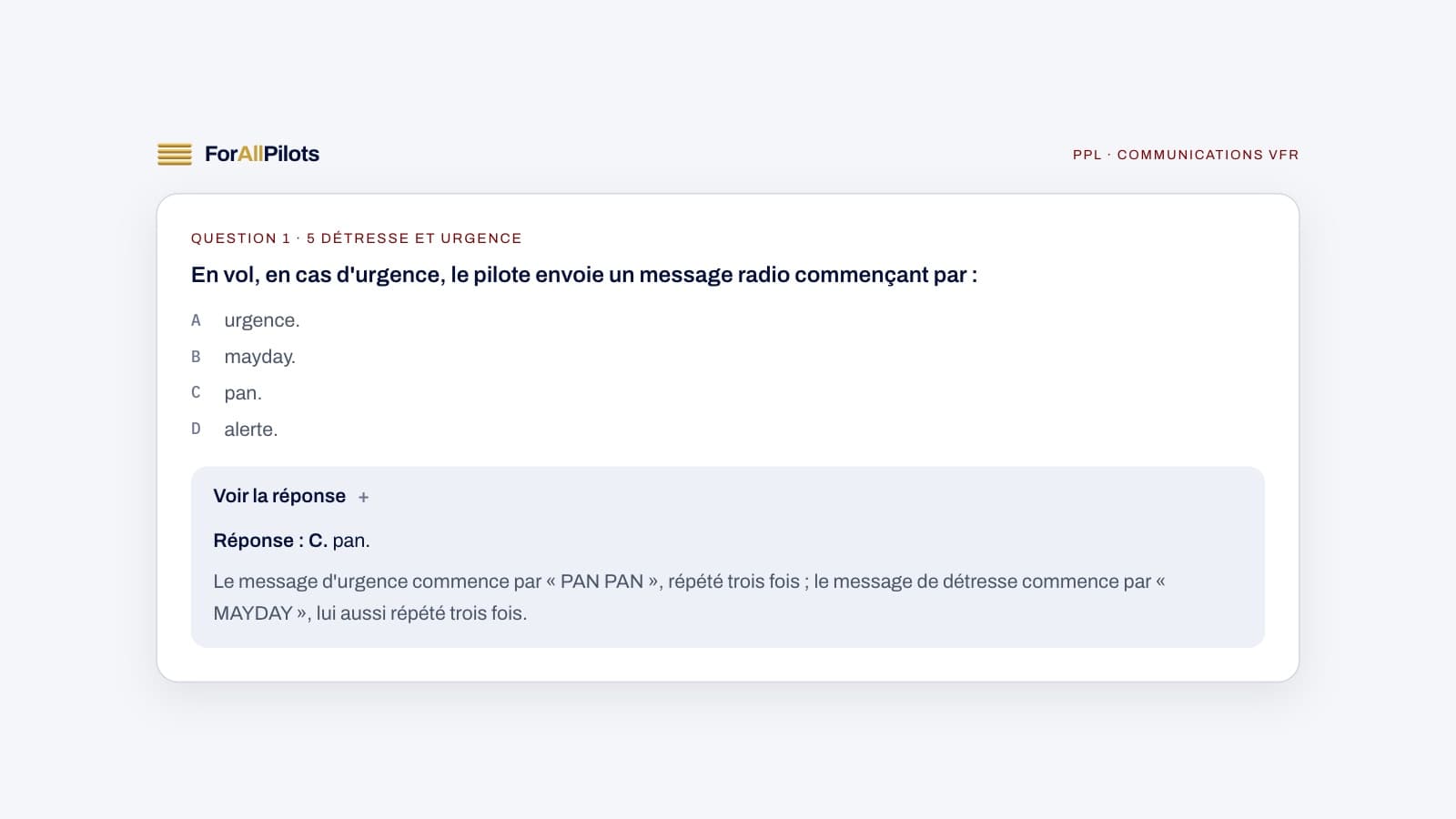
VFR Communications is a subject apart in the PPL theoretical exam: it doesn't call for formulas, but rather precise phraseology that must be memorised and applied correctly in a variety of situations. Many candidates underestimate it, assuming it will mostly be picked up in flight, when in fact it needs to be revised just as methodically as any other subject.
What the subject covers
VFR Communications covers the full range of radio exchanges a pilot must handle in general air traffic, from taxiing through to landing. This includes standard phraseology for initial contact, requesting clearance, position reports, circuit instructions at an aerodrome, as well as procedures for radio failure or emergencies. The subject also deals with how frequencies are organised according to the type of airspace and the service being provided.
It also covers the phonetic alphabet, how to spell out a registration or a callsign, and how to read out parameters such as flight level, heading or transponder code. Part of the syllabus concerns flight information services and which units to contact depending on the phase of flight: tower, approach, information. Finally, the subject addresses radio readability minima and how to behave when in doubt about a message received.
This subject stands out for being highly normative: there is a correct way to phrase every message, and the exam tests both knowledge of the vocabulary and the ability to apply it in a given context. It also overlaps with regulations and operational procedures, which explains why some questions seem to straddle several subjects at once.
Concepts that are often confused
The first point of confusion concerns words that sound similar but don't carry the same operational meaning: “roger”, which simply acknowledges receipt of a message, “wilco”, which means the instruction will be carried out, and “affirm” or “negative”, which answer a closed question. Using one in place of another changes the meaning of the message, and this is a classic trap in question sets on this subject.
A second point of confusion is the difference between a clearance and an instruction. A clearance authorises an action under defined conditions, whereas an instruction requires immediate compliance. Candidates must also distinguish between the different types of service provided by a ground unit, since the level of information given and the pilot's obligations vary depending on which service is active.
Finally, many candidates mix up the rules on mandatory read-back and those where a simple acknowledgement is enough. Certain elements of a message must be read back word for word, while others don't need to be. This distinction comes up regularly in preparation question banks, as it tests rigour more than pure memory.
Frequent mistakes made by candidates
The first mistake is learning phraseology in isolation, without linking it to an actual flight situation. A candidate who knows the set phrases by heart but doesn't know in what order to use them in an aerodrome circuit often trips up when faced with a question that sets out a specific phase of flight rather than just asking for a phrase on its own.
Another common mistake is neglecting the phonetic alphabet and spelling rules, seen as too basic to be worth revising seriously. Yet questions specifically target special cases, such as spelling out letters that sound alike phonetically or reading grouped digits, and these details cost candidates unnecessary points.
Finally, some candidates leave this subject until too late, relying on their flying experience to fill in the gaps in theory. But the exam tests specific cases, some rare in practice, such as radio failure procedures or emergency messages, which require dedicated revision independent of airborne experience.
A progressive revision plan
Start with the basics: the phonetic alphabet, numbers, acknowledgement phrases and initial contact procedures. This first step needs to become automatic before moving on, since the whole subject builds on it. Use flashcards to memorise this vocabulary through repetition, varying the order so you learn through understanding rather than simple association.
Next, move on to the phases of flight: taxiing, take-off, aerodrome circuit, approach, landing. For each phase, identify which unit is contacted, what type of message is expected, and what needs to be read back. Themed MCQ sets are useful here, as they let you work on one phase at a time without spreading yourself too thin.
In a third stage, focus on special cases: radio failure, emergencies, uncontrolled airspace, situations where no station responds. These are often the questions that make the difference on exam day, since they fall outside routine scenarios. Finish your preparation with timed mock exams that mix all these situations together, to check that you can move smoothly from one context to another without hesitating.
How to train effectively
On ForAllPilots, themed MCQ sets let you isolate VFR Communications and progress point by point, without mixing this subject with regulations or navigation. Flashcards are particularly well suited to vocabulary and fixed phrases, which require repeated memorisation more than complex understanding. Also check the site's free glossary as soon as a term seems unclear, rather than guessing its meaning.
Timed mock exams reproduce exam conditions and help you manage your time, an important factor when questions mix several flight situations together. Detailed results then let you spot whether your mistakes are concentrated around a particular type of message, such as emergencies or position reports, so you can target your further revision accordingly.
If a phrase or procedure remains hard to understand even after several re-reads, the AI Instructor can help you rephrase it and answer specific questions in writing, any time of day. Keep in mind that these tools are there to help you train on exam-style preparation questions, and that precision in phraseology is also built through actual flight practice with your instructor.