BIA, PPL & ATPL revision
ATPL: revising VFR Communications
By ForAllPilots · Published · 4 min read
Reviewed and approved by the site's editor before publication. Our method (FR)
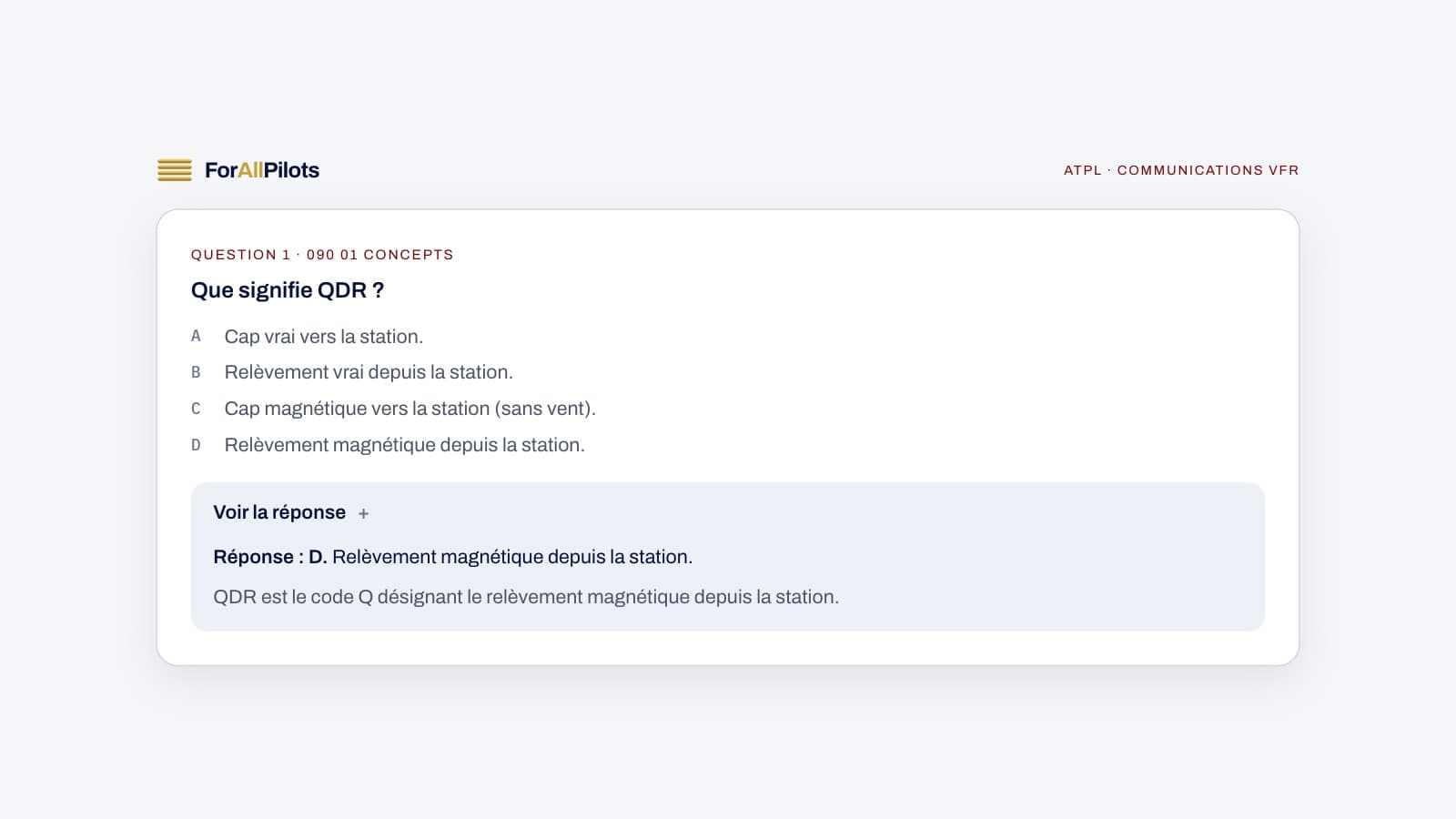
VFR Communications comes back at ATPL theoretical level, even though many candidates assume it was already mastered at PPL stage. The requirement, however, moves up a gear: phraseology needs to be known without hesitation and applied across a wider range of situations. Here's how to structure this revision without underestimating it.
What this subject covers at ATPL level
VFR Communications at ATPL theoretical level covers the phraseology used in visual flight, the radio procedures associated with each phase of flight, and the standardised vocabulary that allows unambiguous exchanges with air traffic services. The framework is the same as at PPL level, but the expectations go further: you'll encounter less common situations, uncontrolled aerodromes, special airspace, and exchanges with different types of units.
This subject isn't just about reciting set phrases. It requires understanding why a message is built a certain way, in what order information must be given, and what changes depending on the type of airspace or the type of flight. It's also a subject where the ATPL candidate must demonstrate command of degraded communication situations, not just the standard exchange.
Finally, this subject overlaps heavily with air traffic regulations and airspace. A good proportion of the questions make more sense once you already know what type of airspace you're dealing with and what service is provided there. Revising VFR Communications in isolation, without that link, leaves gaps.
The concepts most often confused
The first classic confusion concerns the different types of messages and their order of priority: a distress message, an urgency message and a normal message don't follow the same rules of wording or radio priority. Many candidates mix up the first two, or apply the same structure to all three.
The second common trap: confusing procedures depending on the status of the airspace being flown through, controlled or uncontrolled. The expectations for position reports, readbacks or clearances are not the same, and a question may appear to be about general phraseology when it's actually testing knowledge of the airspace concerned.
The third source of error: elements that must be read back compared with those that don't need to be. Candidates who learn this by rote without understanding the logic behind the classification easily get caught out as soon as a question changes the context or the type of instruction given.
Finally, the phonetic alphabet, number groups and the units used in phraseology are sometimes revised too quickly, even though they come up regularly in a slightly different form from one question to the next.
Common mistakes on exam day
The first mistake is treating this subject as a simple refresher of PPL material and not giving it dedicated revision time. ATPL questions cover more scenarios, including uncommon situations, and a candidate who relies solely on what they remember from PPL often leaves points on the table.
The second mistake: answering by instinct on a phrase that “sounds right” without checking the exact expected structure. Phraseology has a precise syntax, and a question may offer several similar-looking answers where only the order of elements or a single word determines which one is correct.
The third mistake, more subtle: neglecting questions that combine communication with regulation, for example on the requirement to report in a given airspace. Candidates who revise this subject in isolation, without linking it to air traffic regulations, get caught out by these questions that straddle two topics.
A progressive revision plan
Start by going back over the basics: standardised vocabulary, the phonetic alphabet, numbers and number groups, and the general structure of a radio message. Even though this foundation comes from PPL, make sure it's solid before adding the ATPL layer, or you risk building on sand.
Next, work through procedures by phase of flight and by type of airspace: taxiing, departure, VFR cruise, joining and approach, systematically distinguishing between controlled and uncontrolled airspace. Link each procedure to the exact phraseology expected, rather than learning them separately.
Third step: focus on special situations — distress, urgency, communication failure — and on the elements that must be read back. These are the points most often poorly mastered, and so the ones that bring the most progress in the least time if you work on them seriously.
Finish with cross-revision alongside air traffic regulations and airspace, to make sure you can always place a radio procedure within its regulatory context before answering.
How to train effectively
On ForAllPilots, start with the MCQ series dedicated to VFR Communications to quickly spot your weak points: message type, readbacks, phraseology by phase of flight. The detailed results by topic help you see where to focus your effort rather than revising the whole subject at the same pace.
Flashcards are particularly well suited to this subject, since much of the content consists of wording that needs to be memorised exactly: the phonetic alphabet, message structures, lists of elements to be read back. Short, repeated sessions work better here than continuous reading.
Timed mock exams get you used to answering quickly on questions where several wordings look alike, which replicates the pressure of exam day. Also keep the glossary close at hand whenever a term feels unclear: it lets you check a definition without interrupting your revision session for long.
If a concept remains unclear despite several rounds of MCQs, the AI Instructor lets you ask the precise question that's holding you back and get a targeted written explanation, at any time of day, rather than letting doubt build up until exam day.