BIA, PPL & ATPL revision
Air France PSY1: the pilot selection process
By ForAllPilots · Published · 5 min read
Reviewed and approved by the site's editor before publication. Our method (FR)
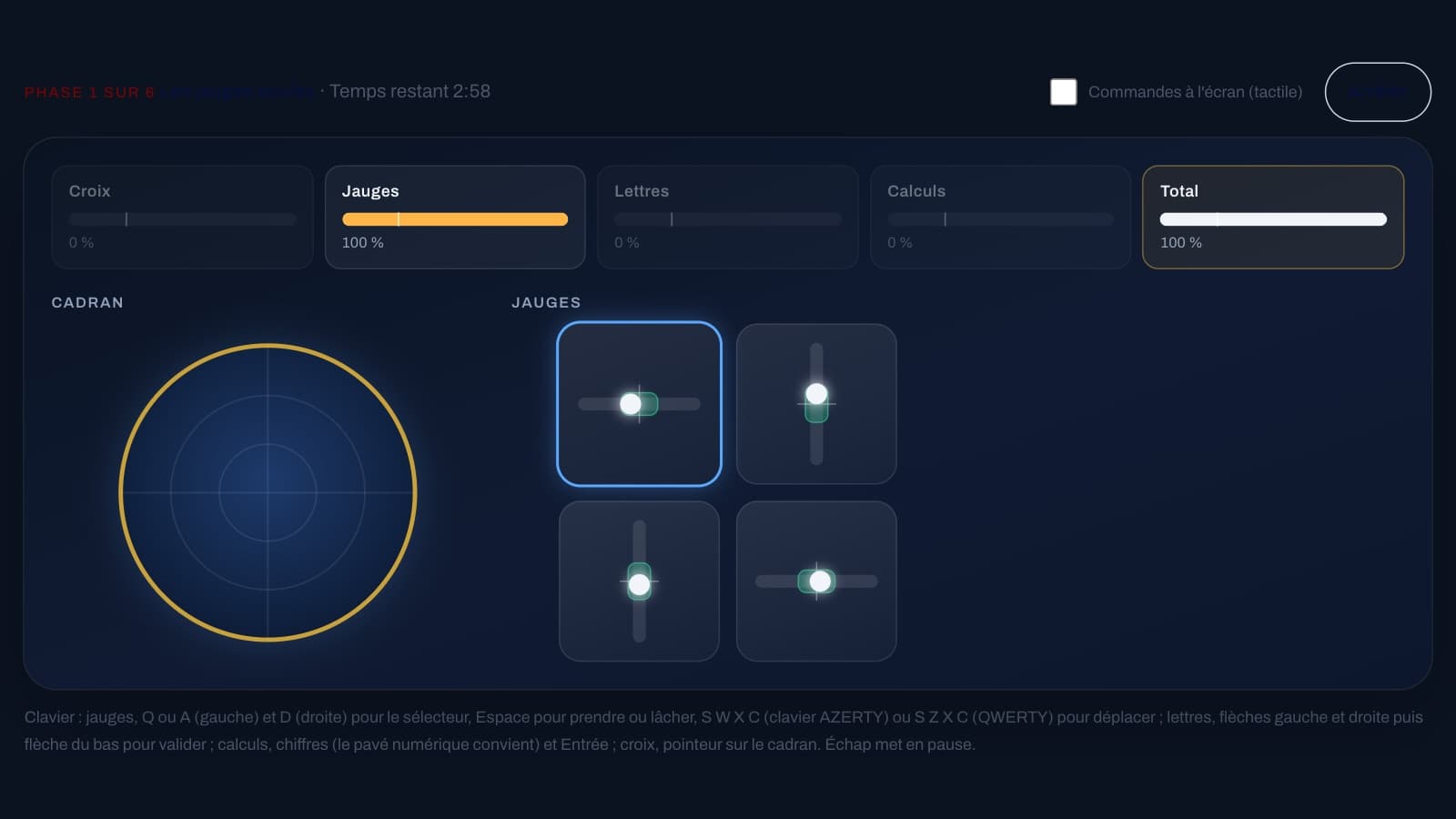
At Air France, becoming a pilot means going through a series of steps with rather clinical names: PSY0, PSY1, PSY2. The most feared of these is PSY1, a full day of psychotechnical and psychomotor testing. Here's what Air France officially says about it, what it doesn't say, and how to prepare without falling for the rumours. Everything below comes from Air France's “Pilote de ligne” page, its “Devenez pilote” brochure, and its announcement of the 2026 cadet campaign: always check the current version before applying, as the rules change from one campaign to the next.
Two routes in: cadets and the professional pathway
Air France recruits its pilots through two routes. The Cadets programme is aimed at candidates without a professional licence: Air France fully funds the training, with an announced duration of 24 months in the June 2026 announcement (the “Pilote de ligne” page states 2 to 2.5 years), under a permanent “contrat de professionnalisation” work-study contract. The professional pathway is aimed at already-qualified pilots, with its own hour and licence requirements.
Both routes go through PSY1 and PSY2. Only cadets also sit PSY0, an online pre-selection stage. According to Air France's page, the 2026 cadet campaign ran from 15 June to 31 July 2026; Air France does not publish the number of places available. Once training is complete, the cadet is assigned either to Air France (A220 or A320) or to Transavia (B737 or A320neo), with no choice in the matter.
PSY0: the cadets' online pre-selection
According to Air France's FAQ, PSY0 is taken remotely, at a time chosen by the candidate within a 36-hour window, and lasts around three hours. It includes an enhanced English test (listening comprehension, reading comprehension and spoken expression), general aeronautical knowledge, and several logic and psychotechnical tests. Candidates must install secure software and have a webcam available; a dropped connection does not cause any loss of progress.
Since the 2026 intake, cadets are no longer required to submit a TOEIC score: the English test built into PSY0 now serves that purpose instead. PSY0 is used to establish a ranking for invitations to PSY1. Be wary of pass-rate figures circulating online: Air France does not publish any.
PSY1: a day of testing at ENAC
According to Air France's brochure, PSY1 takes place over one day on the ENAC campus in Toulouse; for cadets, the “Pilote de ligne” page places it during the Toussaint (All Saints') half-term holidays. Air France describes it only as “various psychotechnical and psychomotor tests”. It does not publish the list of exercises.
This is the key point to bear in mind when reading forums or prep websites: the detailed lists of exercises (n-back, multitasking, mental arithmetic, spatial orientation, and so on) circulating online are not confirmed by Air France. They describe categories of exercises commonly found in pilot selection processes, which makes them good practice material, but not an official syllabus.
At the end of PSY1, each candidate is ranked on a main list, a secondary list, or marked “not admitted”. All candidates on the main list are invited to PSY2; those on the secondary list are invited depending on the airline's needs. In the professional pathway, each result remains valid for two years.
PSY2: group exercise, personality assessment and interview at Roissy
PSY2 takes place at Roissy-Charles de Gaulle, within Air France's selection department. According to the “Pilote de ligne” page, it includes two personality inventories, a group exercise and an individual interview; the brochure, which is shorter, mentions only the group exercise and the interview. Candidates sign a confidentiality agreement covering the group exercises.
A recruitment board then decides between admission and deferral. Air France makes a point worth noting for your budget: according to the airline, paid coaching for the group exercise “has shown no demonstrated benefit in Air France selection processes”.
Eligibility requirements for the cadet programme
According to Air France's page for the 2026 intake: candidates must hold the nationality of a European Economic Area country or Switzerland, be fluent in French, have a clean criminal record, and must never have been eliminated from an Air France or Transavia pilot training programme. In terms of qualifications, one of the following is required: a “bac” (French high school diploma) combined with a valid theoretical ATPL from an approved school, at least one validated year of “classe préparatoire” (excluding literary streams), a science-based qualification at bac+2 level or 120 ECTS credits, or a Master's 1 degree.
A valid Class 2 medical certificate is required when submitting the application (a Class 1 certificate is also accepted), followed by a Class 1 certificate before entering flight school. Candidates must not hold a CPL at the application closing date: only a theoretical ATPL or a PPL are accepted. The application fee is €200, with an exemption for candidates receiving means-tested grants.
There is no age limit. However, Air France notes that the chances of success at PSY0 and PSY1 decrease with age, and that beyond age 35 the risk of difficulty during training rises significantly.
How many attempts are allowed?
The rules for the cadet pathway, as described by Air France: three failures at PSY0 or two failures at PSY1 result in permanent elimination from the cadet route, though the professional pathway remains open. A deferral at PSY2 gives candidates another chance; the board sets the waiting period: one year (retaking only PSY2 at the next intake) or two years (retaking PSY0, PSY1 and PSY2).
In the professional pathway, two failures at PSY1 result in a deferral at PSY2, and since 1 January 2025, two deferrals at PSY2 result in elimination. Pilots on this pathway must also present a TOEIC Listening & Reading score of at least 850 obtained within the last two years, and an ICAO English language level of at least 5. The details are subject to change: re-read the official page before each application.
How to prepare for PSY1
Air France gives no preparation advice for PSY1. What you can honestly do is work on the abilities this kind of day draws on: dividing your attention across several tasks, doing mental arithmetic under time pressure, visualising an angle or a rotation in space, and holding one piece of information in mind while processing another. Consistency is what matters most: short, frequent sessions, tracking your scores, are worth more than one intensive week right before the test.
On ForAllPilots, the Air France - ENAC tab of the psychotechnical tests section brings together exercises of this kind, including multitasking and angles, with a guide detailing the method for each (“Test Psy 1 pilote: multitâche et angles”). These are training exercises, not the official tests themselves: the site is not affiliated with either Air France or ENAC, and the actual rules or scoring may differ.
For PSY0, also revise your English, both comprehension and expression, along with your general aeronautical knowledge: BIA and PPL question banks cover the basics of aviation culture. For PSY2, Coaching Sélection offers a simulated written interview with an AI panel, currently in beta, which of course does not guarantee the outcome of a real selection process.