BIA, PPL & ATPL revision
Wizz Air pilot selection: stages and minima
By ForAllPilots · Published · 4 min read
Reviewed and approved by the site's editor before publication. Our method (FR)
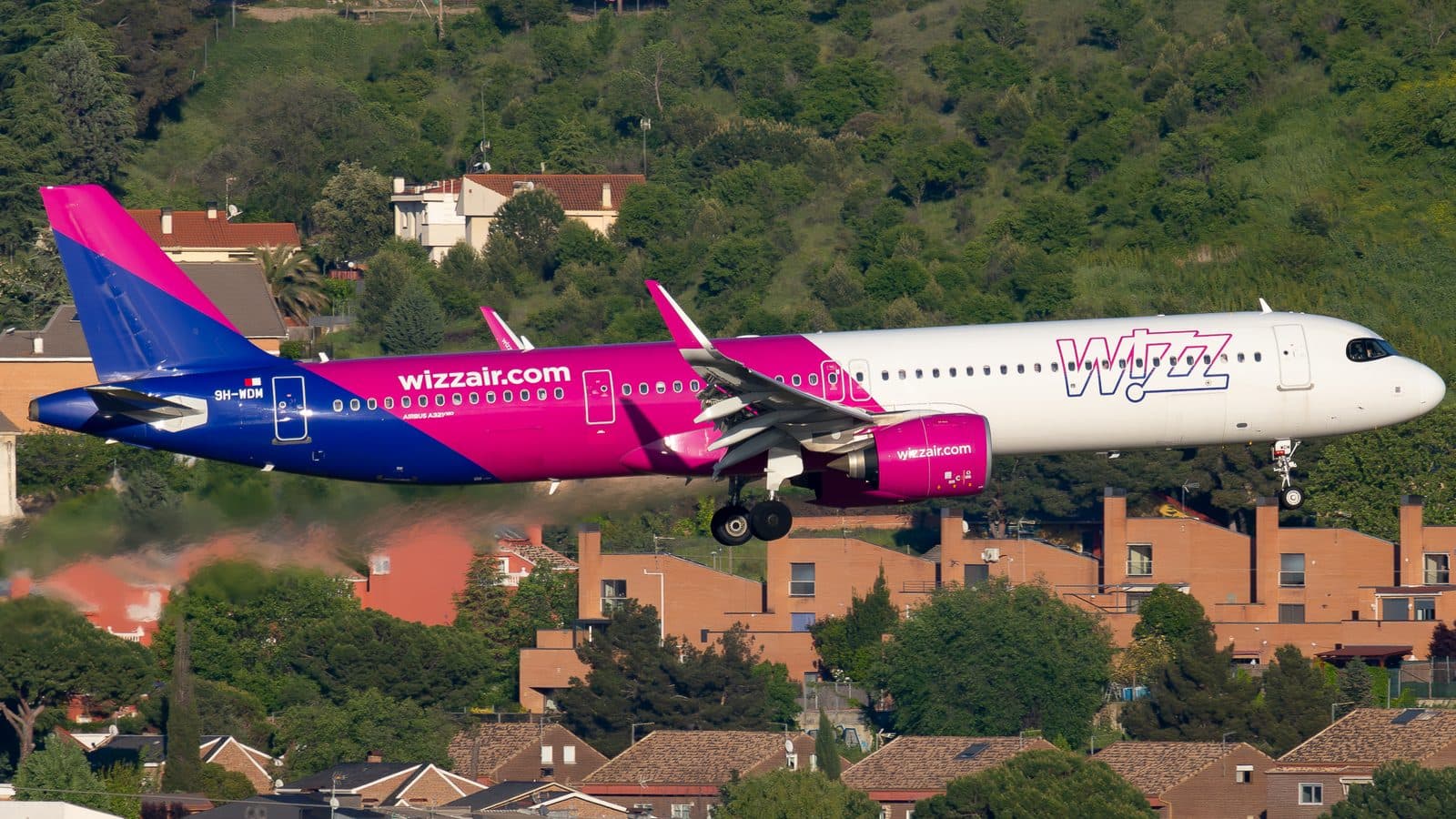
Photo: Lukas Bessert, CC BY 4.0, Wikimedia Commons

Wizz Air recruits pilots at every level, from cadet to direct-entry captain. But not all routes are open to French candidates, and a lot of the information circulating online is out of date. Here's what Wizz Air's careers pages and its July 2026 pilot brochure actually say: the entry routes, the stages of selection, the published minima, and how to prepare. Always check the current online version before applying — the requirements change often.
The entry routes into Wizz Air
Wizz Air states that it recruits “from cadet level to direct-entry captains”. First, there's the Wizz Air Pilot Academy (WAPA), an integrated ab initio course run with the Tréner flight school in Nyíregyháza, Hungary: around 18 months of training, followed by 5 to 6 months of company training, leading to a CPL with ATPL theoretical credits, a multi-engine rating, instrument flying, and a crew-cooperation module.
Next come first officer positions, either at cadet level (newly qualified pilots) or experienced level, with or without an A320 type rating, followed by direct-entry captain positions. Each route has its own minima, detailed further below.
WAPA: cost, commitment and nationalities
According to the academy's FAQ, the ab initio course costs €61,460, of which €13,950 is payable upfront; the remainder is repaid over five years once the pilot is on the line as a first officer, and the last five monthly instalments are waived if the pilot stays with the company for five years. The advanced course (A320 type rating) is billed at €40,000, reduced to €25,000 if the pilot stays with the airline for five years. A guarantor — usually a family member — signs a surety agreement.
An important point for French candidates: the standard WAPA is reserved for nationals of a specific list of Central and Eastern European and Caucasus countries (Hungary, Poland, Romania, Bulgaria, Serbia, Georgia...). France is not on that list. Another ab initio route, announced in September 2026 — the “Wizz Air Pathway Program – URBE” — accepts candidates with the right to live and work in the European Union, but the announcement doesn't specify the flight school, the cost, or the location.
The stages of WAPA selection
After the online application and an initial screening, the academy selection process runs through four stages, according to Wizz Air. First, an online aptitude test, TestAir 360, with a €130 fee: candidates get two months to practise at home (four one-hour sessions), followed by a proctored final exam lasting roughly three to four hours. Next comes an online psychological test.
The final two stages take place on the same day at Wizz Air's training centre in Budapest: a group exercise followed by an individual interview. Travel costs are at the candidate's own expense. A Class 1 medical certificate is not required for the assessment itself, but is required before training begins.
First officers and captains: the four-stage assessment
For already-qualified pilots, the July 2026 brochure describes four stages: a company presentation, document checks and a group exercise (including a technical test for first officer candidates); a combined HR and technical interview; a simulator session, for which Wizz Air specifies that A320 knowledge is not required of pilots without a type rating; and finally an online psychometric test. The assessment runs over two days.
Applications go through a single form and an hours-scoring grid: Wizz Air ranks candidates automatically based on their documents and flight hours, applying coefficients according to aircraft type and role on board. After an unsuccessful attempt, it's the assessors who set the waiting period before a candidate can reapply — no fixed timeframe is published.
The published minima
For the Hungarian or Maltese Air Operator's Certificate, Wizz Air requires the right to live and work in the European Union (or in certain listed neighbouring countries), an EASA ATPL or CPL licence, a Class 1 medical certificate, and a minimum ICAO English level of 4.
For a first officer position at cadet level, candidates need a frozen ATPL and at least 140 actual flight hours on aeroplanes from an integrated course, or 200 hours from a modular course, along with an A320 type rating or, failing that, a multi-engine rating, instrument flying, and Upset Prevention and Recovery Training (UPRT). Microlight, motor-glider, helicopter and simulator hours do not count.
An experienced first officer holding an A320 type rating must have at least 500 hours on the A320; without a type rating, 500 hours on a multi-pilot turbine aircraft in commercial air transport are required. A direct-entry captain must show at least 3,500 weighted hours, with command minima on Airbus or on heavy jets depending on the route.
Where do you fly at Wizz Air?
The careers pages list bases across Central and Eastern Europe (Budapest, Warsaw, Kraków, Bucharest, Sofia...), Italy (Rome, Milan, Naples...), Spain (Madrid, Valencia) and the UK (Luton, Gatwick). No base is listed in France, Belgium or Switzerland. Selection sessions were announced for October in Rome, Madrid and Barcelona, as well as in Budapest.
According to its results published on 6 August 2026, Wizz Air operated a fleet of 270 Airbus A320-family aircraft as of 30 June 2026, including 191 A321neo and 9 A321XLR. This means a career flying entirely single-aisle Airbus types.
How to prepare
For the academy, Wizz Air itself gives some pointers: hand-eye coordination, visual and short-term memory, mental arithmetic, mathematics (fractions, equations, trigonometry), physics (kinematics, forces, energy, electricity), and intermediate-level English; for the interview, motivation, teamwork and communication. Wizz Air also states that it does not recommend any paid preparation courses, and that such courses have no direct bearing on the outcome.
On ForAllPilots, you can work on the relevant skills with psychotechnical tests (mental arithmetic, divided attention, spatial orientation, memory), revise ATPL theoretical subjects with MCQs and the AI Instructor, and practise for the interview with Coaching Sélection — a simulated written interview with an AI panel, currently in beta, which does not guarantee the outcome of a real selection process. The site has no connection with Wizz Air, and its exercises are not the airline's actual tests.