BIA, PPL & ATPL revision
PPL: revising Air Law
By ForAllPilots · Published · 4 min read
Reviewed and approved by the site's editor before publication. Our method (FR)
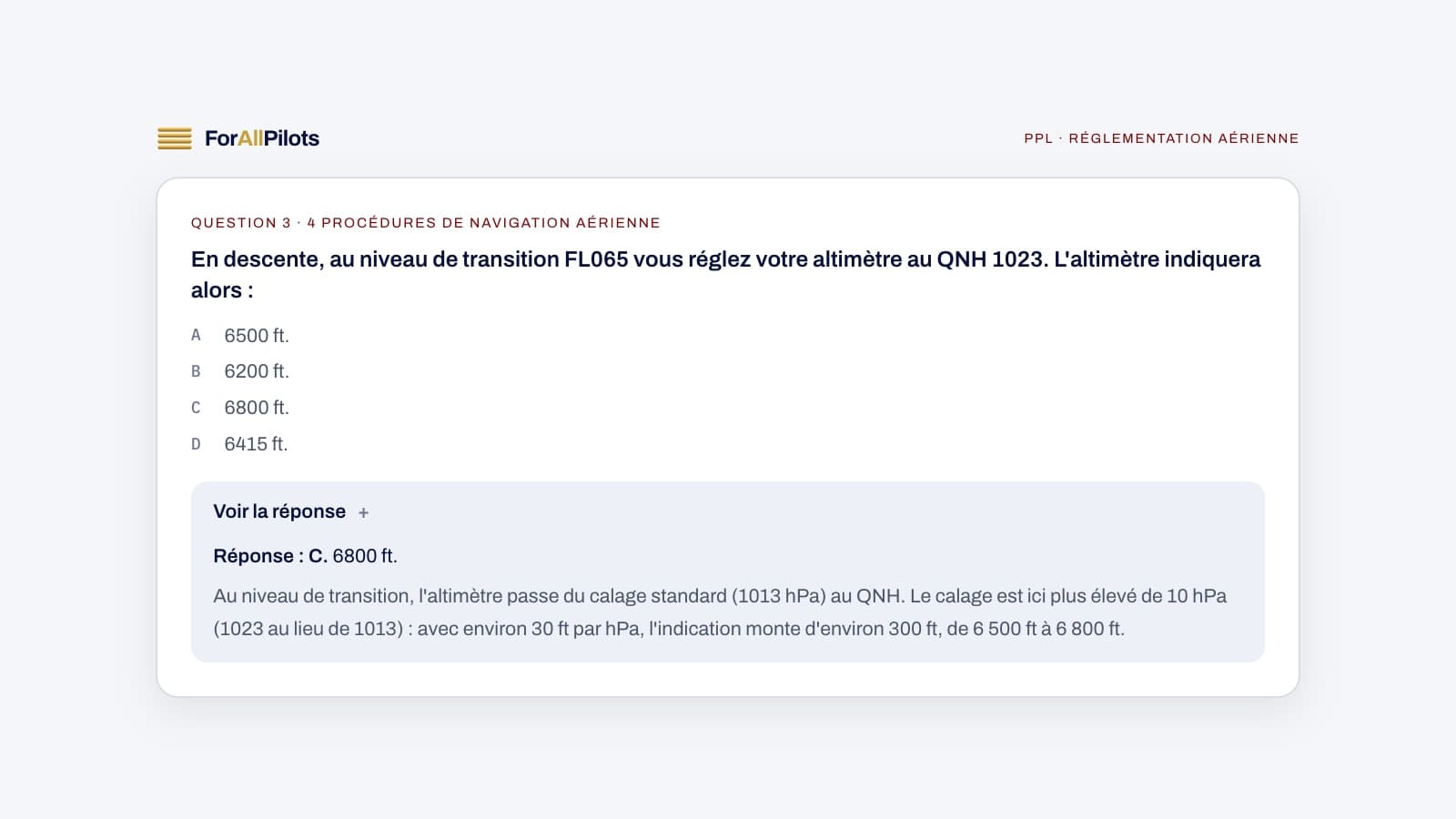
Air Law is a PPL theory subject that many candidates leave until last, assuming it simply comes down to rote-learning text. That's a mistake: what it really demands is an understanding of the logic behind how airspace is organised and what a pilot's responsibilities are. Here's how to structure your revision so it actually sticks.
What the subject covers
Air Law covers the texts that govern VFR flight: the rules of the air, airspace classes, licences and ratings, the documents required on board, right-of-way rules in the air and on the ground, and the weather minima associated with each airspace class. It also deals with aerodrome traffic rules, the status of the various types of regulated airspace, and the pilot-in-command's responsibilities towards the civil aviation authorities.
This subject stands apart from the others in its nature: it isn't built on calculations or physical mechanisms, but on a system of rules that interlock with one another. Understanding how one article refers to another, or how a given airspace class determines particular minima, matters far more than memorising an isolated figure.
Many candidates find it dry because it feels abstract, far removed from the stick and the instruments. Yet it's actually an extremely concrete subject once you connect it to real flying: every rule answers a real flight situation — overflying an area, entering controlled airspace, handling an emergency. Keeping that thread in mind helps make sense of notions that, in isolation, can seem arbitrary.
The concepts most often confused
The first classic confusion is between the different airspace classes: candidates mix up clearance requirements, visibility and cloud-distance minima, and the type of service provided by ATC depending on whether they're in controlled or uncontrolled airspace. It's worth building your own summary table rather than re-reading the same text several times without actually synthesising it.
A second common confusion involves the documents: the pilot's licence, the certificate of airworthiness, the certificate of registration, and the flight manual. Each has its own purpose and validity, and exam questions like to trip candidates up on which document must be carried on board versus which simply needs to exist.
Right-of-way rules make up a third classic trap: who gives way between two aircraft on approach, between a glider and an aeroplane, or during overtaking. These rules seem logical once understood, but they're often learned the wrong way round by analogy with the highway code, which leads to mistakes. Finally, the distinction between prohibited, danger and restricted areas comes up often, since their implications for the pilot are not the same.
Common training mistakes
The first mistake is trying to memorise regulatory articles without linking them to concrete cases. A pilot retains a rule far better by asking how it would apply during a specific flight — crossing a zone boundary, or departing from an uncontrolled aerodrome — rather than by reciting an isolated formula.
The second mistake is neglecting questions that combine several concepts at once, for example a weather situation linked to an airspace class and a right-of-way rule. These questions, which take longer to work through, are often under-practised even though they reflect the real spirit of the exam well.
A third common mistake: revising this subject at the end of your preparation, under pressure, on the assumption that it requires less time than the more technical subjects. In reality, the sheer number of concepts that need linking together justifies spreading the work out and repeating it, not last-minute cramming.
A progressive revision plan
Start with an overview read-through to identify the main blocks: rules of the air, airspace, licences and documents, aerodrome traffic rules. Don't try to memorise everything at this stage — aim instead to understand the overall structure of the subject.
Next, go back over each block in detail and build your own reference points, for example a comparison table of airspace classes or a diagram of right-of-way priorities. Use MCQ sets targeted by topic to check that each concept is understood before moving on to the next, rather than jumping into mixed sets too early.
In a third stage, move on to mixed question sets and timed mock exams, to get used to quickly identifying the relevant rule among several closely related concepts. Keep a regular eye on your results by topic to spot the points you're still getting wrong, and go back over them before the exam rather than leaving them aside.
How to train effectively
Flashcards are especially useful for this subject, as they let you fix precise definitions — such as those for airspace classes or required documents — through short, regular repetition. They work well alongside MCQ sets, which get you used to the format of the questions and how they're worded.
Timed mock exams are useful for simulating real exam conditions and practising your time management on questions that require you to cross-reference several rules. They also reveal the topics where you're still hesitant, which the results page lets you visualise clearly by subject.
The glossary, which is free to access, is a good habit to fall back on whenever a term feels unclear — a type of airspace or a regulatory acronym, for example — so you avoid building your understanding on a rough guess. If a concept remains unclear after re-reading, the AI Instructor lets you ask your question in writing and get a rephrased explanation at any time, which is especially useful for a subject where the overall logic matters just as much as the detail.