BIA, PPL & ATPL revision
ATPL: revising Air Law
By ForAllPilots · Published · 4 min read
Reviewed and approved by the site's editor before publication. Our method (FR)
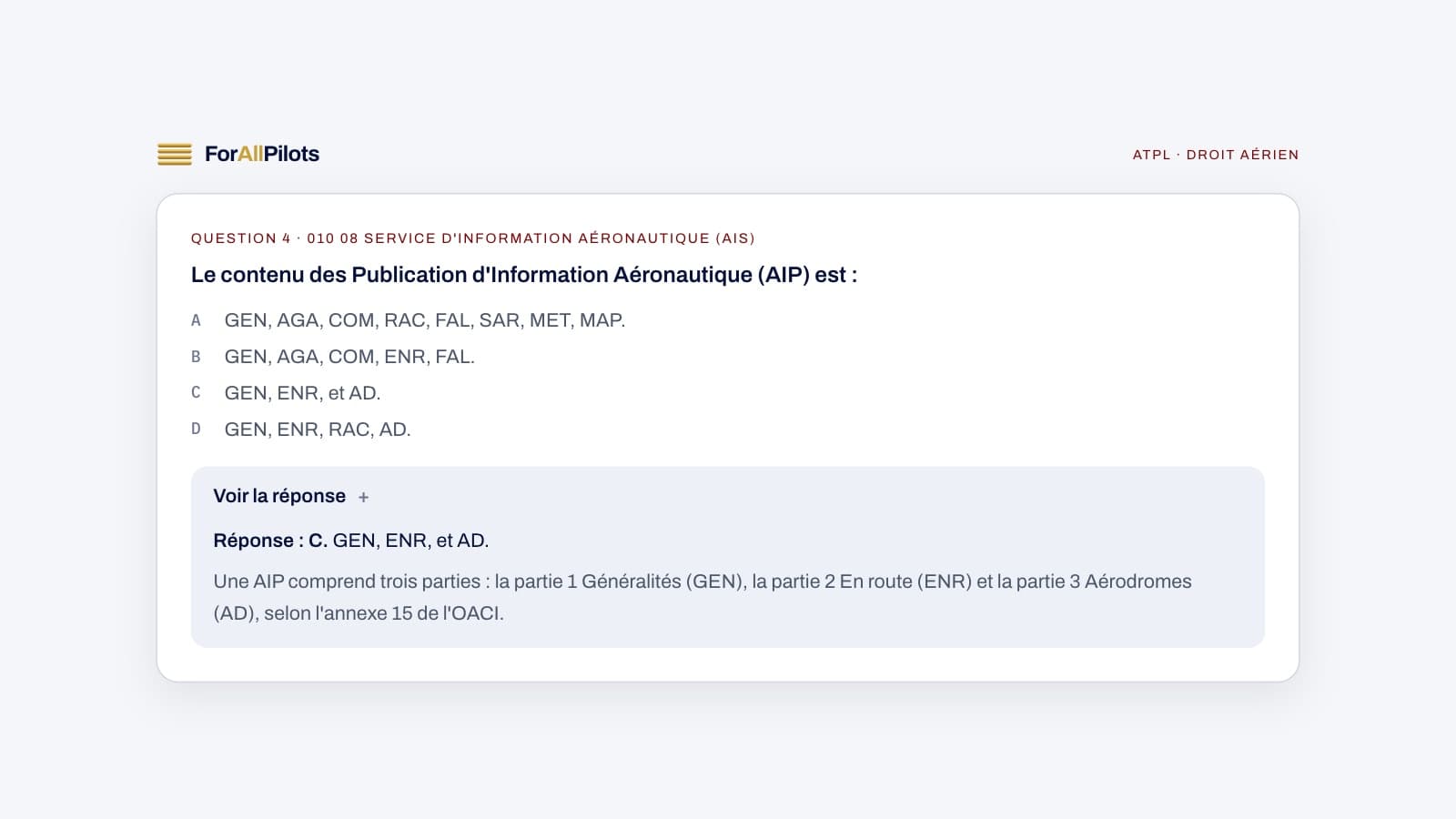
Air Law is an ATPL theoretical subject that many candidates treat as a simple memory exercise. That's a methodological mistake: it rests on an architecture of texts that nest within one another, and it's this logic that needs to be grasped before learning the details. Here's how to structure your revision so you don't get lost in it.
What Air Law actually covers
Air Law at ATPL level covers the organisation of air transport: the international conventions that set the framework, the European regulations derived from them, and the national texts added on top. To this are added the licences and ratings held by flight crew, the rules governing aircraft and their operation, airspace, and the responsibilities of the various parties involved in a commercial flight.
Unlike PPL Regulations, which stay focused on the private pilot and their immediate environment, ATPL Air Law broadens the scope to commercial operations: airlines, operators, maintenance organisations, oversight authorities. The subject therefore requires understanding not just what a text says, but also who it applies to and at what level.
This subject also stands out for its style: reference texts are written in precise legal language, where every word matters. A nuance between “must” and “should”, between an obligation and a recommendation, can tip the correct answer on a prep question. Reading too quickly here costs you points.
The concepts most often confused
The first source of confusion concerns levels of text. A candidate who cannot distinguish between an international convention, a directly applicable European regulation, and a national order ends up mixing up sources and guessing as soon as a question asks which one takes precedence over another. You need to know how to place each rule within its hierarchy, not just memorise its content.
The second confusion concerns the respective responsibilities of the pilot-in-command, the operator, and the oversight authority. These three roles often appear in the same question, with obligations that look similar but apply to different people. Learning “who must do what” is just as important as learning the content of the obligation itself.
The third classic pitfall: definitions. An airspace, a licence category or a type of operation each has a precise definition, and two similar-sounding terms can refer to different realities. Many errors stem from a definition only half-learned — one that was enough for the PPL but no longer suffices at ATPL level.
Common revision mistakes
The first mistake is treating Air Law as a block of text to be learned by rote, without looking for the overall logic. This approach tires you out quickly and is forgotten even faster, since pure memorisation can't withstand the variety of ways a question can be phrased in the exam.
The second mistake is revising this subject in isolation, when it actually overlaps with concepts covered in other ATPL subjects, notably Operational Procedures and Flight Planning and Monitoring. A candidate who links these subjects together retains the material better, because they encounter the same concepts from several angles.
The third mistake, more subtle, is neglecting topics seen as secondary, such as rules specific to certain types of operation or continuing-oversight procedures. These topics come up less often, but it's precisely their rarity that makes them so dangerous: without revision, they turn into easy lost marks.
A progressive revision plan
Start by mapping out the major blocks of the subject: the international organisation of air transport, licences and ratings, aircraft operations, airspace, and responsibilities. For each block, identify the relevant reference texts before learning the details. This organising step will save you time on everything else in your revision.
Then move forward block by block, alternating between reading and practice. After each course section, run a set of MCQs targeted at that same block to check what's solid and what's still unclear. Use flashcards to fix precise definitions and thresholds of responsibility in your memory, as these are the first things to fade over time.
In a second phase, go back over the whole subject with mixed question sets that recombine the blocks the way the actual exam will. Finish your preparation with timed mock exams, to get used to the reading pace that a legal text demands under time pressure. Review your results to spot the blocks that keep coming up as weak points, and rework those as a priority.
How to train effectively
Topic-based MCQ sets are the foundation: they let you progress block by block without spreading yourself too thin, then let you test your solidity with mixed sets once the basics are in place. Flashcards are especially useful for precise definitions and thresholds, which call for faithful memorisation rather than understanding that has to be rebuilt each time.
The glossary, available free of charge, is a good reflex as soon as a term feels unclear: it's better to check a definition straightaway than to half-guess it and hope it won't matter. Timed mock exams get you used to the density of regulatory text under time pressure — a factor often underestimated in unstructured revision.
If a point of logic resists you — for example the hierarchy between two texts, or how two responsibilities fit together — the AI Instructor can help you rephrase it in writing, at your own pace, until the distinction becomes clear. Finally, keep an eye on your results week by week: they'll show you objectively where to focus your final sessions before the exam.