Psychometric tests for pilots
Aviation word problems: speed, time and fuel
By ForAllPilots · Published · 3 min read
Reviewed and approved by the site's editor before publication. Our method (FR)
A speed in knots, a duration in minutes, fuel consumption in litres per hour, a headwind: aviation word problems mix units and set well-known traps. The right answer is rarely hard to calculate, but the wrong answers are built on classic mistakes. Here is how to avoid them.
Read the problem before calculating
Mentally underline what is asked and in which unit: minutes or hours, kilometres per hour or knots, rounded to the metre or to the tenth. Many mistakes come from a right answer given in the wrong unit. Also spot the unnecessary data: a problem statement can contain a number that is never used.
Write the formula down before calculating: distance = speed × time, time = distance ÷ speed, speed = distance ÷ time. These three lines help you set up any speed, time or distance problem.
Conversions to know by heart
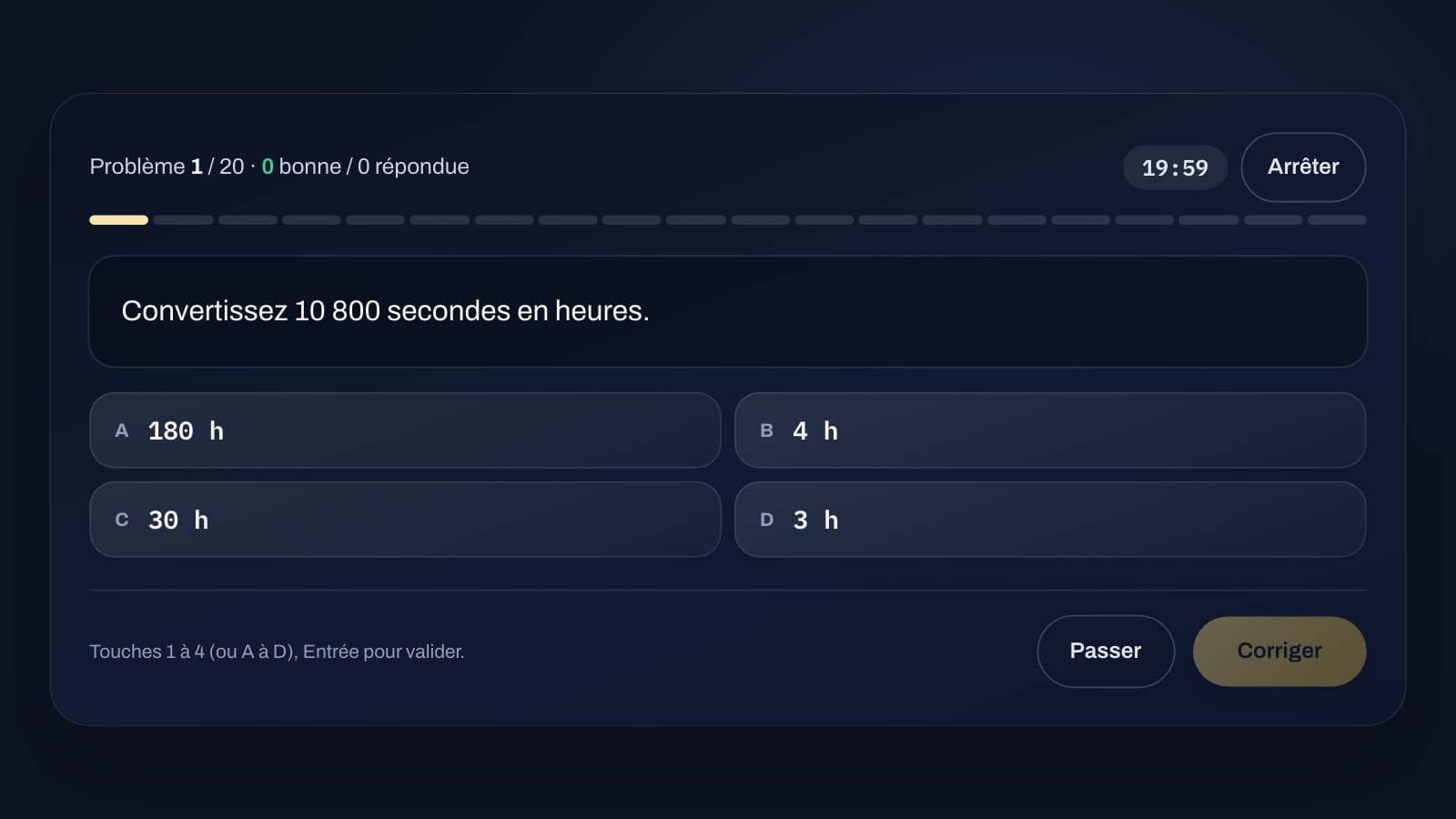
One hour equals 60 minutes and 3,600 seconds: 21,600 seconds make 6 hours. A speed of 5 miles per minute is 300 miles per hour. The knot (kt) is one nautical mile per hour. To convert a decimal duration into minutes, multiply the decimal part by 60: 4.5 hours make 4 h 30 min, not 4 h 50 min.
This last confusion (decimal fractions of an hour mistaken for minutes) is a classic trap, and in some problems one of the wrong answers is built on it. A flight lasting 2.5 hours lasts two and a half hours, never 2 h 50. Be wary of a result such as 4 h 50 for 4.5 hours: it is exactly the answer this trap can offer you.
Heading, wind and true airspeed
With a tailwind, ground speed is greater than true airspeed: ground speed = true airspeed + wind. With a headwind, it is smaller. To find the true airspeed, do the reverse operation: true airspeed = ground speed − tailwind. If you get the direction wrong, the wrong answer will be among the choices offered: check that your result is consistent with the statement.
In turns, a right turn increases the heading and a left turn decreases it. A heading is written with three digits (045°, not 45°); if the result reaches 360° or more, subtract 360°, and if it is negative, add 360°: 233° − 125° = 108°, but 300° + 90° = 390°, that is 030°. For the return heading in a straight line, start from the heading that leads from the departure point to your position: add 180° if it is less than 180°, subtract 180° otherwise. The classic mistake is to keep that heading without reversing it.
Crossing midnight and adding durations
For a flight that passes midnight, break the duration down: from take-off to midnight, then from midnight to landing, and add the two. From 20:42 to midnight is 3 h 18 min; from midnight to 05:06 is 5 h 06 min, so 504 minutes in all. The classic wrong answer is 24 hours minus the result, obtained by forgetting that the flight crosses midnight.
To subtract a duration from a time, convert everything into minutes since midnight, calculate, then convert back. This is safer than reasoning directly in hours and minutes.
Geometry and proportion problems
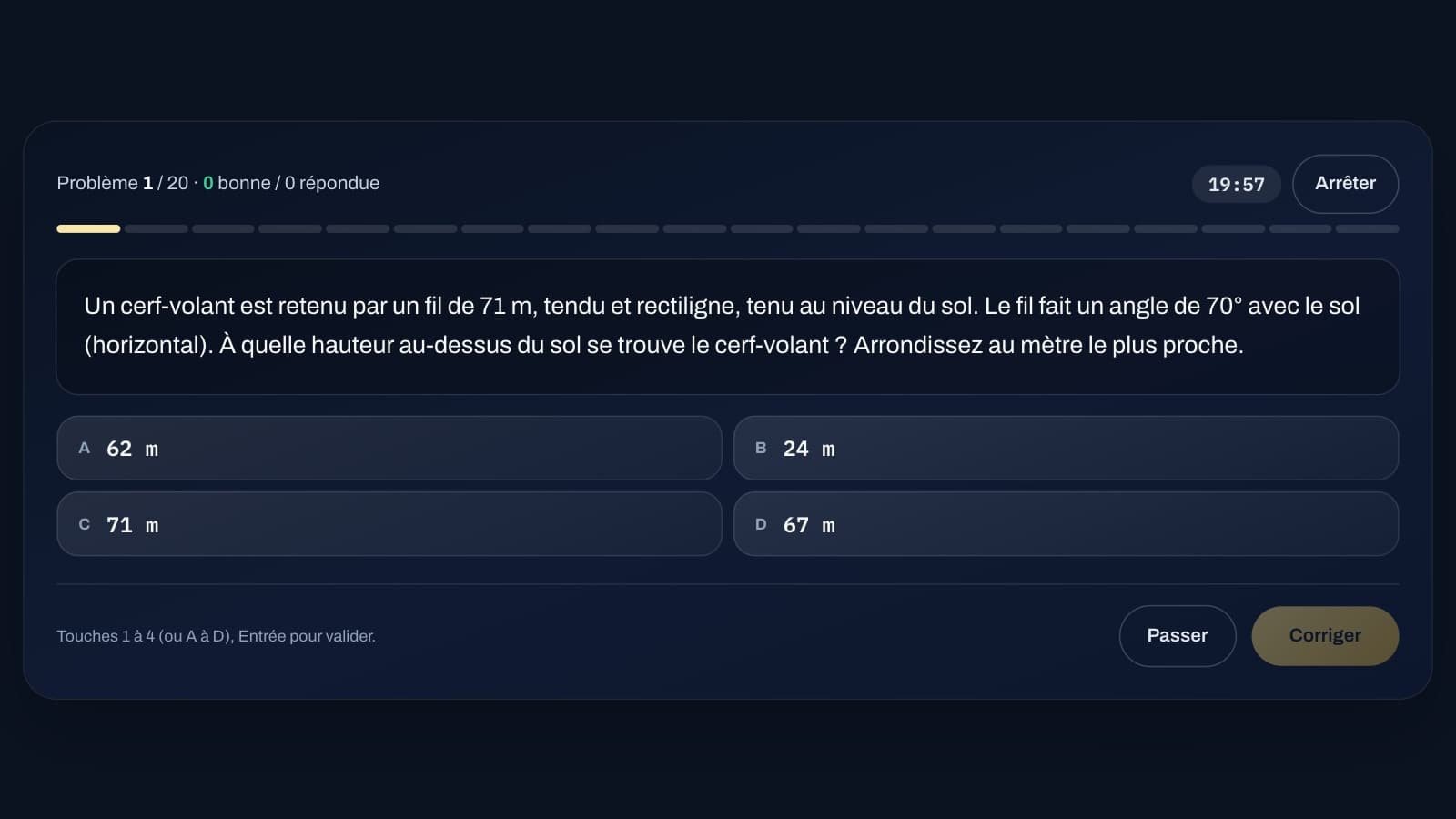
Some problems use an angle and a right-angled triangle: the height of a kite at the end of a string, the length of a mast guy wire, the distance from the foot of a ladder to the wall. Identify the hypotenuse (the longest side, opposite the right angle), then the side you are asked for: opposite or adjacent to the angle. Sine relates the opposite side to the hypotenuse; cosine relates the adjacent side.
For proportions and chains of prices, work back to the unknown starting from the given data: if C costs three times B, then B = C ÷ 3. Finish with a plausibility check: a mast cannot have a guy wire shorter than its height, and a ladder cannot be farther from the wall than it is long.
Practising
Redo problems of each type until you recognise the trap: every problem has its own wrong answers, and spotting them quickly saves you time. On ForAllPilots, the word problems exercise offers 20 problems with four possible answers each, from the easiest to the hardest, to be completed in 20 minutes (the timer is optional). With the “Show corrections” option on, “Check answer” shows the correct answer and the detailed solution after each problem, and the timer stops while you read it; at the end, your mistakes are listed with the correct answer and the solution. It is included with the ATPL subscription; it is practice, not an official test.