Psychometric tests for pilots
Raven-style matrices: finding the rules in a grid
By ForAllPilots · Published · 4 min read
Reviewed and approved by the site's editor before publication. Our method (FR)
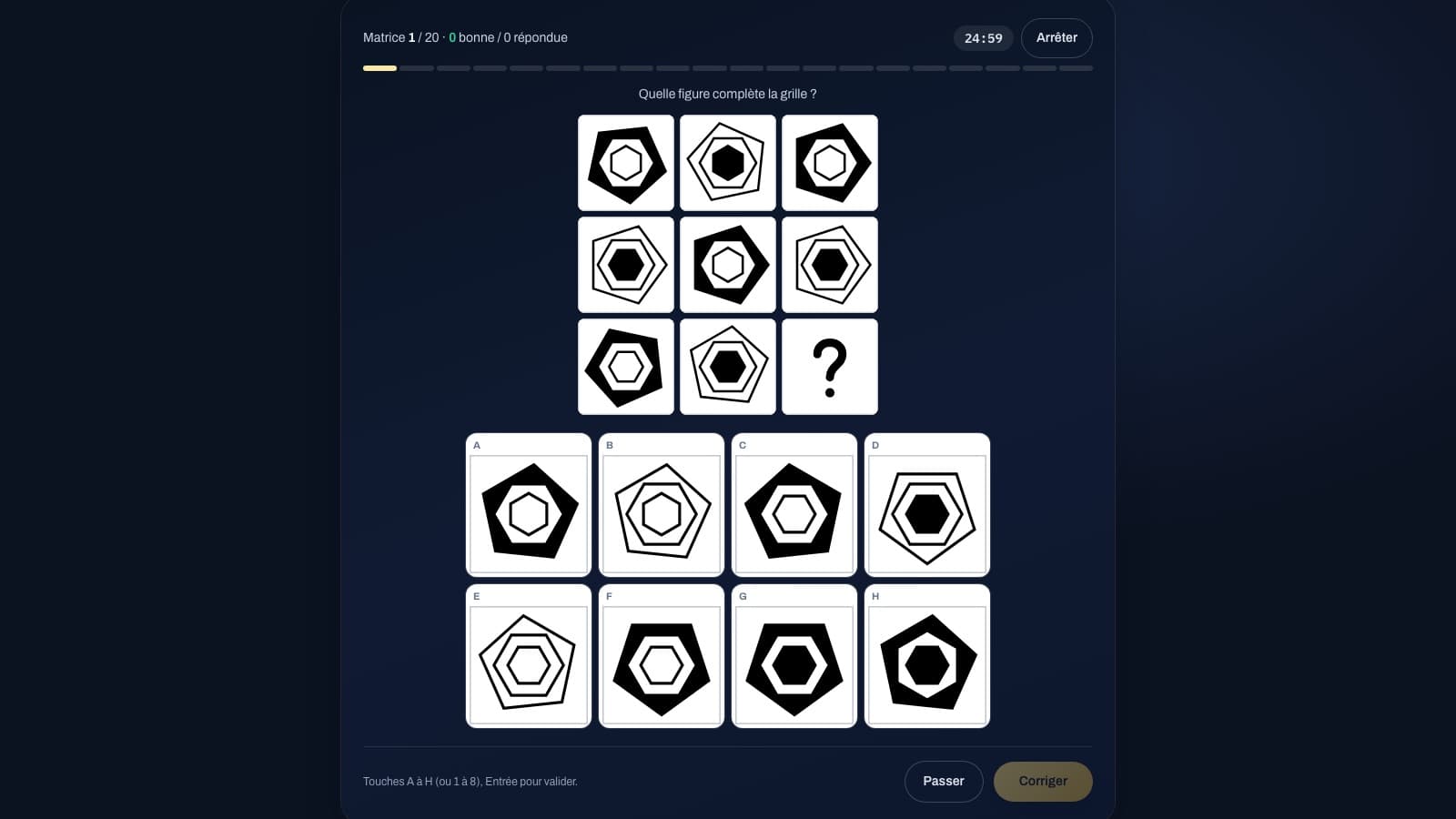
A three-by-three grid of figures with the last cell missing, and eight possible answers: Raven-style matrices train logical reasoning without any text or numbers. They look intuitive, but the method makes all the difference. The idea is not to look at the whole grid and wait for a flash of insight, but to break it down into simple rules and check them one by one.
Break the grid down rather than taking it in as a whole
Each cell in the grid is a drawing made up of one to three objects (tokens placed on the cell, or three nested shapes), and you can track several attributes of each one: its shape, rotation, fill, position and number of sides. Each attribute changes according to its own rule, often a very simple one, as you move through the grid, row by row or column by column.
Pick one object (or one layer, if the shapes are nested) and look at just one of its attributes at a time. You are trying to answer one precise question: what happens to this object from cell to cell? With two to four independent rules, the grid becomes a collection of small, easy problems.
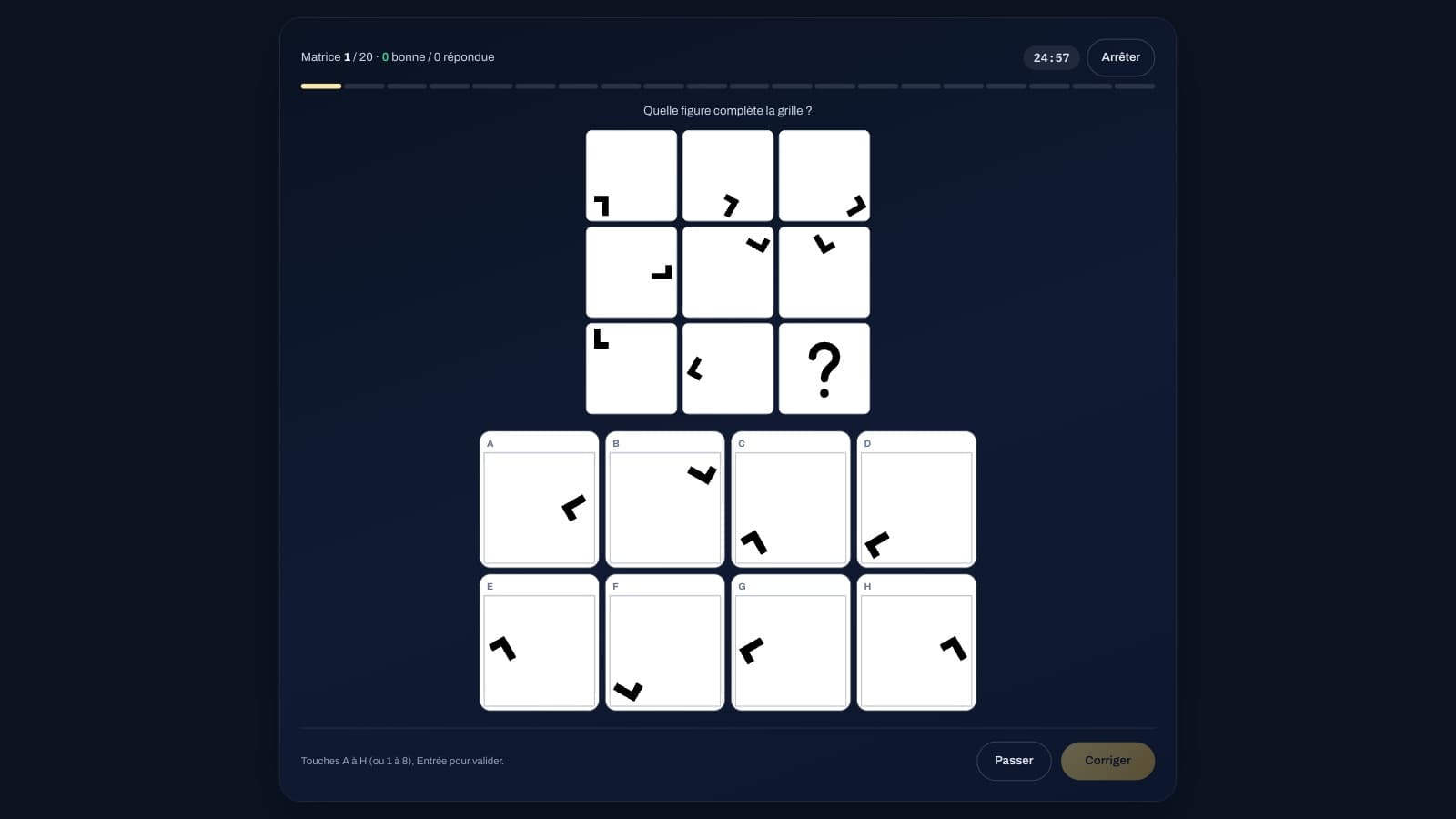
The most common rules
Regular rotation: an object turns by the same angle in each cell (30°, 45° or 90°), always in the same direction. Movement: an object advances by one or three positions along the edge of the cell, or bounces along a line of three positions, setting off in the opposite direction at each end. Alternating fill: an object is filled, then empty, then filled again, or two objects alternate, one being black when the other is white.
Number of sides: it goes up or down by one at regular intervals (a triangle, then a square, then a pentagon), every two or three cells, or from one row to the next. Flipping: an object is flipped vertically in every cell or every other cell, or alternately horizontally and then vertically. Finally, with nested shapes, either a single shape rotates at each step, each in turn, or the total number of sides increases by one in each cell, starting with the outer shape.
Check the reading direction
A rule is read either from left to right, row by row, or from top to bottom, column by column, and the missing cell is the ninth in that reading order. Within a single grid, different rules can run in different directions: test both directions for each one. A rule that changes from cell to cell carries on from one row to the next: the first cell of the second row continues from the last cell of the first row and does not start again from the beginning. If it is the column that is regular instead, switch to the other reading direction.
Think also about rules that compensate for each other: when two objects alternate their fill, one is black when the other is white, so the number of these two objects that are filled never changes. And a correct rule holds across every visible cell, without exception: if it works on the first two rows but not on the third, you have misread it or read it in the wrong direction, so go back to it.
Predict the missing cell before looking at the answers
Once you have identified the rules, draw the missing cell in your head: which shape, which rotation, which fill, which position? Only then look at the eight options. This discipline stops you from being swayed by the answers: each one is built from the correct answer by breaking at least one rule (a rotation off by one step, a figure in the wrong place, an inverted fill), so they look very much alike.
Every wrong answer breaks at least one rule. Work by elimination: first remove those whose fill or position is obviously wrong, then those whose rotation, flip or number of sides is wrong. Only one answer is left that respects every rule. Several wrong answers differ from the correct one by a single attribute only: if two almost identical figures remain, compare them attribute by attribute.
Managing your time and practising
In the ForAllPilots set, you have twenty matrices to work through in twenty-five minutes (the timer is optional), which is seventy-five seconds per grid on average. The first ones are the easiest, with two rules: do not linger on them, so as to keep time for the last ones, which combine four. If you get stuck on one rule, move on to another attribute: finding three rules out of four often leaves two figures in contention instead of eight. A skipped matrix counts as wrong, exactly like a wrong answer, and no points are deducted: it is better to select the most plausible figure than to skip it.
On ForAllPilots, the matrices exercise gives you new grids in every set, and the correct answer is the only one that respects every rule. If you leave the “Show corrections” option on, “Check answer” shows the correct figure and the rules explained one by one after each answer; at the end of the set, your mistakes are reviewed again with their solution. It is included in the ATPL subscription: it is practice, not an official test, and it does not reproduce the test of any school or airline.