Psychometric tests for pilots
Psychometric tests for pilots: where do you start?
By ForAllPilots · Published · 5 min read
Reviewed and approved by the site's editor before publication. Our method (FR)
Divided attention, working memory, logical reasoning, spatial awareness, mental math: psychometric exercises train the way you process information, often under time pressure, rather than what you know. The good news is that they can be practised. Here is how to go about it, in what order, and how to measure your progress without kidding yourself.
What these exercises train, and what they do not measure
A psychometric exercise targets one specific mental ability and works on it through short sets of questions, usually timed, whose difficulty generally rises as the set goes on. It is neither a knowledge exam, nor a medical test, nor an assessment of your flying ability: a good score does not tell you that you will fly well, and an average score on a day when you are tired does not tell you the opposite.
What responds best to practice, on the other hand, is your working habits: staying calm when two tasks overlap, checking your work or rushing, dropping a question that resists you or stubbornly sticking with it. These are what you can work on, set after set.
Five families of exercises to practise
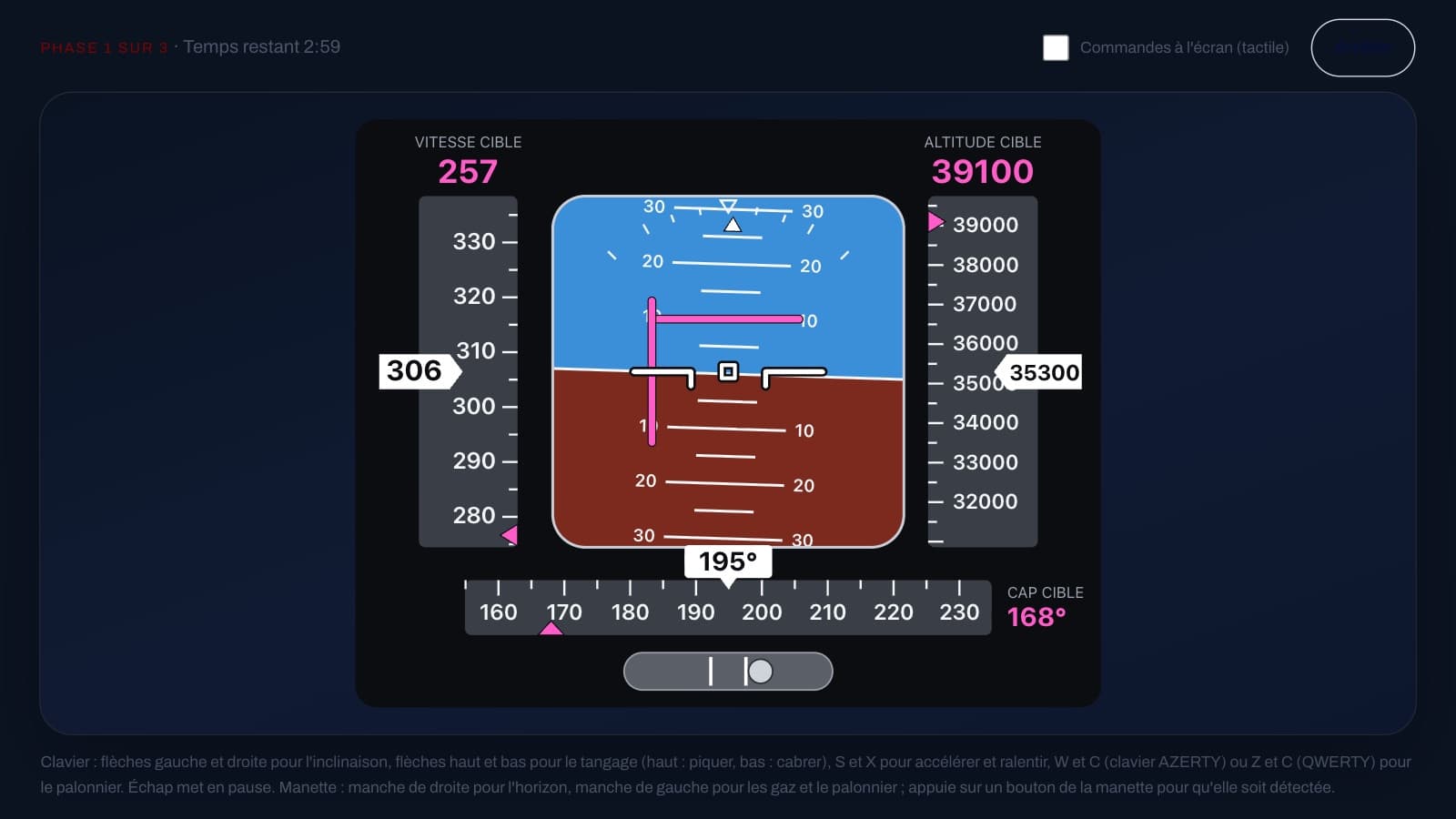
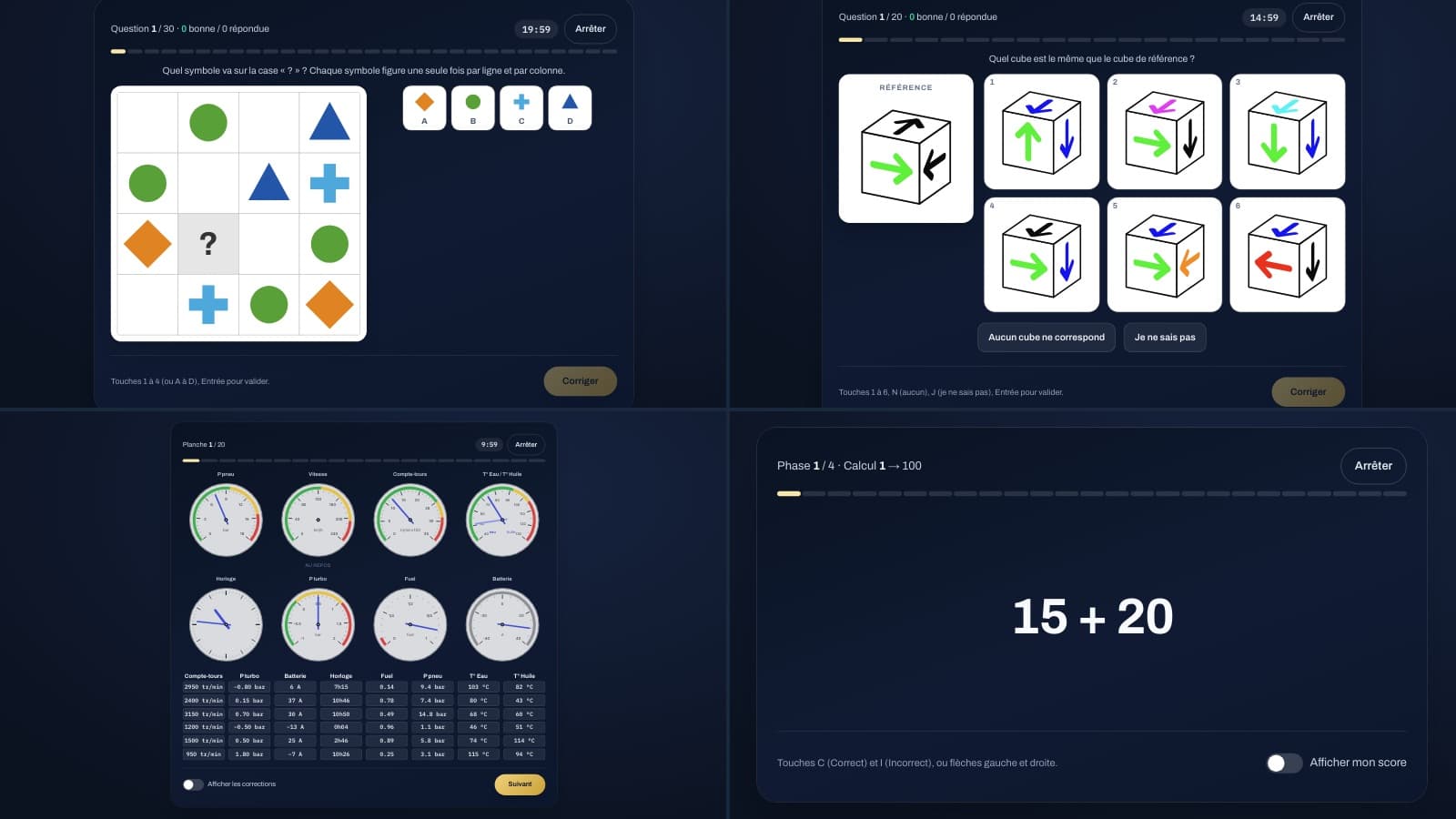
Divided attention: handling several tasks at once, for example keeping gauges centred, keeping a cross inside a moving circle, spotting letters and solving calculations at the same time, or landing aircraft by moving a runway while checking equations and spotting repeated letters. Logical reasoning: finding the hidden law that links three shapes, three words or three numbers, completing a grid where each symbol appears once in every row and column, or choosing the missing shape in a matrix.
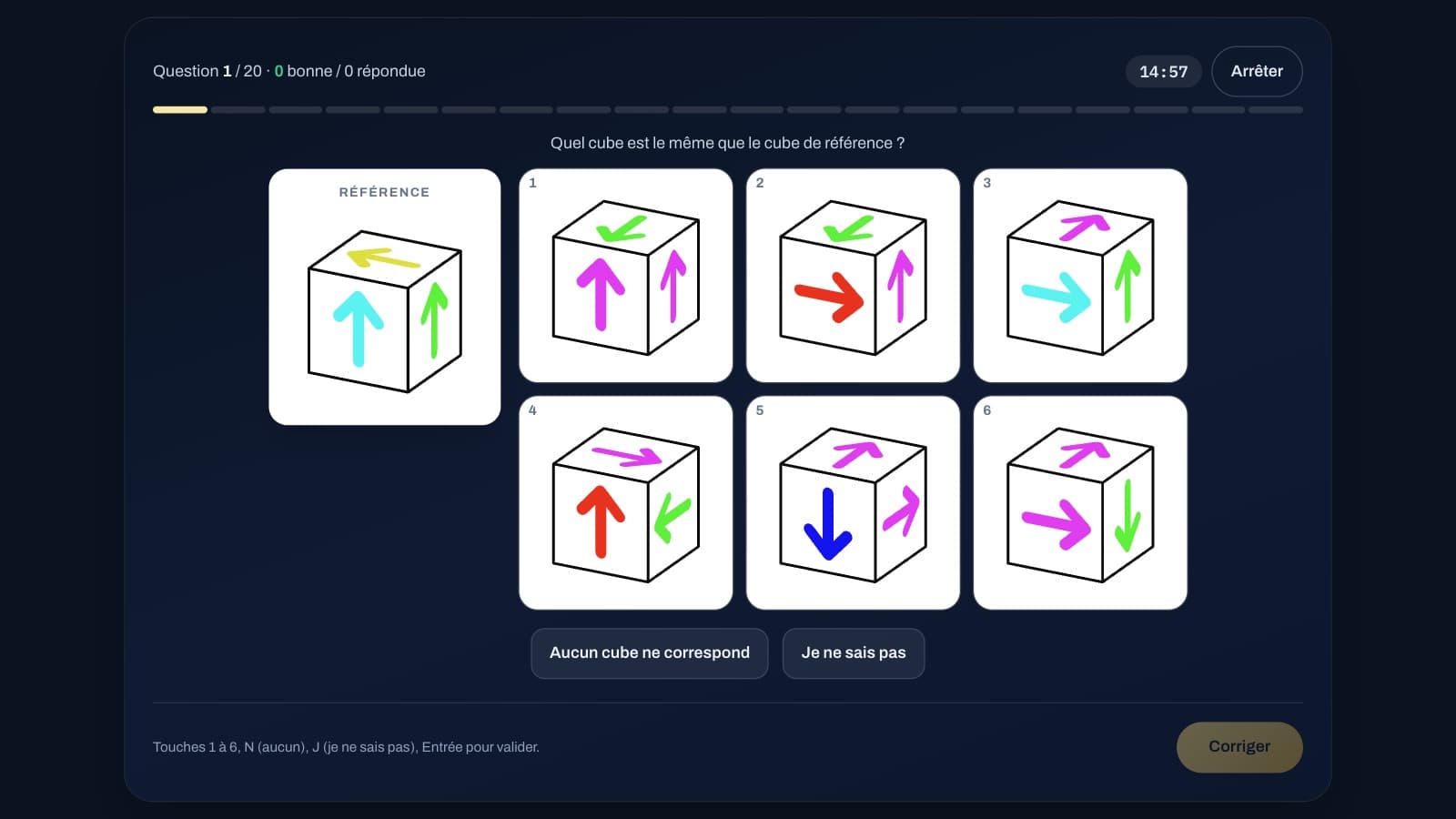
Spatial awareness, in two and three dimensions: finding, among five shapes, the one with the requested angle value in the correct direction of rotation; finding, among six cubes, the one that is the same as the reference cube, rotated in space; mentally folding a cube net; and finding on a map the aircraft described by three dials (heading, bearing to a beacon, bank angle). Mental math and working memory: additions and subtractions without a calculator, word problems on speed, time or fuel, and exercises such as the n-back, where you must hold one result in mind while calculating the next. Finally, instrument reading: reading the value shown by a needle on a dashboard dial, such as a rev counter, a clock or a fuel gauge. Please note that the multitask, angles, Tangram, mental math, EFG, gauges and n-back exercises are currently available in French only, on forallpilots.fr. The others listed here are available in English, in the BQ tab, the CUT E tab and the COMPASS tab.
A three-step training method
Start by exploring the exercises at your own pace: most offer optional corrections (“Show corrections”), which show the correct answer and, depending on the exercise, the law, the deduction or the solution, and several have a timer that you can switch off. The aim is to understand the rule and to see why an answer is wrong. You can lose points not through lack of ability but because you misread an instruction, a direction of rotation or a scoring rule. Exercises with a fixed pace have no timer to switch off: play the multitask exercise one phase at a time, and in the n-back, show your score to see the answer to each calculation.
Then switch the timer on, with no corrections during the set: you get back the pressure of time slipping away. Finally, target your weak points: the breakdown by part in your statistics shows where you lose the most points, and you redo the exercise concerned several times, in short sets, rather than running through all the exercises in the same session. Three well-chosen twenty-minute sessions are worth more than one long, scattered one.
Measuring your progress without fooling yourself
A single result means almost nothing: fatigue, a slipped finger or a set of hard questions can move it by several points. Look instead at your average score and the trend: after a few completed sets, the statistics compare the average of your last three sets with that of the three before. If the trend is rising, your method is working; if it is flat, change something (the strategy, the pace, the exercise you are working on). If you stop a set before the end with the “Stop” button and choose to see your results, it is kept as interrupted and does not count towards your statistics: it does not skew your average.
Some exercises give a class from 1 to 9, those that have a scoring scale; the others give a score as a percentage. Keep in mind that a class obtained in practice depends on the exercise's scale: it does not predict the class in a real selection, whose scale may differ. Use it to compare your sets with each other, not to promise yourself a result.
During the set: pace, fatigue and mistakes
Do your sets rested and with a clear head: these exercises demand attention and quick movements, and a set done while tired tells you little. In a timed set, do not linger on a question that resists you: choose the answer that seems most plausible and move on. A few exercises (the EFG, mental math, matrices, word problems) have a “Skip” button, but it counts as a wrong answer: it saves time, it does not avoid the error. The time lost on a single question often costs more than the point it earns.
Always read the scoring rule. When no answer counts as an error and a wrong answer costs nothing more, as in most sets of questions, it is better to try a plausible answer than to leave it blank. When a wrong answer takes away points, as with the equations and letters in the landing exercise, it is better to answer correctly than to answer quickly. And if you make a mistake, do not dwell on it: in most exercises, the next question does not depend on the previous one, and brooding over a slip costs you concentration for what follows.
Practising on ForAllPilots
The psychometric tests section on ForAllPilots brings together practice exercises from each family: divided attention, reasoning, spatial awareness, mental math and dial reading. They are included with the ATPL subscription, and your results (history, classes, statistics) stay on your device: nothing is sent to a server, unless you ask for a personalised tip yourself, which uses only a numerical summary of the set. As everything is kept in your browser, your history disappears if you clear the site's data, and another device starts from scratch. These are practice exercises, not an official test: they do not reproduce the test of a school or an airline, and they measure neither your medical fitness nor your level as a pilot.