Psychometric tests for pilots
Triangles, Data Processing, Prediction: The Method
By ForAllPilots · Published · 4 min read
Reviewed and approved by the site's editor before publication. Our method (FR)
Three exercises in the DLR series depend on applying a rule quickly or anticipating a movement: triangles, data processing and trajectory prediction. They're rarely failed through lack of understanding, but through hesitation or poor reflexes. Here's how to make them automatic.
Triangles: Two Rules to Apply
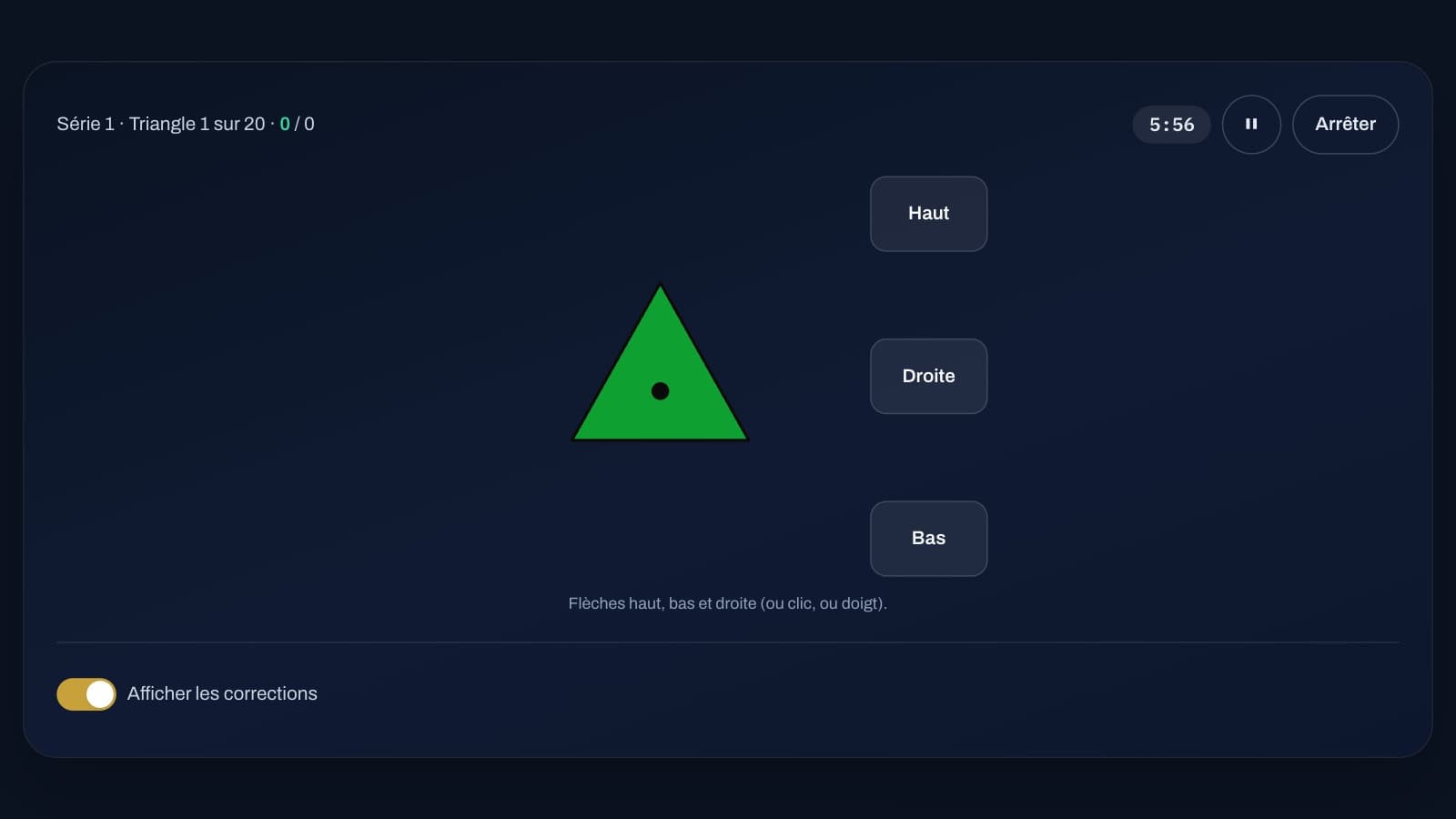
A triangle has a colour (red, blue, green or yellow), a direction (the way its point faces) and a number of black dots, from 0 to 5. At the start of each series, two rules are given, each based on a different characteristic: if the triangle shares that characteristic with the previous one, press the top (or bottom) button. If neither rule applies, press the right-hand button; on the first triangle of a series, there's nothing to compare it to, so it's always the right-hand button.
There are three series of 20 triangles, 6 minutes in total, and the rules change with each series. Repeat the two rules under your breath before starting, then only compare the two characteristics in question: the third one doesn't matter for the current series.
Data Processing: One Colour, One Transformation
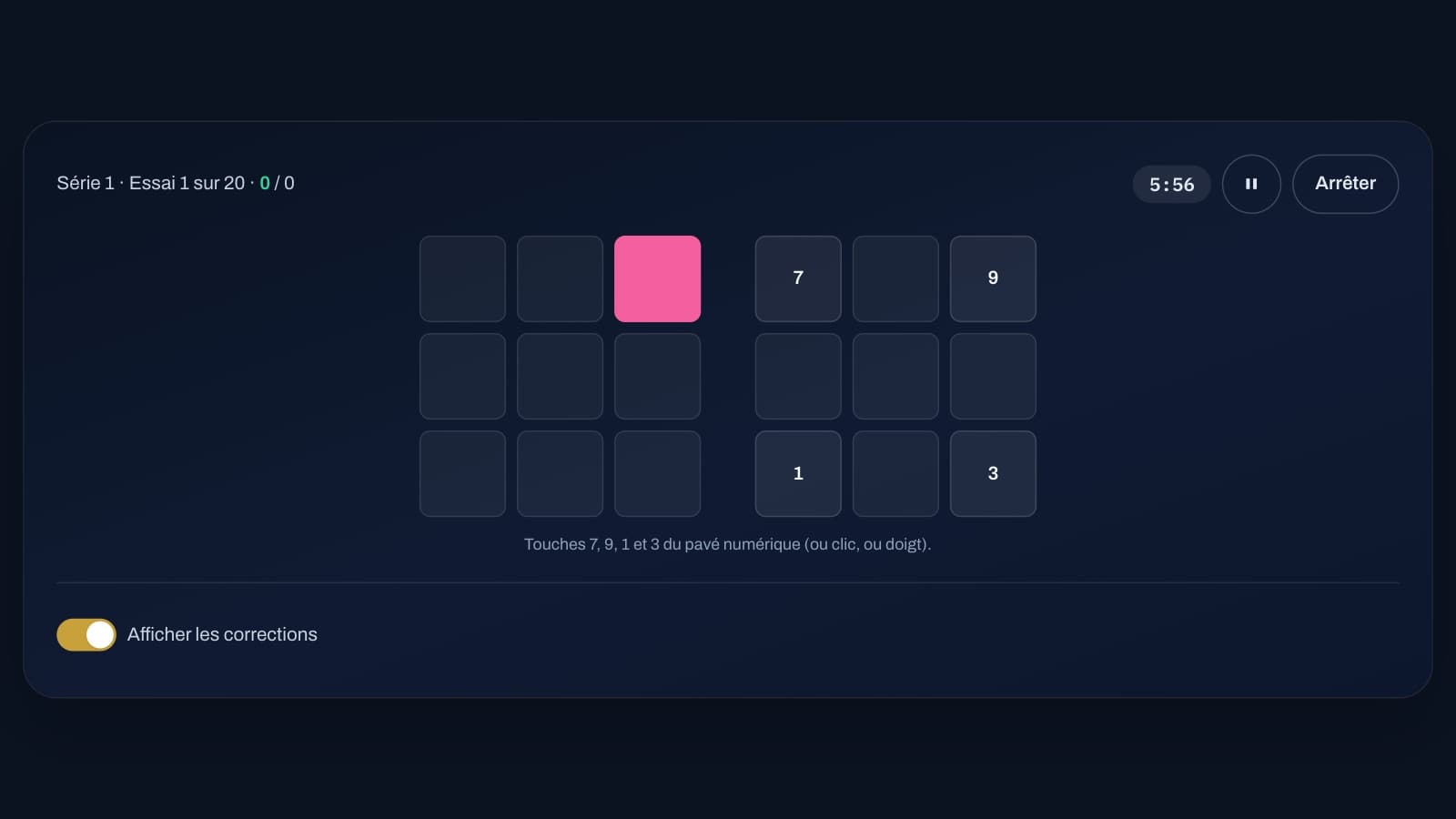
A grid of nine boxes is laid out like a numeric keypad, but only its four corners matter: 7, 9, 1 and 3. A coloured square appears on one of them, and its colour tells you which transformation to apply to find the correct key: the same box, the opposite box on the same row, the opposite box on the same column, or the diagonally opposite box.
Here too, there are three series of 20 attempts in 6 minutes, with new rules for each series. Start with feedback displayed, and learn one colour at a time: once one becomes automatic, add the next, rather than trying to memorise all four at once.
Trajectory Prediction: Remembering the Speed
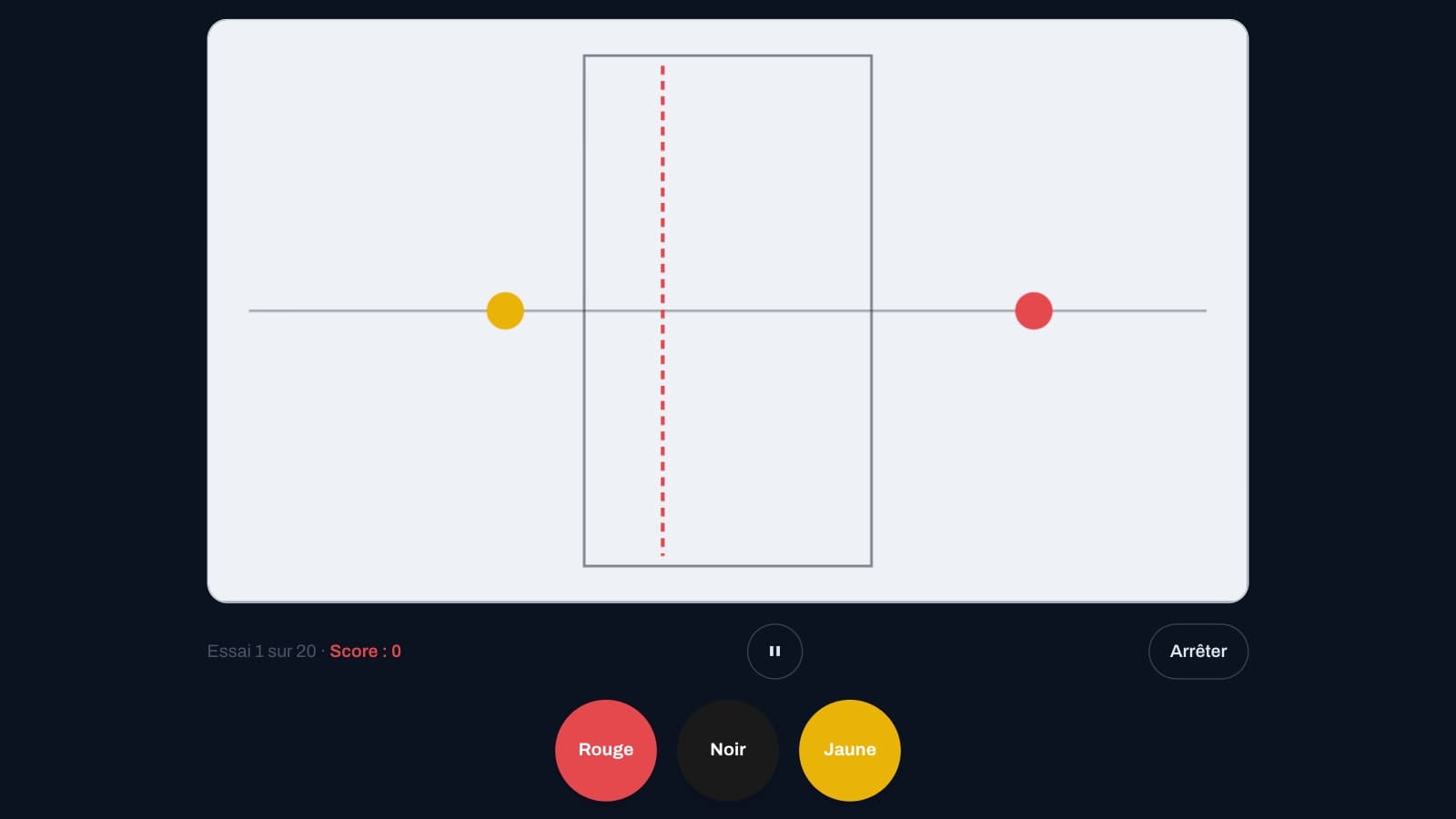
A red ball and a yellow ball enter a corridor from opposite ends, each at its own constant speed, moving toward each other. In the middle, a greyed-out zone hides them: they keep moving, invisible, at the same speed. Depending on the trial, you must press at the exact moment a ball reaches a dotted line of its colour, when it re-emerges from the hidden zone, or, when the two cross paths within the zone, at the moment they cross, using the black button.
Everything hinges on the moment just before a ball disappears: that's when you need to clock its speed, for example by counting how long it takes to cover a visible stretch of the corridor. Pressing too early doesn't count yet, pressing too late means you miss the trial, and only one press counts per trial: if in doubt, wait until you're sure rather than pressing at random.
Making the Rule Automatic
These three exercises reward consistency more than raw speed: a fast, correct answer comes from a rule that has become automatic, not from working it out afresh on each trial. Start slowly, with feedback displayed when the exercise offers it, then speed up once you stop making mistakes.
In the triangles exercise, don't under-use the right-hand button out of reflex: it's often the correct answer. In data processing, check the colour before the position, not the other way round. In the prediction exercise, run several series back-to-back to get used to the duration of the hidden zone.
The Most Common Mistakes
In the triangles exercise, the classic mistake is keeping the rules from the previous series: they change every series. The other is comparing a characteristic that isn't part of the two current rules, or forgetting that the first triangle of a series always calls for the right-hand button.
In data processing, the most common mix-up is between the opposite box on the same row and the opposite box on the same column: pick a fixed anchor ("row means horizontal") and repeat it at the start of each series. In trajectory prediction, the most frequent error is pressing too early out of impatience, even though an early press doesn't count and only one press is registered per trial.
A Simple Training Plan
For the triangles and data processing exercises, do a first series with feedback displayed, taking the time to check each answer, then run through series without feedback, watching your score per series in the results. Since the rules change every series, what really improves is the speed at which you pick up a new one.
For prediction, run two or three series of 20 trials back-to-back: the consistency of your timing improves quickly once the duration of the hidden zone becomes familiar. The result shows your average reaction time on successful trials, a good indicator of that consistency.
In the DLR Series
These exercises sit alongside spatial tests (cube folding, 2D and 3D orientation, maze) and sustained-attention tests (vigilance, gauges) in the DLR series: alternating between families from one session to the next avoids repeatedly tiring the same ability.
These exercises are included with the ATPL subscription: they are training tools, not official tests, and are not linked to the selection test of any school, organisation or airline — the exact rules or scoring of a real selection process may differ.