Psychometric tests for pilots
ENAC EPL Competition: Stages and Psychotechnical Tests
By ForAllPilots · Published · 8 min read
Reviewed and approved by the site's editor before publication. Our method (FR)
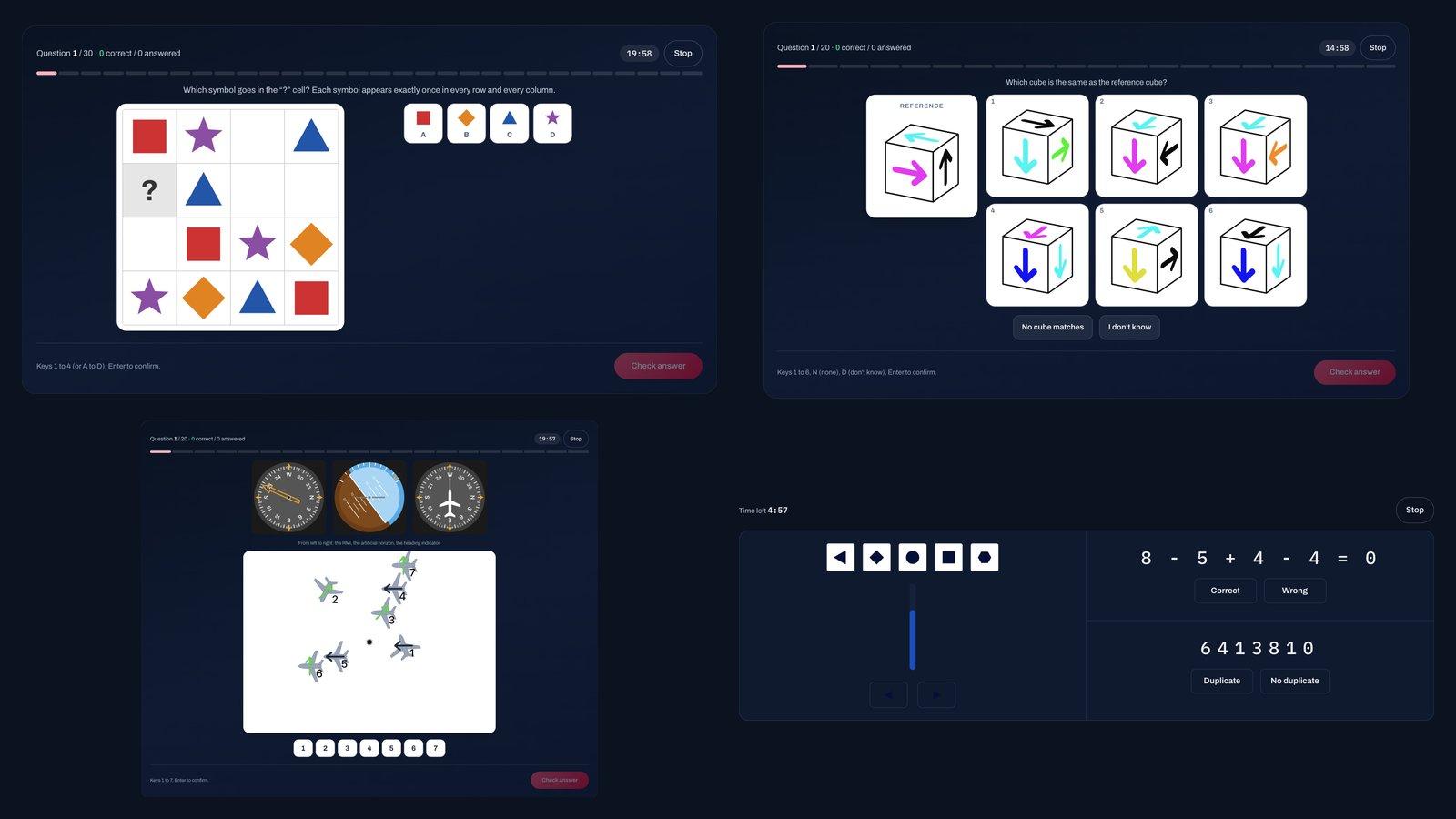
Every year, the ENAC's EPL competition selects the airline pilot cadets trained by the École nationale de l'aviation civile, a programme whose technical costs are covered by the school. Three separate competitions coexist, EPL/S, EPL/U and EPL/P, and all of them go through the same admission stages in Toulouse: psychotechnical and psychomotor tests, psychological assessments, an English oral exam, then a class 1 medical examination. Here is the full process, step by step, based on ENAC's official 2026 notices, along with how to prepare for it.
EPL/S, EPL/U, EPL/P: which competition is right for you?
The EPL/S competition is aimed at science students. You must be a national of the European Union or the European Economic Area, be over 16 and under 23 years old on 1 January of the year of the competition, and have completed a course of study equivalent to 60 ECTS credits: a classe préparatoire aux grandes écoles, a science degree (licence), or a course leading to a level 5 national diploma in science and technology. For 2026, ENAC was expected to offer 14 places. Registration was open from 1 December 2025 to 30 January 2026 at midnight, and the written exam took place on Tuesday 31 March 2026.
The EPL/U competition is aimed at candidates who already have an aeronautical background: a Bac+3 degree, a BTS or DUT in a scientific or technological field (or 120 ECTS credits with a valid ATPL(A) theoretical knowledge certificate), a valid LAPL or PPL licence (aeroplane, helicopter or glider) with a current rating, and a pass in the FCL .055 D English exam. You must be over 17 and under 28 years old on 1 January of the year of the competition. In 2026, probably 4 places were available, with the same registration dates as EPL/S and a deadline for submitting documents of 7 February 2026 at 5 p.m.
The EPL/P competition is aimed at holders of the baccalauréat who also hold a CPL(A) professional pilot licence, a valid class or type rating, a class 1 medical certificate, ATPL(A) theoretical exams dated less than 18 months ago (this time limit does not apply if you hold a valid IR(A)) and the FCL .055 D. You must be over 18 and under 30 years old on 1 January. In 2026, probably 2 places were available, with registration open until 31 March 2026 and a deadline for submitting documents of 7 April 2026.
For all three competitions: registration is only possible via concours.enac.fr, with a registration fee of €190 payable by credit card (free for scholarship holders funded by the French government), and no refunds in the event of withdrawal. You may only apply to one track per year, and no more than three times to the EPL competition across all tracks combined; the EPL/S notice specifies that only attempts that resulted in elimination at an admission test actually count. In 2025, EPL/S had 1,537 registered candidates for 14 successful ones, EPL/U had 81 registered candidates for 4 admitted, and EPL/P had 15 registered candidates for 2 admitted.
Stage 1: the written eligibility exams
For EPL/S, eligibility is decided over a single day of written exams, generally held in around twenty cities (Paris, Toulouse, Lyon, Bordeaux, Lille, Marseille, Nantes, Strasbourg and others, as well as the French overseas departments and territories), with a centre opening depending on the number of candidates registered there. There are three exams of 2 hours each, coefficient 1, marked out of 20, which may be set wholly or partly in multiple-choice format: mathematics (first-year PCSI prépa syllabus), physics (first-year MPSI prépa syllabus) and English.
Each exam carries an eliminatory threshold: under 5 out of 20 in mathematics or physics, under 10 out of 20 in English. The written English exam consists of a series of vocabulary and language structure questions, on topics from everyday life or general current affairs. In 2025, 131 candidates out of 1,537 registered were shortlisted (“sous-admissibles”) after the written exams; among the 14 successful candidates, 8 came from second-year science prépa, 3 from first year (PCSI or MPSI) and 3 held an engineering degree.
For EPL/U, there is no written exam but a file-based preselection: the panel reviews the candidate's scientific level based on all higher education transcripts (particularly in mathematics and physics) and their motivation based on a cover letter and a CV. It awards a mark out of 20, ranks the candidates and sets the number of pre-admitted candidates called for the following tests. The notice does not describe any preselection stage for EPL/P.
Stage 2: the psychotechnical and psychomotor tests
This is the first admission test, common to all three competitions. Eligible candidates are called to ENAC, in Toulouse, for a day of computer-based tests: between 18 and 22 May 2026 for EPL/S, and on 18 or 19 May 2026 for EPL/U and EPL/P. This day is eliminatory.
According to the notice, these tests assess candidates' ability to follow the theoretical and practical training provided by ENAC and to work as an airline pilot within an airline. They require no specific prior knowledge: this is not about revising a syllabus, but about applying certain abilities (processing speed and accuracy, memory, attention, coordination) within a limited time frame.
ENAC does not publish the detailed content of the exercises. So rather than working from a fixed list, focus on the broad categories of ability assessed by pilot selection tests, and get used to switching between different exercises over a full day. If you are also registered for other competitions, the EPL/S notice asks you to mention them at the time of registration, to help with scheduling this test day.
Stages 3 and 4: psychological assessments and the English oral exam
Depending on your results in the psychotechnical and psychomotor tests, you are called back to Toulouse for a second day: between 15 and 19 June 2026 for EPL/S, and on 15 or 16 June 2026 for EPL/U and EPL/P. This day brings together the psychological assessments and the English oral exam.
The psychological assessments include group exercises, observed by a panel of examiners made up of at least one pilot and one psychologist, followed by separate interviews with the psychologist(s) and the pilot(s). They assess the non-technical skills needed to complete the training, to work as part of a crew, and ultimately to serve as commander. No specific prior knowledge is required. At the end, the examiners issue an assessment: unfavourable (the candidate is eliminated), favourable, or highly favourable.
The English oral exam lasts a maximum of 15 minutes. A file contains four sections of a spoken news bulletin; after 20 minutes of preparation, you give the examiner an accurate, detailed oral summary of two of them. You may take notes, but you must neither write out your presentation in full nor read it aloud. The examiner then starts a conversation, either on a topic from your summary or on another subject. The exam is marked out of 20 (listening comprehension and spoken expression) and any mark below 10 out of 20 is eliminatory. For EPL/U and EPL/P, this is the only marked admission test.
EPL/P candidates also sit an additional day of assessment on an FNPT flight training device, covering handling, cockpit organisation and conduct of the flight. This test is eliminatory and lasts about 45 minutes.
The final ranking is established in two groups: group A brings together candidates who received a highly favourable assessment, group B those who received a favourable assessment, and group A is ranked first. Within each group, EPL/S candidates are ranked according to their combined results in the written exams and the English oral (in the event of a tie, the better mark in the English oral, then in the written English exam, acts as a tiebreaker); EPL/U and EPL/P candidates are ranked according to their English mark.
Stage 5: the medical examination, then training
Based on the full set of results, successful candidates (EPL/S and EPL/U, EPL/P candidates already holding their class 1 certificate) are called in July for the class 1 medical fitness examination, at the CEMPN in Toulouse-Blagnac. This examination is a condition for starting training. ENAC asks candidates to review the class 1 medical standards in advance, published on enac.fr under the Formations/EPL section: it is better to clear up any doubts before committing to the competition.
The training programme is an integrated commercial air transport pilot course lasting about 24 months. The theoretical part, taught in person at ENAC, covers air law, general aircraft knowledge, performance and flight planning, human performance, meteorology, navigation, operational procedures, flight mechanics and communication. The practical part, held at ENAC's training centres, prepares candidates for the CPL(A) professional pilot licence, the multi-engine aeroplane instrument rating (IR), and the MCC (multi-crew cooperation) training certificate. Successful EPL/U candidates follow the full training programme, on the same schedule as EPL/S graduates of the same year.
All technical training costs are covered by ENAC. You remain responsible for tuition fees of €1,500 per year, as well as accommodation and meals; accommodation may be offered, subject to availability, at the centres in Biscarrosse, Carcassonne, Grenoble, Saint-Yan and in Toulouse, but not in Montpellier. A means-tested maintenance grant is also available. Note: a student may be eliminated at any point during training if found unfit to continue it normally, and a graduate who is excluded may not sit the competition again.
Preparing for the EPL competition with ForAllPilots
For the EPL/S written exam, ENAC publishes past papers online at enac.fr, under the Formations/EPL section. ForAllPilots compiles them on its ENAC past papers page, covering mathematics, physics and English, so you can practise with previous years' papers under multiple-choice and timed conditions, and identify which first-year prépa syllabus topics need extra work.
For the day of psychotechnical and psychomotor tests, ForAllPilots' psychotechnical test hub brings together exercises in mental arithmetic, memory (n-back), cube and spatial orientation tasks, multitasking, angles, gauges and Raven's matrices, with tracking of your scores. Practise in short, regular sessions, reading each instruction in full, then do a few longer sessions to build the concentration needed for a full day.
For English, which matters both in the written exam (eliminatory mark below 10 out of 20), in the oral exam (eliminatory mark below 10 out of 20) and in the ranking, ForAllPilots' FCL 055 English section offers listening exercises and multiple-choice questions to work on listening comprehension and vocabulary. Also practise summarising English-language news bulletins out loud, in a few minutes and without reading your notes: this is exactly the format of the oral exam. For EPL/U and EPL/P, a pass in the FCL .055 D is a registration requirement in any case.
Finally, keep an eye on the calendar: the notices and dates for the next session are published on concours.enac.fr, and the list of documents to submit (transcripts, licences, certificate of participation in the Journée défense et citoyenneté for those under 25) means you need to plan ahead. Sources: official ENAC 2026 notices “EPL/S Pilote de ligne” and “EPL/U & EPL/P Pilote de ligne” (concours.enac.fr, documents with no contractual value).