Psychometric tests for pilots
Cube tests: comparing and folding methodically
By ForAllPilots · Published · 3 min read
Reviewed and approved by the site's editor before publication. Our method (FR)
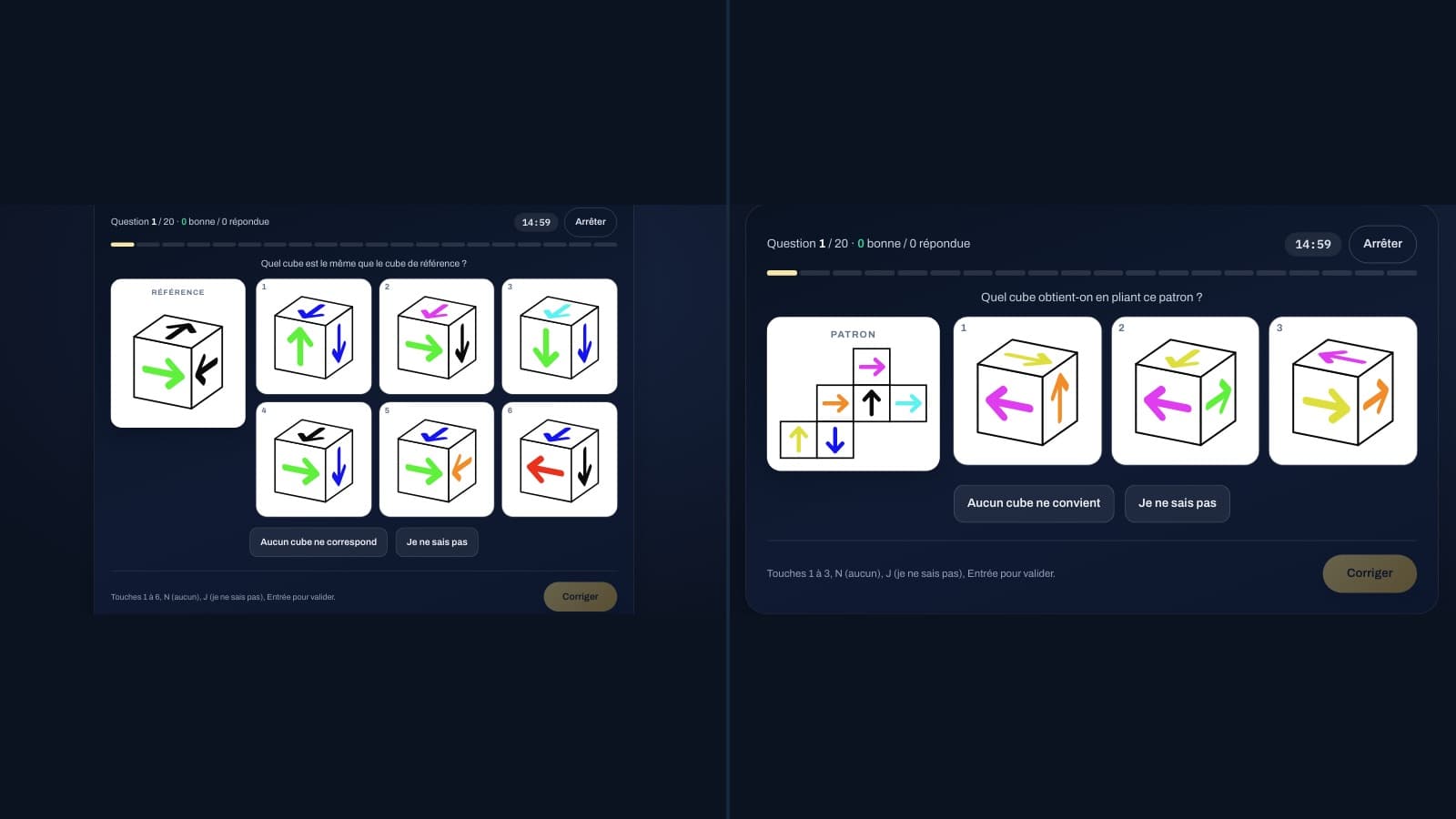
Two spatial visualisation exercises use cubes: cube comparison (is it the same cube, turned in space?) and the cube net (which cube do you get when you fold it up?). They have one thing in common: instead of picturing everything at once, you have to reason face by face. Here is a method for working through them step by step.
Cube comparison: the principle
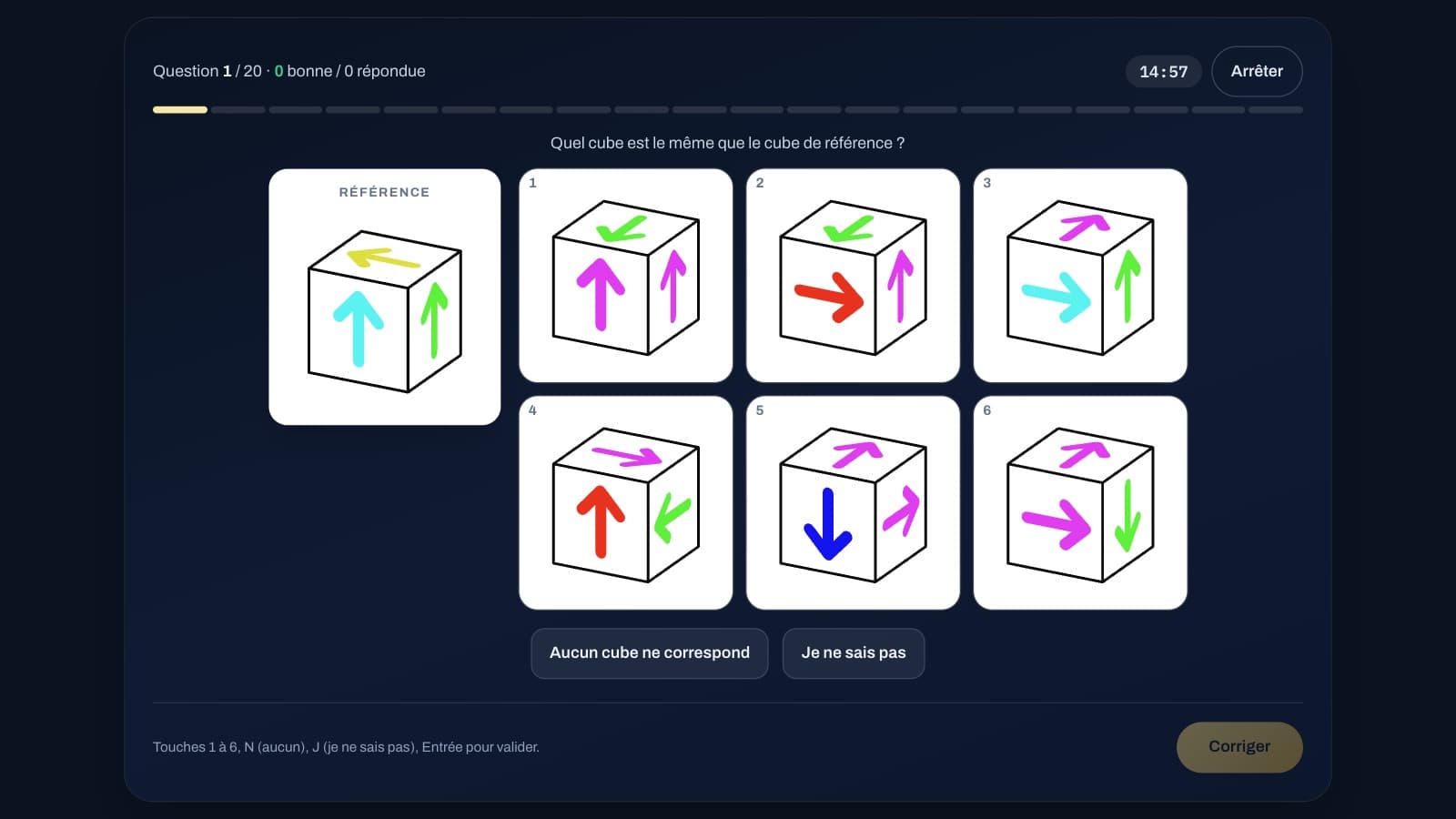
A reference cube is shown, with three faces visible (the top, the front face and the right-hand face), each bearing a coloured arrow. Six cubes are proposed. Only one can be the same cube, turned in space, never flipped as in a mirror. It is also possible that none of the cubes fits.
Since each cube shows only three faces, you cannot check everything: the criterion is that at least one face of the proposed cube can be found on the reference, with the same colour and the arrow turned along with the cube. A cube is wrong when a shared face has a different colour or a different arrow direction.
Choosing an anchor face
Don't try to compare everything at once. Pick an easily recognisable face on the reference (a colour that appears only once, for example), then look for it on each of the six cubes. If it is missing from a cube, that does not make the cube wrong: it may simply be hiding it. In that case, move on to another face of the reference. When you do find it, note the position of a second, neighbouring face and check that it sits correctly relative to the first.
Arrow direction is a trap: two faces of the same colour can differ by a quarter-turn or a half-turn. Always reason by mentally turning the cube around the anchor face, rather than moving the arrow around on the screen.
What stays the same when a cube is turned
Three faces that meet at a corner keep the same cyclic order when the cube is turned: if, going clockwise around the corner, you see red first, then blue, then green, you will always see them in that order, whatever the orientation of the cube. A mirror would reverse that order: when a proposed cube shows the same three colours as the reference but in the reverse order, it is generally a wrong cube, even though its colours are right.
A cube always shows three faces that meet at a corner: two opposite faces are never visible together. This rule is mainly useful for the cube net, where all six faces are drawn and you therefore know which ones are opposite each other: a proposed cube showing two of them side by side is wrong.
The cube net: folding face by face
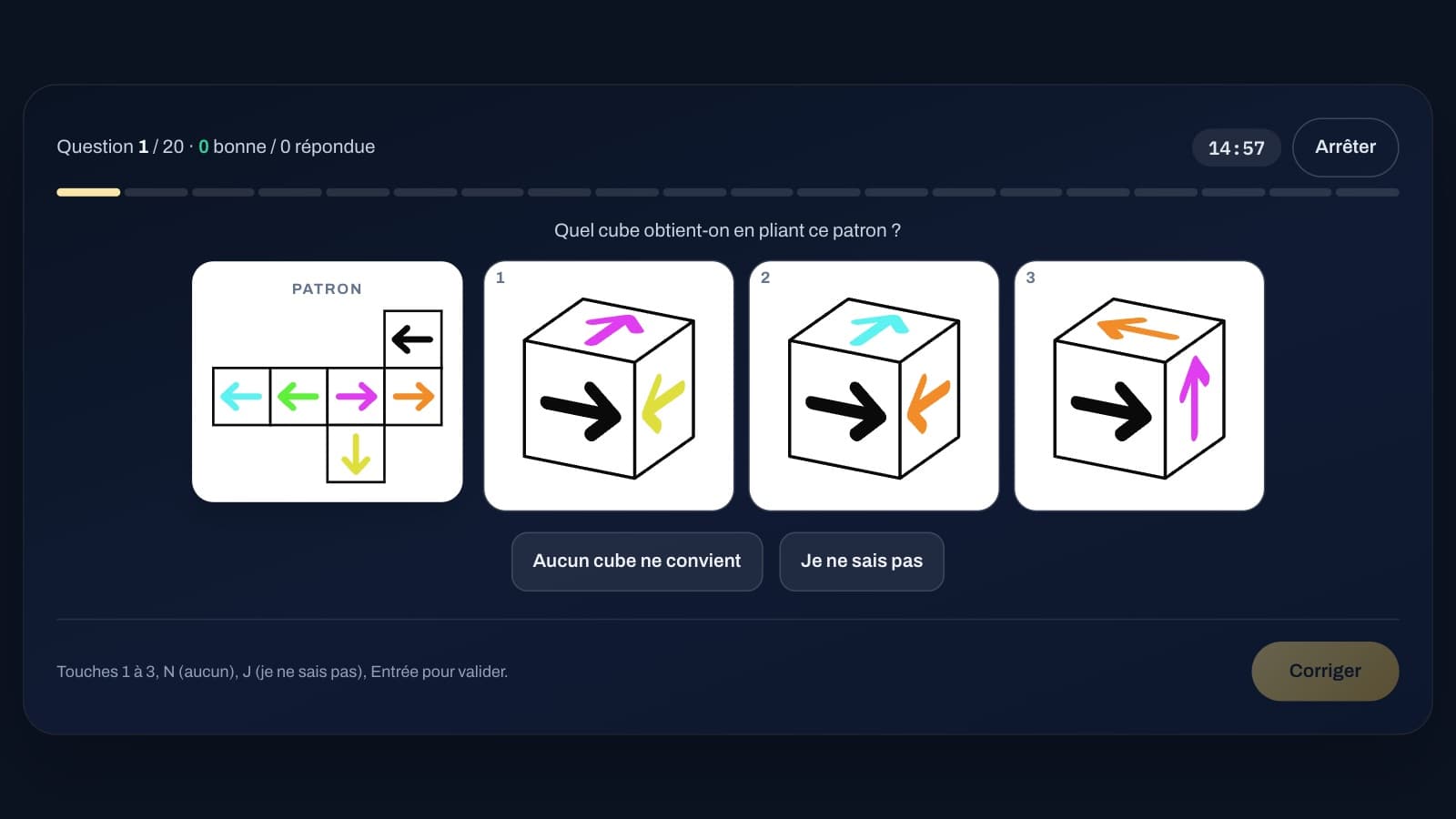
A cube net is an unfolded cube: six squares joined along their sides, each with a coloured arrow. You fold it mentally, arrows facing outwards. Choose one square as the base of the cube and fold its direct neighbours upwards: these are the side faces. Then attach the other squares one by one as they meet; the one that ends up opposite the base is the top.
Spot the squares that touch along a side on the net: they will be neighbours on the cube and share an edge. Two squares that are separated by a single square within a row of the net will be opposite each other. Check the orientation of the arrow each time: it turns with the square, not with the screen.
The proposed cubes (three for the first questions, five for the last ones) each show three faces and can be turned any way you like. Find these three faces on your folded cube, with their colours and arrow directions, and rule out any cube that shows two opposite faces of the net side by side.
Knowing when to say "none", and how to practise
On average, roughly one question in six has no correct cube. Don't give in to the temptation of picking the least wrong one: if every cube shows a clear flaw (a changed colour, a turned arrow, two swapped faces), then "none" is the right answer. Still, check every cube against the faces of the reference before concluding: an anchor face missing from a cube proves nothing, since the cube may be hiding it.
To make progress, mix the two exercises and keep the corrections displayed at the start. In the BQ tab of ForAllPilots, cube comparison and the cube net each offer 20 questions in 15 minutes (the timer is optional), from the easiest to the hardest. With the "Show corrections" option, the "Check answer" button shows the correct cube in green and your incorrect answer in red, and the timer stops while you read them. Both are included with the ATPL subscription: they are practice exercises, not an official test, and they do not reproduce the test of any school or airline.