Psychometric tests for pilots
N-Back Test with Mental Math: Method and Mistakes to Avoid
By ForAllPilots · Published · 4 min read
Reviewed and approved by the site's editor before publication. Our method (FR)
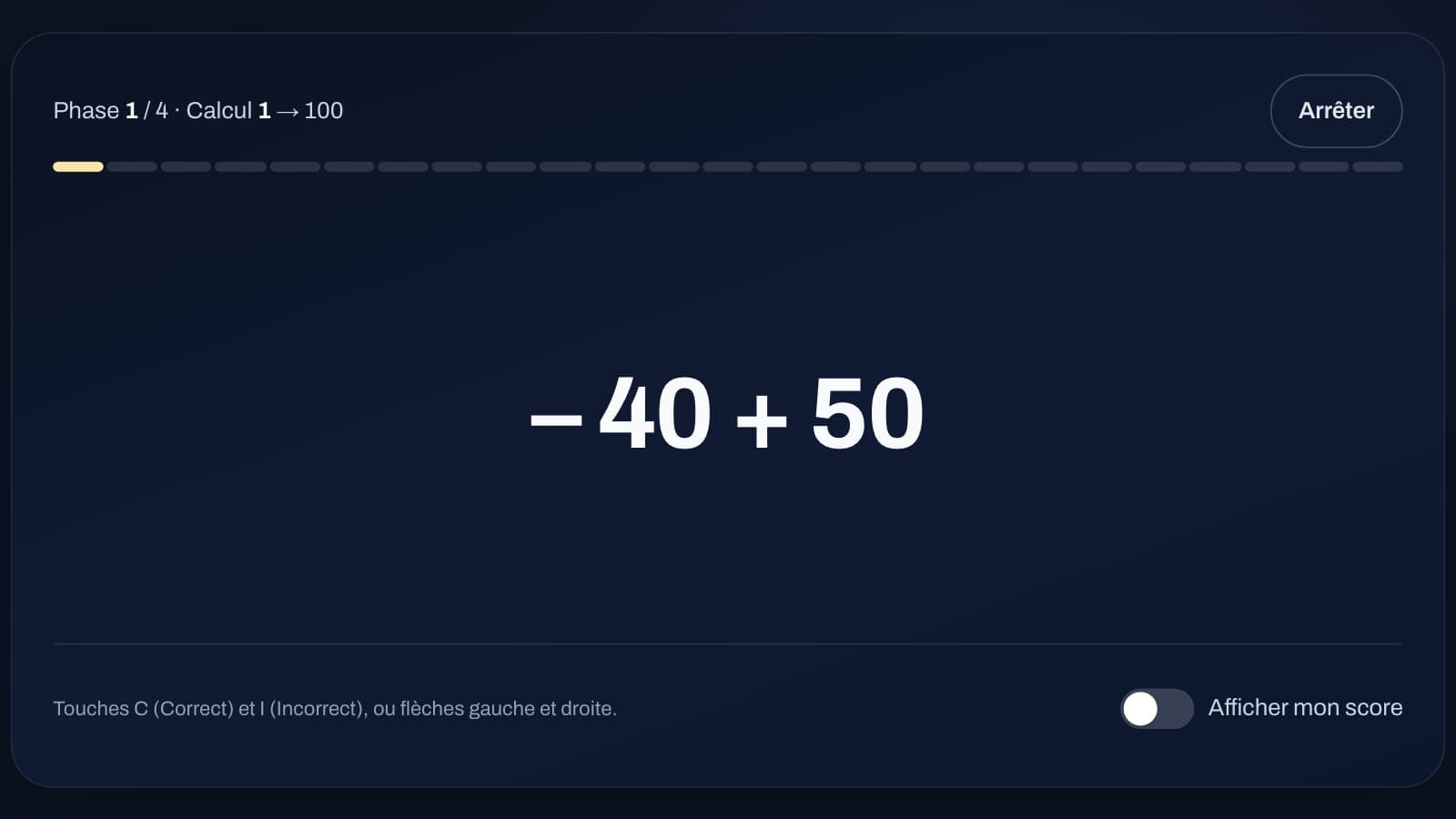
The n-back is a classic of psychometric testing: it measures working memory, that is, the ability to keep one piece of information available while processing new ones. The mental math variant adds a difficulty: the information to retain is not given to you, you produce it yourself by calculating. Here is how to organise yourself to keep up the pace without getting muddled. This exercise is currently available in French only on forallpilots.fr, but the method below stays useful for any n-back task with calculations.
How the test works
A calculation is displayed for 2 seconds and then disappears; two buttons then take its place, "Correct" and "Incorrect". You answer from memory, depending on whether the result matches the expected value or not, using the buttons, the C and I keys or the left and right arrow keys; your first answer is the one that counts. The test has four phases of 25 calculations, so 100 calculations in about 9 minutes, and the pace is fixed: 0.75 second of blank screen, 2 seconds for the calculation, 2 seconds to answer.
Before each phase, a screen announces what to compare against: either a fixed value A, or the result of the calculation that appeared one position earlier (N-1), or the one that appeared two positions earlier (N-2). A is not displayed again after that. The four phases always run in the same order: N-2, fixed value, N-1, then N-2 again. In the N-1 phase, the first calculation primes your memory; in the N-2 phase, the first two do: they call for no answer. In the fixed-value phase, every calculation calls for one. Of the 100 calculations, 5 only prime your memory and 95 are scored: you are scored on the number of correct answers, and a missing answer counts as an error.
Retain the result, not the calculation
The first mistake is memorising the expression: "minus seventy plus fifteen" will be of no use to you once it has gone by. Calculate quickly, keep only the result and forget the calculation. The operands are multiples of 5 between 10 and 90, so the result is also a multiple of 5, never beyond 90 in absolute value. The calculation -70 + 15 comes down to -55 if you reason by difference: 70 minus 15, then apply the sign.
To calculate quickly, break the calculation down: add the tens first, then adjust with the units, and deal with the signs before anything else. A calculation such as minus 50 minus 15 is simply "minus 65"; 25 + 65 is "90". The calculation stays on screen for only 2 seconds: the faster you solve it, the more attention you have left for your memory.
The sliding buffer technique
In the N-2 phase, you must keep the last two results in mind and update them with each calculation. Picture a buffer with two slots: with each new result, you compare it with the oldest slot, answer, then discard that slot and store the new result. The most recent slot becomes the oldest one for the next calculation.
Repeat the two values in your head, in order: "minus sixty-five, ninety". This verbal repetition keeps your memory active while you calculate. In the N-1 phase, the buffer has only one slot: it is simpler, but the current calculation has to be solved during the 2 seconds it is displayed, because it then disappears and you answer from memory. In the fixed-value phase, you only need to keep A in mind, with nothing to update. At the start of each new phase, the buffer starts again from scratch: the results of the previous phase are of no further use.
When you lose track
You will lose track at some point, and that is normal: a longer calculation, a lapse in concentration, and the value you were holding is gone. The golden rule is not to freeze: guess if you have to, then update your buffer with the result of the calculation that has just appeared. One mistake costs you one point; stubbornly trying to recover the lost value can cost you several, because you miss the calculations that follow.
And because a missing answer counts as an error, it is better to answer every calculation that calls for a response, even without being certain. In each phase, about half of the expected answers are "Correct" (40 to 60%): a random choice therefore earns you one point in two on average, whereas a blank earns nothing.
Practising methodically
The order of the phases is fixed: the set starts straight away with an N-2 phase, with no warm-up, then moves on to the fixed value, then N-1, and a final N-2. The announcement screen waits for you to click the start button: take the time to read the rule and concentrate before launching the phase. Do complete sets of 100 calculations at least two or three times before judging your level: the calculations are drawn at random for each set, and fatigue can make itself felt as the phases go by. Compare your scores phase by phase to see where it drops off.
On forallpilots.fr, the French-language n-back exercise applies this pace (0.75 s, 2 s, 2 s) across four phases of 25 calculations. Its score option shows your running score and whether each of your answers was correct; at the end, you see your score as a percentage, your score for each phase, your time and the number of calculations left unanswered. During a phase, the stop button lets you see your results before the end: the set is then kept as interrupted and does not count towards your statistics, which stay on this device. It is a training exercise included with the ATPL subscription, not an official test: the exact rules or scoring of a real test may differ.