Psychometric tests for pilots
EFG Test: The Law and Anti-Law Method
By ForAllPilots · Published · 3 min read
Reviewed and approved by the site's editor before publication. Our method (FR)
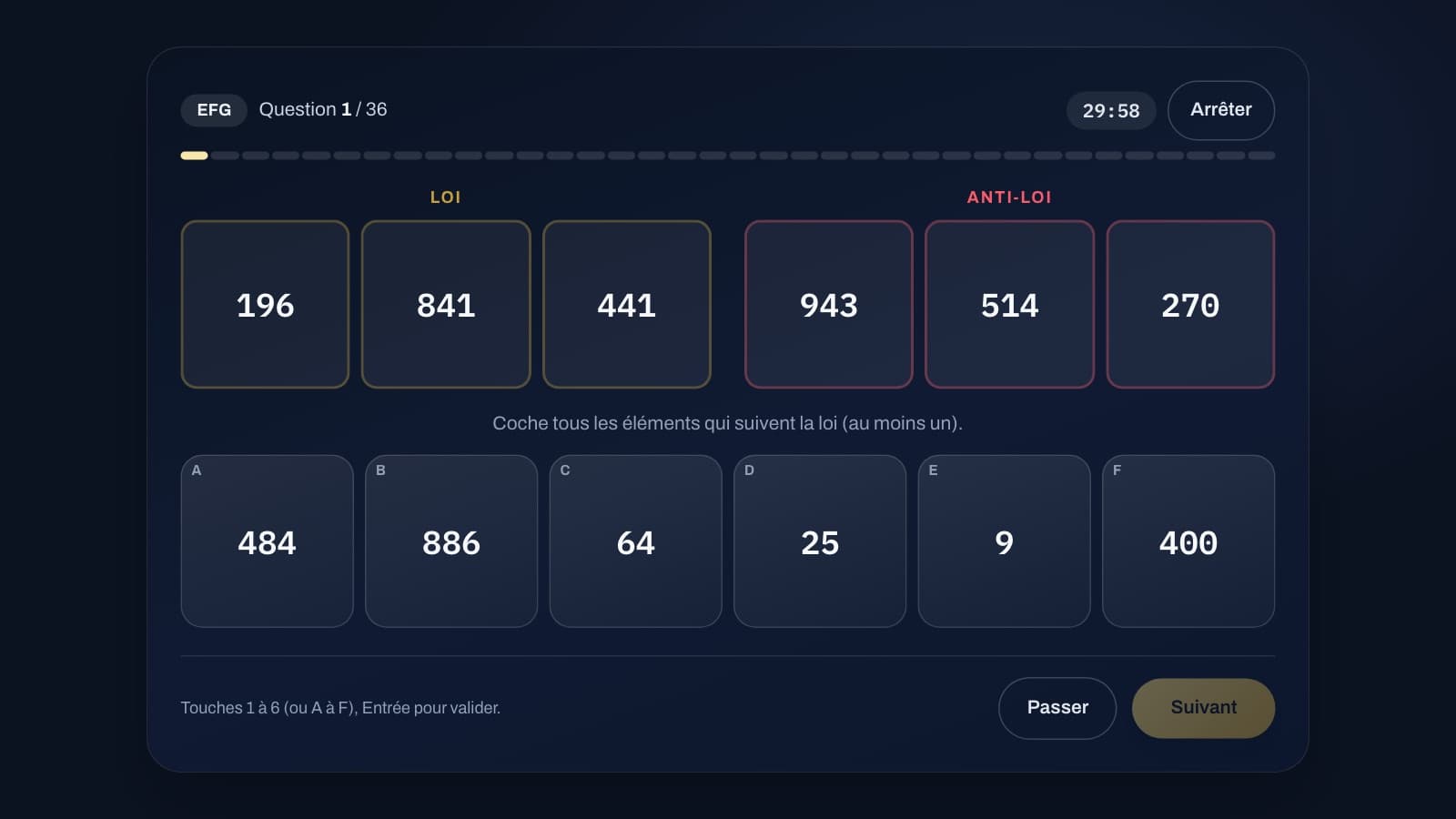
Three elements follow a hidden law, three others do not: the general efficiency test (EFG) asks you to work out what the first three have in common, then to tick, among six proposals, all those that obey the same law. On ForAllPilots, the exercise uses shapes, words and numbers, and it is currently available in French only on forallpilots.fr. Here is how to reason in each case.
Understanding the law and anti-law mechanism
On the left (the "Law" block), three elements follow the law. On the right (the "Anti-law" block), three elements do not, and they help you rule out hypotheses that are too broad. A good law is therefore true for all three elements on the left and false for all three on the right. Below are six proposals: you tick all those that follow the law. There is always at least one, and never all six.
A question is correct when you tick exactly the right elements, no more and no less. This is what makes the exercise demanding: finding an approximate law is not enough, you need the right one.
Shapes: counting, comparing, checking orientation
With shapes, first examine what can be counted (number of shapes, odd or even), then what can be compared (increasing or decreasing size, position, concentric shapes or shapes nested inside one another), then what has an orientation (angle of a line, symmetry). Take stock of the three elements on the left: what is true for all three? Then check that this property is false for all three on the right.
If several laws seem possible, keep the one that has you tick the most elements among the six: that is how the exercise works, a broader law wins over a narrower one.
Words: meaning, form and sound
With words, look in three directions. Meaning and nature: lexical field (sea, music, cooking, sport, aviation), noun, verb in the infinitive, adjective or adverb, gender of the noun, word borrowed from a foreign language, proper noun. Form: number of letters, first or last letter, a letter that is present or repeated, a group of letters or an ending, alphabetical order, palindrome. Sound: homophones, that is, words that are pronounced the same but spelled differently.
Anagrams are a special case: two words are anagrams if they use exactly the same letters. The law can then be that the letters of the word, rearranged, form another word. Take the time to check letter by letter, as visual resemblance is often misleading. And when a law based on meaning does not fit all three elements, move on to form.
Numbers: parity, multiples, digits
With numbers, go through the arithmetic properties: even or odd, multiple of 3, 4 or 5, divisible by 7 or 11, prime number, perfect square. Then look at the digits: sum of the digits, identical digits, digit in first or last position, ascending or descending order. Finally, position on the number line: below or above a threshold, between two values.
Divisibility rules save you time: a number is divisible by 3 if the sum of its digits is, by 4 if its last two digits form a multiple of 4, and by 9 if the sum of its digits is a multiple of 9. Learn them by heart.
Managing your time: 36 questions in 30 minutes
Test mode has 36 questions in 30 minutes, 12 on shapes, 12 on words and 12 on numbers, all mixed together: a little under a minute per question, 50 seconds on average. There is no correction along the way and no going back: once a question has been submitted or skipped, you cannot return to it. So do not fixate on a law you cannot find. Be careful: a skipped question counts as a wrong answer, and a wrong answer does not remove any points, so if time is short, it is better to tick your best guess than to skip. If the timer reaches zero, the set stops: the current question counts if you have ticked something, and all the remaining ones are counted as wrong.
Practise by type first: 12 questions in 10 minutes, with a timer and corrections that you can switch on or off (Show corrections). With corrections on, the Check answer button shows the correct elements and the law, and the timer stops while you read them: you will soon build up your own list of frequent laws. In its French version on ForAllPilots, the EFG test offers both formats, with your result as a band from 1 to 9 according to the exercise's scale, the result for each type and your mistakes with the law for each question. It is included with the ATPL subscription; it is practice, not an official test.