Psychometric tests for pilots
DLR Pilot Test: The Exercises and How to Train
By ForAllPilots · Published · 4 min read
Reviewed and approved by the site's editor before publication. Our method (FR)
ForAllPilots' DLR series brings together twelve exercises that are all quite different from one another: picturing a cube or a path in space, applying a rule at speed, anticipating a hidden movement, remembering a sequence, and above all staying focused for several minutes at a stretch. Here's what each one requires, and a simple order to train in without spreading yourself too thin.
Spatial representation: cube, orientation, maze
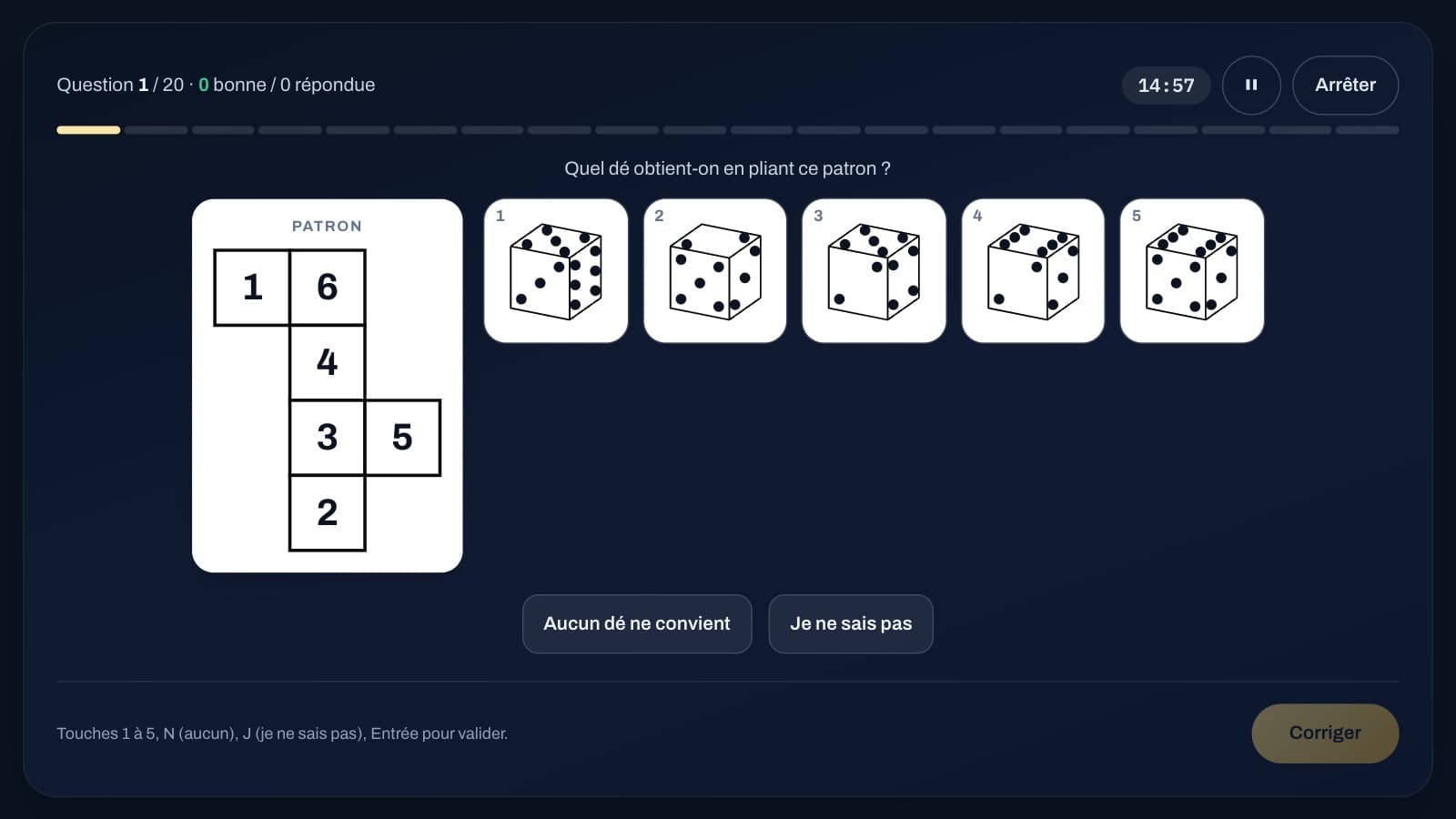
Cube folding shows a die unfolded into six squares numbered 1 to 6: you must identify, among five dice drawn in perspective, the one you'd get by folding it back up, or answer that none of them match (roughly one question in six). A series has 20 questions in 15 minutes, running from easiest to hardest.
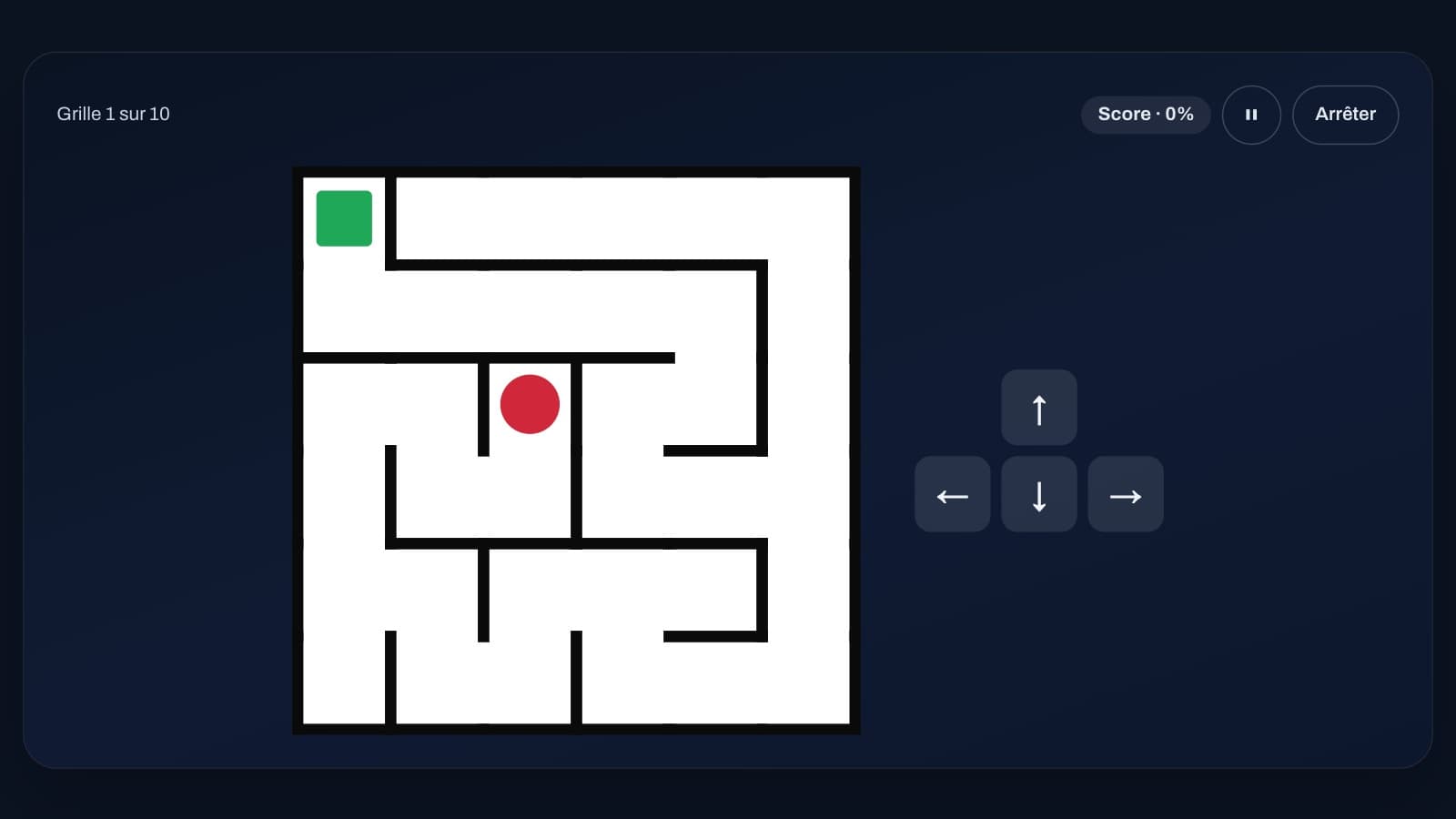
2D spatial orientation starts from a point on a 10 x 10 grid, always facing upward: instructions appear one at a time (move forward, turn right, turn left, turn around), each moving you forward one square, and you then need to pick, from four grids, the one showing the correct end square and the correct heading. 3D spatial orientation announces a starting face, then five face names, and you must touch, in order, the cube — among six marked with a cross — that corresponds to each word. Finally, the rotating maze asks you to reach the exit of a grid drawn from a constantly changing angle, with buttons that always keep the same direction.
Rules and anticipation: triangles, data processing, prediction
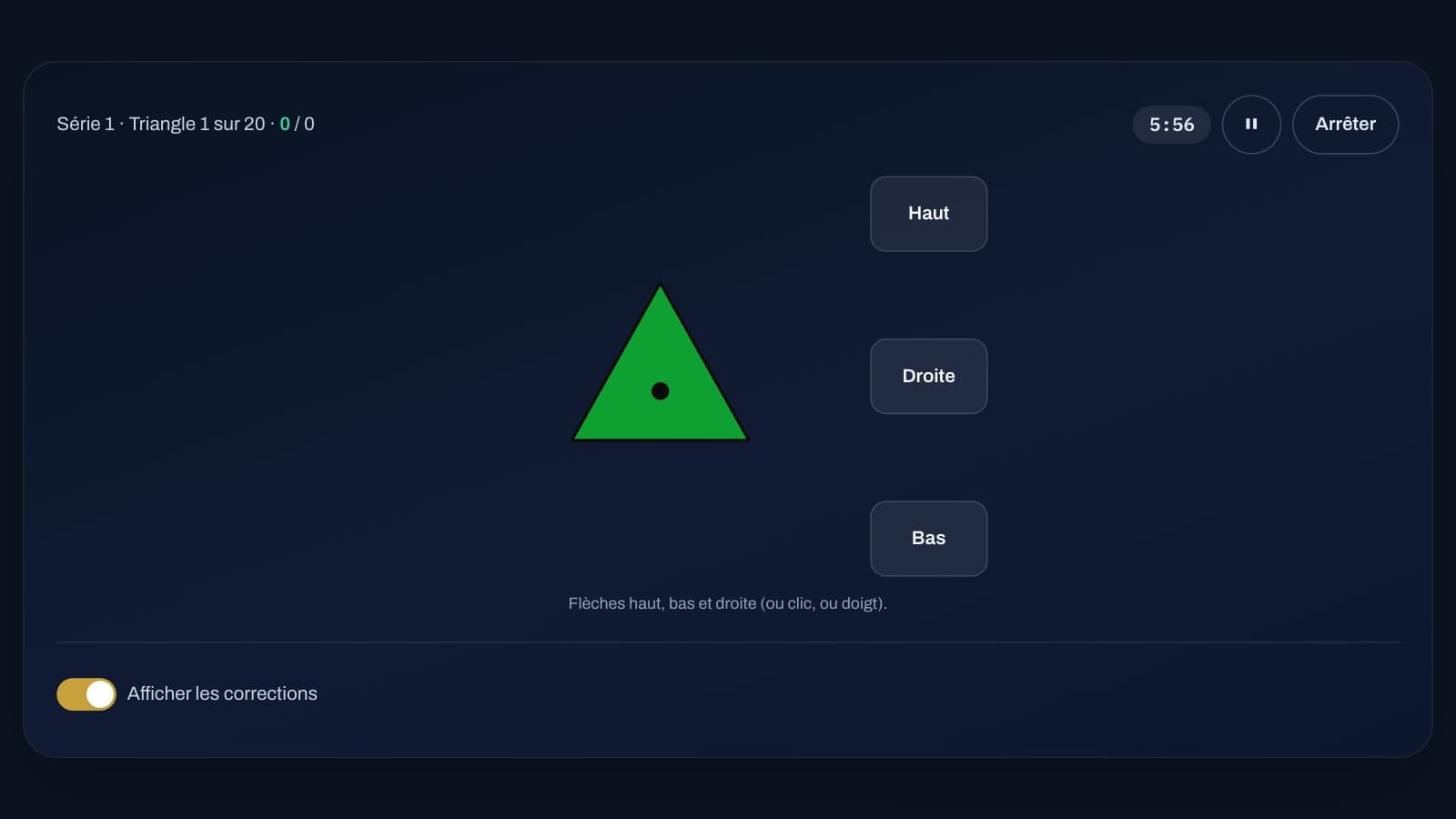
Triangles and data processing are played in three series of 20 attempts, 6 minutes in total, with rules drawn at random at the start of each series. In triangles, you compare each triangle to the previous one (colour, direction, number of black dots) according to two rules; in data processing, the colour of a square placed on a corner of a grid tells you which key on the numeric keypad is correct.
Trajectory prediction has a red ball and a yellow ball enter a corridor whose middle section is hidden: you must press at the exact moment a ball reaches a line, exits the hidden zone, or crosses the other ball, without being able to see it. Twenty attempts, with only one press counted each time.
Memory, vigilance and divided attention
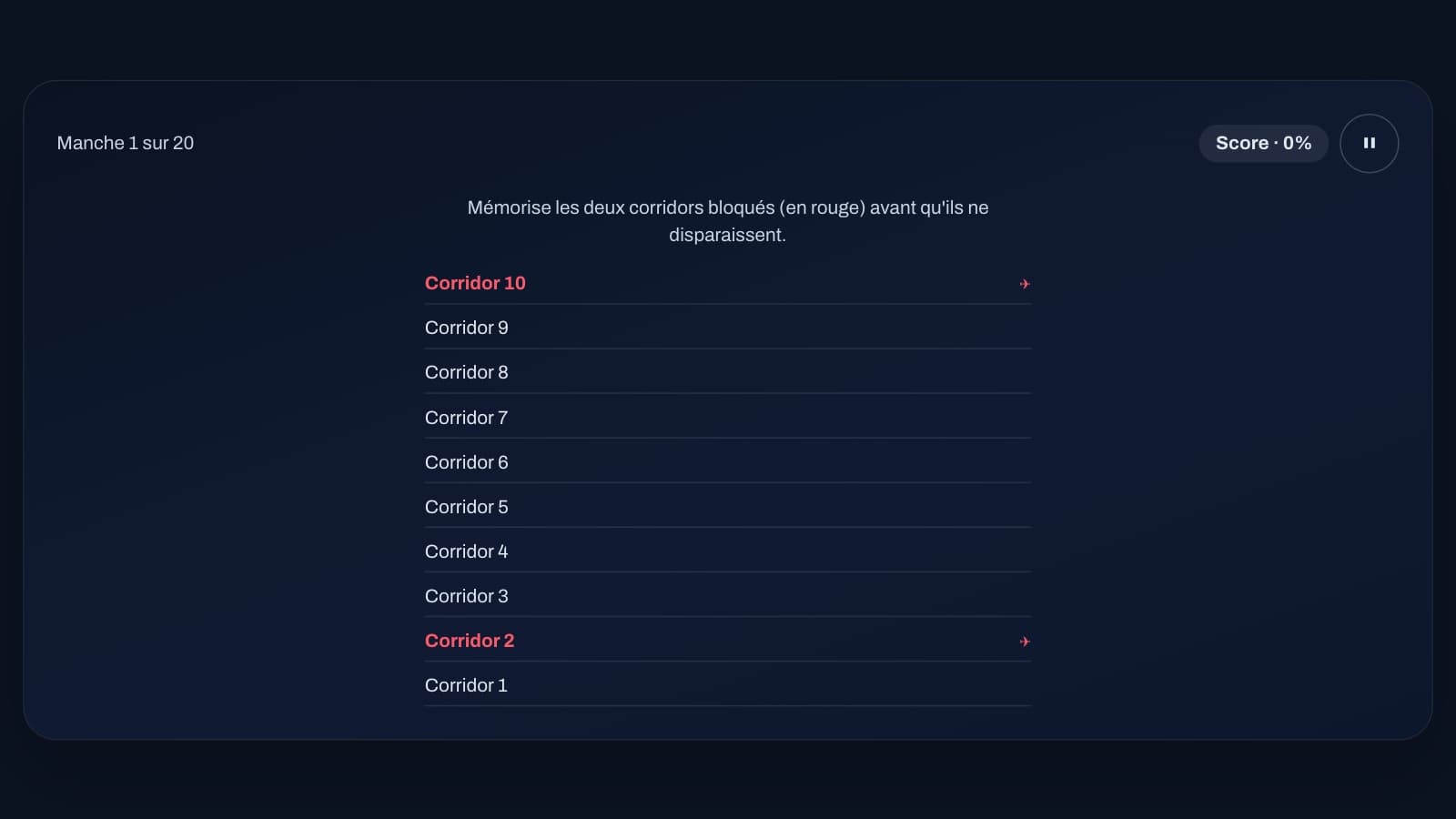
Corridors shows two corridors blocked out of ten, then reads out announcements aloud (a city, a corridor): you must remember only the cities announced on a corridor that remained open, then tick them off in a long list. Twenty rounds, getting progressively busier.
Vigilance 1 has you compare a heading dial to its numerical value every two seconds, while also listening for sounds to spot the same sound three times in a row. Vigilance 2 has you track a dot moving around a dial that suddenly changes colour, shape, direction or step size. Perception and Information Processing has you monitor three gauges while mentally adding numbers. These three tests run continuously, in either a short or a full-length version, after 30 seconds of practice. Finally, Timed Calculation reuses the calculation problems from the BQ series, with a time limit for each one.

What order to train in
Start with the exercises that let you take your time to understand the rule: cube folding and data processing with the corrections displayed, and 2D spatial orientation, which has no time limit for answering. Once you've got the logic down, move on to the exercises where speed matters: triangles, prediction, maze.
Keep the long vigilance and divided-attention tests for separate sessions: do the short version first, including the practice run, then move on to the full version once the rules have become automatic. What they measure is your ability to stay accurate over time, not a strong start: a well-run short series every day beats an occasional long session.
Alternate exercises from one session to the next: they rely on different mechanisms, and fatigue on one will throw off your score on the next. Every completed series is saved to your history on the device, so you can see whether you're actually making progress.
Setting up good conditions for a session
Play on a reasonably large screen in a quiet space: most exercises in the series work fine on a phone, but the vigilance tests and the gauges exercise require you to take in the whole screen at a glance. The “Full screen” button above each test strips away the rest of the page.
Vigilance 1 and Corridors use sound: headphones help you clearly distinguish the sounds and announcements. On the keyboard, each exercise's keys are reminded on its page, and numbers can be typed just as well from the top row of an AZERTY keyboard as from the numeric keypad.
If you need to stop partway through, the “Pause” button freezes the exercise; “Stop” offers to show your results based on what's already been done, with the series then saved as interrupted and not counted in your statistics. During the continuous tests, switching browser tabs will also pause the exercise.
Tracking your progress from session to session
Every completed series is scored as a percentage and saved on your device. The “My Statistics” page brings together, test by test, your best score, your average, your most recent score and your series trend curve: this is what tells you whether a method is working, far more reliably than an impression from a single session.
Compare like with like: a short vigilance series and a full-length one aren't equivalent, and a first attempt at a new exercise is mainly about understanding the rule. What matters is the trend over one or two weeks of regular practice.
What the DLR series is not
These exercises train abilities found in many pilot selection processes: spatial orientation, speed under a rule, sustained attention. They do not replicate the test used by any particular school or airline, and they measure neither medical fitness nor flying skill.
These exercises are included with the ATPL subscription: they are training tools, not official tests, with no connection to the selection test of any particular school, organisation or airline, and the exact rules or scoring of a real selection process may differ.