Psychometric tests for pilots
Gauges Test: Read a Dial Fast and Accurately
By ForAllPilots · Published · 4 min read
Reviewed and approved by the site's editor before publication. Our method (FR)
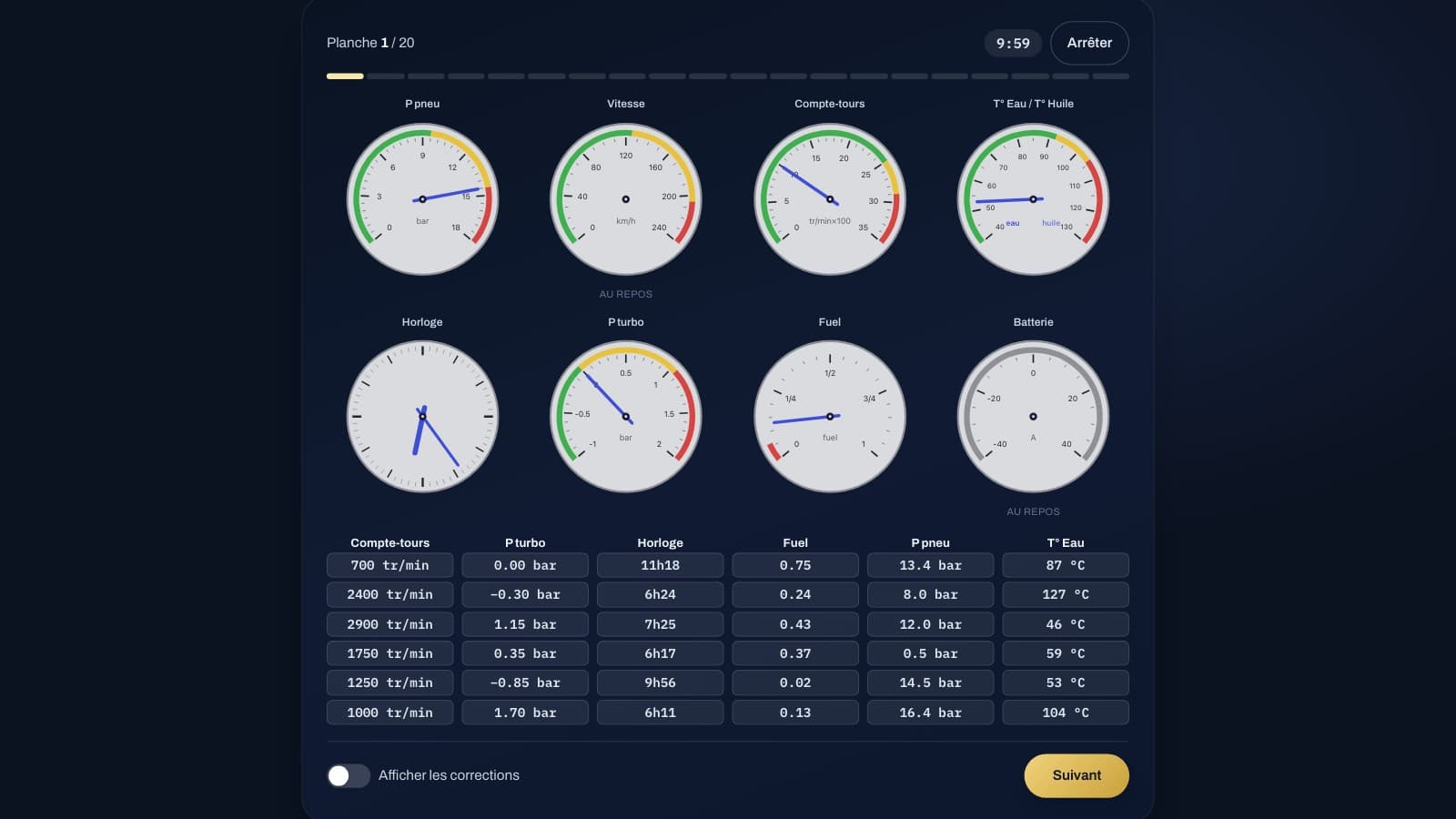
Rev counter, speed, pressure, clock, fuel, battery, temperatures: the gauges test asks you to read the value shown by a needle and pick it from six options, panel after panel. The difficulty is not understanding a dial but reading it quickly, without mistaking the scale or the unit. Here is a rigorous reading method that stays fast. This exercise is currently available in French only on forallpilots.fr, but the method below works on any dial.
How the exercise works
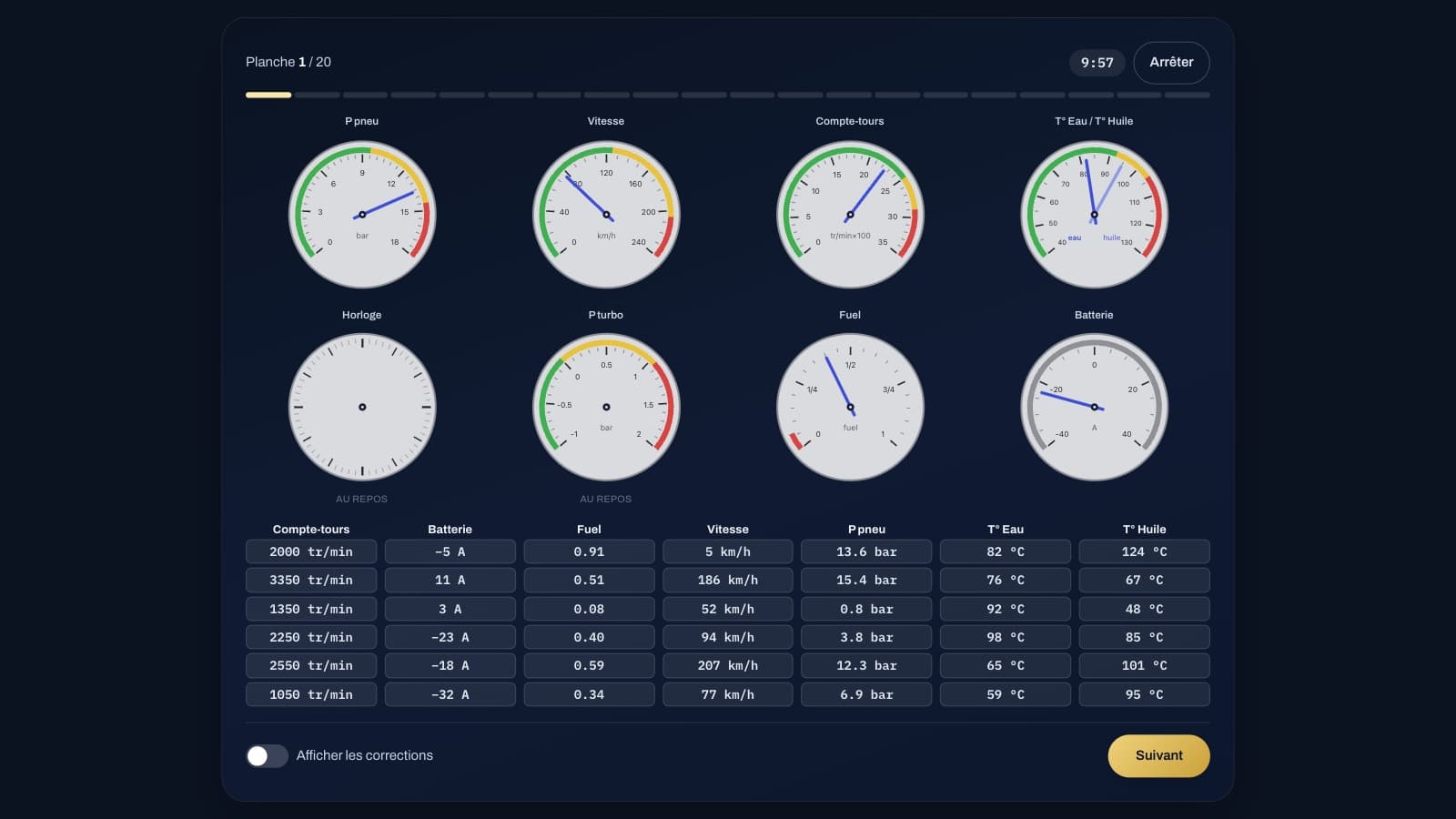
Each panel shows eight dials. For every dial whose needle is visible, you read its value and pick it from six options placed in its column. A dial with no needle is at rest: you must not read it, so a panel contains from six to nine readings. The temperature dial may carry two needles, the dark one for water and the light one for oil: that makes two readings, each with its own six options. Each needle reading counts as one, and a reading left unanswered is wrong.
The options close to the correct one get tighter as the set goes on: wide apart on the first panels, close together on the last ones. That rules out rough approximations: the aim is to read, not to guess.
Always start with the scale
Before looking at the needle, find the dial's minimum and maximum, the unit (bar, km/h, °C, amps) and the value of one graduation. On the speed dial, graduated from 0 to 240 with numbers every 40, each small tick is worth 10: that value is what separates 130 from 140. On the rev counter, the numbers on the dial are hundreds of revolutions per minute: the 10 on the dial means 1000 rpm.
Also note where zero sits. On some dials (battery, turbo pressure), zero is not at the start of the scale, and negative values lie on one side. A needle to the left of zero is read with a minus sign. Do not forget this, because the options may mix positive and negative values.
Interpolating between two graduations
When the needle falls between two ticks, estimate its position as a fraction of the interval: a quarter, a half, three quarters. Then calculate: if an interval is worth 10 and the needle is halfway, add 5. Next, compare with the six options and discard those that are clearly too high or too low.
Use the options to check your reading as well, but do not round to the nearest graduation: the values offered are not marks on the dial. Speed is read to the nearest km/h, turbo pressure to the nearest 0.05 bar, tyre pressure to the nearest 0.1 bar, and the correct answer is the exact value the needle shows. So if your reading comes to about 137, the correct option may be 136 or 138, not necessarily 135 or 140. The other options are always separated from the correct one by at least a few degrees of needle angle: choose the one closest to your reading.
The clock: do not mix up the hands
The clock needs a separate approach: two hands to read together, on a twelve-hour face, with no numbers, only tick marks, longer every five minutes and thicker at the quarter hours. First tell the hour hand (the shorter, thicker one) from the minute hand (the longer one). Read the minutes first, then the hour: the position of the hour hand must be consistent with the minutes. At 3:50, the hour hand is almost on the mark for 4, not on the mark for 3.
Check that the two agree. When the minutes approach the next hour (around 50), the hour hand is almost on the next mark but the hour is still the previous one: 3:50, not 4:50. Just after the hour (around 05), the hour hand has only just passed the mark: 4:05. And be wary of neighbouring options, some of which differ from the correct time by only a few minutes: re-read the minutes before you confirm.
Pacing yourself across the 20 panels
A set has 20 panels to get through in 10 minutes with the timer, which you can turn off. The time is shared across the whole set: 30 seconds per panel is an average, not a limit. As a panel has from six to nine readings, that comes to about 4 seconds per reading. Read the simplest dials first (those where the needle is close to a graduation), then the finer ones. If a reading resists you, pick the most plausible option and move on: a wrong answer costs no more than a reading left blank, which also counts as wrong. When time runs out, whatever is ticked on the current panel counts, and the remaining panels are counted as wrong.
In the exercise, new panels are generated for every set, with exact correct answers. With “Show corrections” (off by default), “Check answer” shows the right values in green and your mistakes in red, and the timer stops while you read them. At the end, you see your score, your time, your score per dial and your mistakes with the correct answer (sixty at most). The “Stop” button pauses the timer: “See my results” keeps the set in your history as interrupted, without counting it in your statistics, and “Leave without saving anything” records nothing. Your history and statistics are kept on the device you are using.
The test is included in the ATPL subscription: it is practice, not an official test, with no link to any school's or airline's assessment, and your score is read as a band from 1 to 9 on the exercise's own scale.