Psychometric tests for pilots
Multitask Landing Test: The Runway Comes First
By ForAllPilots · Published · 6 min read
Reviewed and approved by the site's editor before publication. Our method (FR)
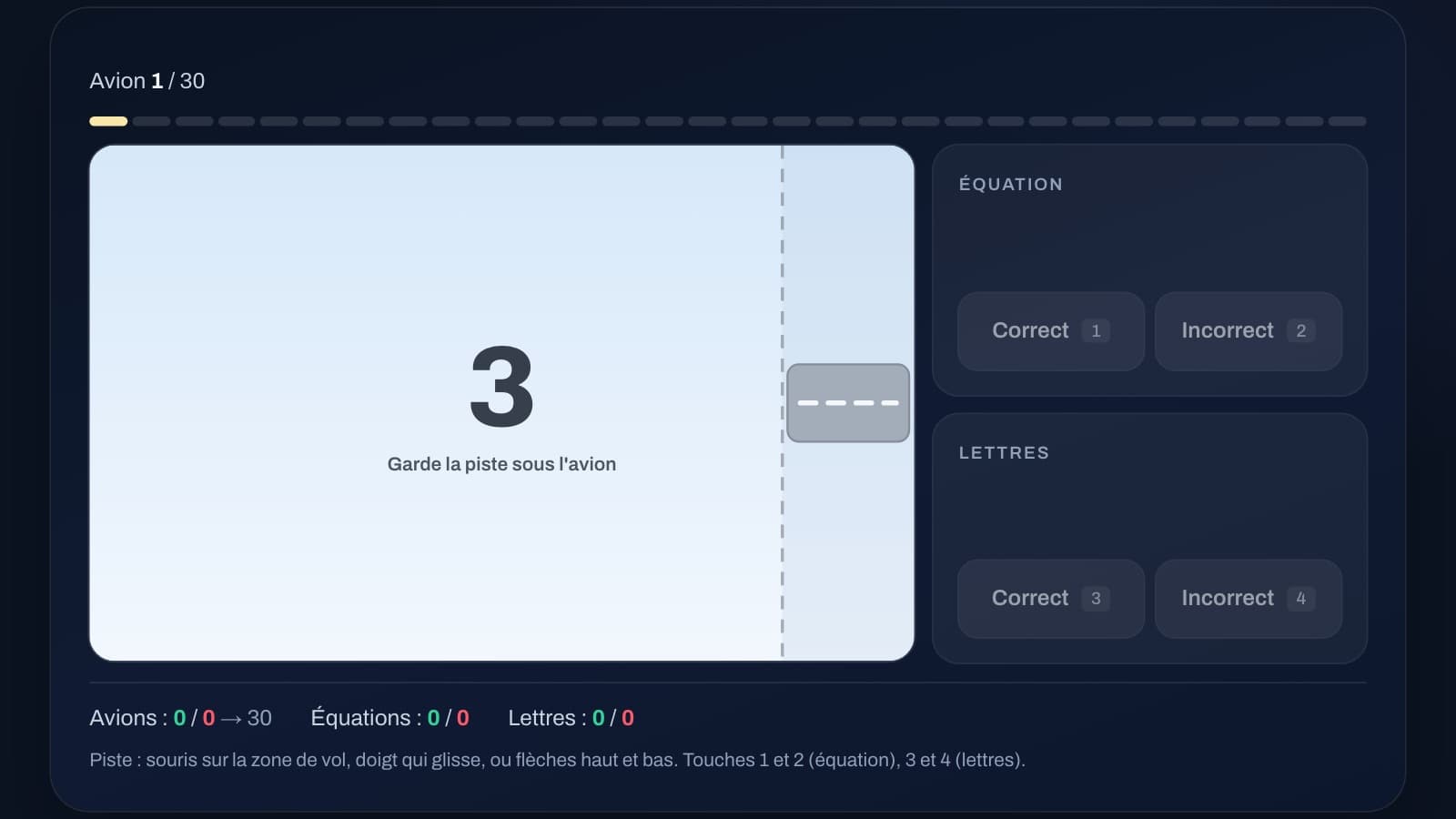
Thirty aircraft climbing and descending without warning, a runway to keep under each one, and meanwhile an equation to check and eight letters to scan for a repeat: the multitask landing exercise trains your divided attention. The temptation is to try to do everything at the same speed. That is the mistake: the three tasks do not weigh the same in the score, and the runway comes before everything else. Here is how the exercise works, how to divide your attention and how to practise over two weeks.
Three tasks, one order of priority
Landing counts for 60% of the score, equations for 20% and letters for 20%. In concrete terms, out of 100 points, each aircraft landed is worth 2 points, each equation answered correctly is worth roughly two-thirds of a point and each group of letters answered correctly is worth half a point. A missed aircraft therefore costs as much as three right equations or four right groups of letters.
For the equations and the letters, wrong answers take points away from right ones: the calculation is right minus wrong, between 0 and 30 for the equations and between 0 and 40 for the letters. A random answer takes away as much as it adds on average: guessing gains nothing. Since an item left unanswered stays on screen until you answer, with no penalty, it is better to take two extra seconds than to guess.
Landing the aircraft: only the moment of arrival counts
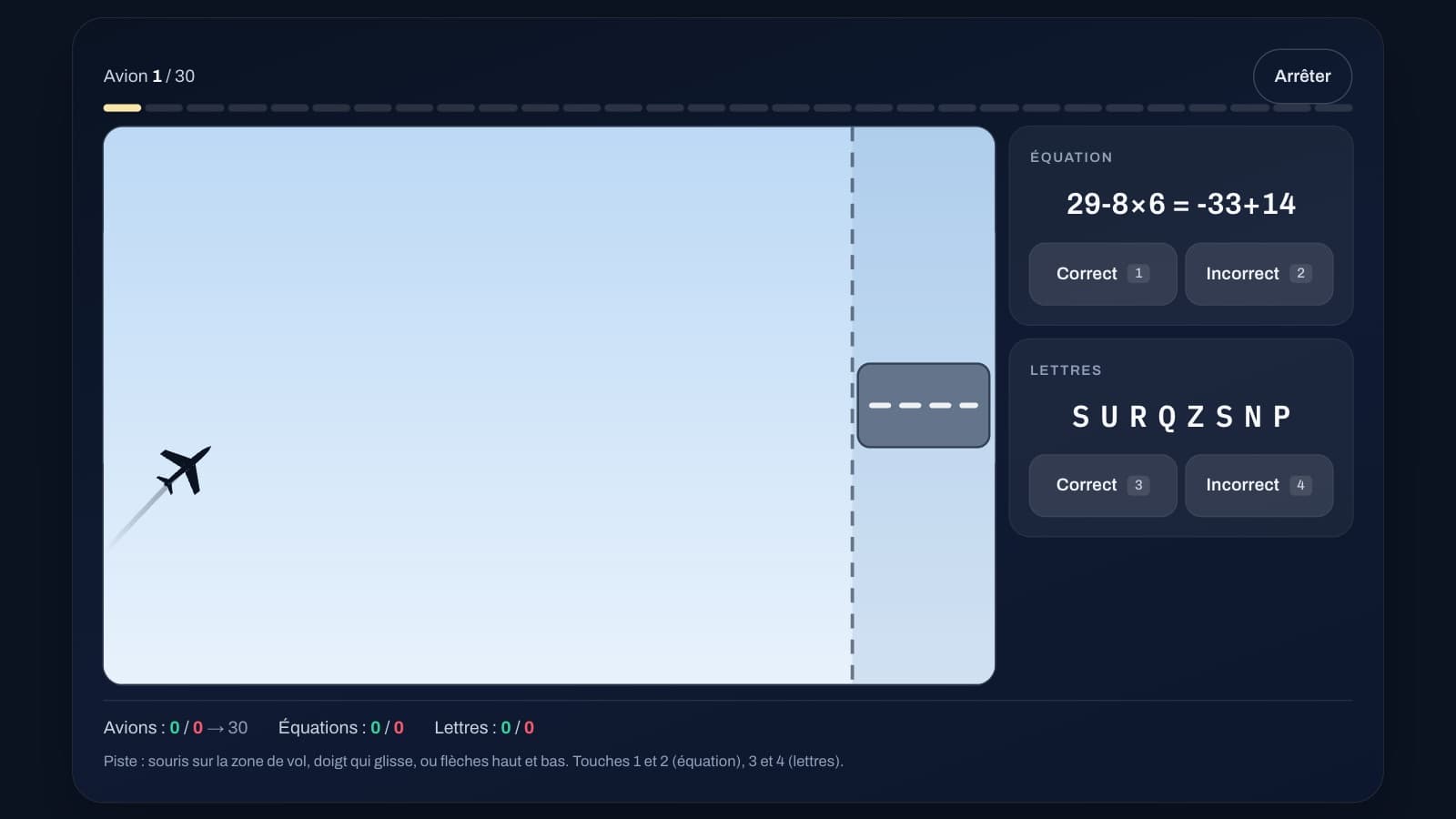
One aircraft at a time crosses the flight area, from the left edge to the dashed line, at a constant speed but climbing and descending irregularly: it changes direction at random moments, and its arrival point cannot be guessed. A flight lasts 8 to 11 seconds, followed by a pause of 1.2 to 2 seconds. The runway is the grey rectangle in the strip on the right and only moves up or down. The aircraft lands if, at the instant it reaches the line, the centre of the runway is within half a runway height of it. The runway covers 15% of the height of the flight area: the margin is 7.5% on each side.
Since only the arrival is judged, remember two habits. Do not try to extend the flight path with your eyes: the vertical speed changes at intervals of 0.6 to 1.8 seconds, so you follow the aircraft, you do not get ahead of it. And tighten your tracking over the last two seconds, which the faint trail left by the aircraft helps you read. Loose tracking early in the flight leaves you time for the other tasks; a catch-up in the last second remains risky.
The controls: one hand for the runway, one for the answers
With a mouse, the runway follows the height of the pointer over the flight area, without clicking; on a touchscreen, it follows your finger as it slides across the area. Only height matters: place the pointer level with the aircraft. With the keyboard, the up and down arrow keys move the runway for as long as they are held, and it then moves more than twice as fast as the aircraft can climb or descend.
Answers are given with keys 1 and 2 for the equation (Correct, Incorrect) and keys 3 and 4 for the letters, on the top row or the numeric keypad, on AZERTY and QWERTY keyboards alike. Use them in preference to the buttons shown near the flight area: with a mouse, clicking takes your pointer off the area, and the runway stays frozen at its last height.
Equations: checking without calculating everything
The equations use only small numbers, with a little order of operations, brackets, a square or a minus sign at the start, such as "(11-5)×8 = 7+23": 48 on one side, 30 on the other, so "Incorrect". About one equation in two is correct and the others are wrong by 1 to 45. So do not expect any pattern: judge each equation on its own.
First work out the heavier side, usually the one with brackets, a product or a square, then the sum on the other side. Compare the last digit: if it differs, the equation is wrong and you can answer without going further, which is enough for the great majority of wrong equations. If it is the same, check the tens and the sign as well. Watch out for the usual traps: multiplication comes before addition, and a square is always positive.
Letters: searching for the echo
Eight letters are displayed: either they are all different, or one letter appears twice. Read them once from left to right, saying them in your head, and listen for the "déjà vu" when the second one arrives. To go faster, split the letters mentally into those from the start of the alphabet (A to M) and those from the end (N to Z): a repeated letter can only be inside one group, which reduces the number of comparisons.
Only answer "Correct" if you have seen exactly the same letter twice, not two letters that look alike, such as M and N. If a second reading reveals nothing, answer "Incorrect": a display of letters contains a repeated letter about one time in two.
Dividing your attention during the set
The right rhythm is a cycle: eyes on the aircraft, a glance at the equation or the letters, the answer on the keyboard, back to the aircraft. The pause of 1.2 to 2 seconds between two aircraft is the best moment to answer, since no aircraft is in play. After each answer, a green tick or a red cross shows whether you were right, and a new item appears a moment later.
A figure to keep in mind: the ceiling is 30 net right equations and 40 net right groups of letters, for 30 aircraft. One equation and one group of letters per aircraft therefore reaches the equation ceiling and three quarters of the letter ceiling. If you feel overloaded, sacrifice the letters first, then the equations, never the runway, and do not answer at random to catch up.
Reading your results and practising over two weeks
At the end of the set you see your score out of 100, the aircraft landed out of 30, your right and wrong equations and letters, your time, and a row of 30 coloured markers showing what happened to each aircraft. The statistics add the best score, the average, the latest score with its trend (from five completed sets) and the breakdown by part: aircraft landed, then equations and letters right among those you answered. If few aircraft land, go back to the runway; if many answers are wrong, slow down. There is no class scale for this exercise. If you stop and choose to see your results, the set is kept as interrupted (aircraft not yet flown count as missed) and does not count in the statistics; if you leave, nothing is saved.
Days 1 to 3: answer neither the equations nor the letters, just land the aircraft, first with the mouse then with the arrow keys, and keep whichever gives you the most aircraft landed. Days 4 to 7: add the equations in the pauses between two aircraft. Days 8 to 11: add the letters. Days 12 to 14: full sets, two at most per session. These learning sets count as completed sets: the average for your first days will be low, what matters is the progress.
On ForAllPilots, the multitask landing exercise is in the CUT E tab of the psychometric tests, and it is included with the ATPL subscription. Your results stay on your device, unless you yourself ask for a personalised tip (reserved for the ATPL subscription): a summary of the figures from your latest set is then sent. This is a practice exercise, not an official test: it does not reproduce a school's or an airline's test, promises no result, and measures neither your medical fitness nor your level as a pilot.