Psychometric tests for pilots
Deductive Reasoning: The Symbol Grid Method
By ForAllPilots · Published · 3 min read
Reviewed and approved by the site's editor before publication. Our method (FR)
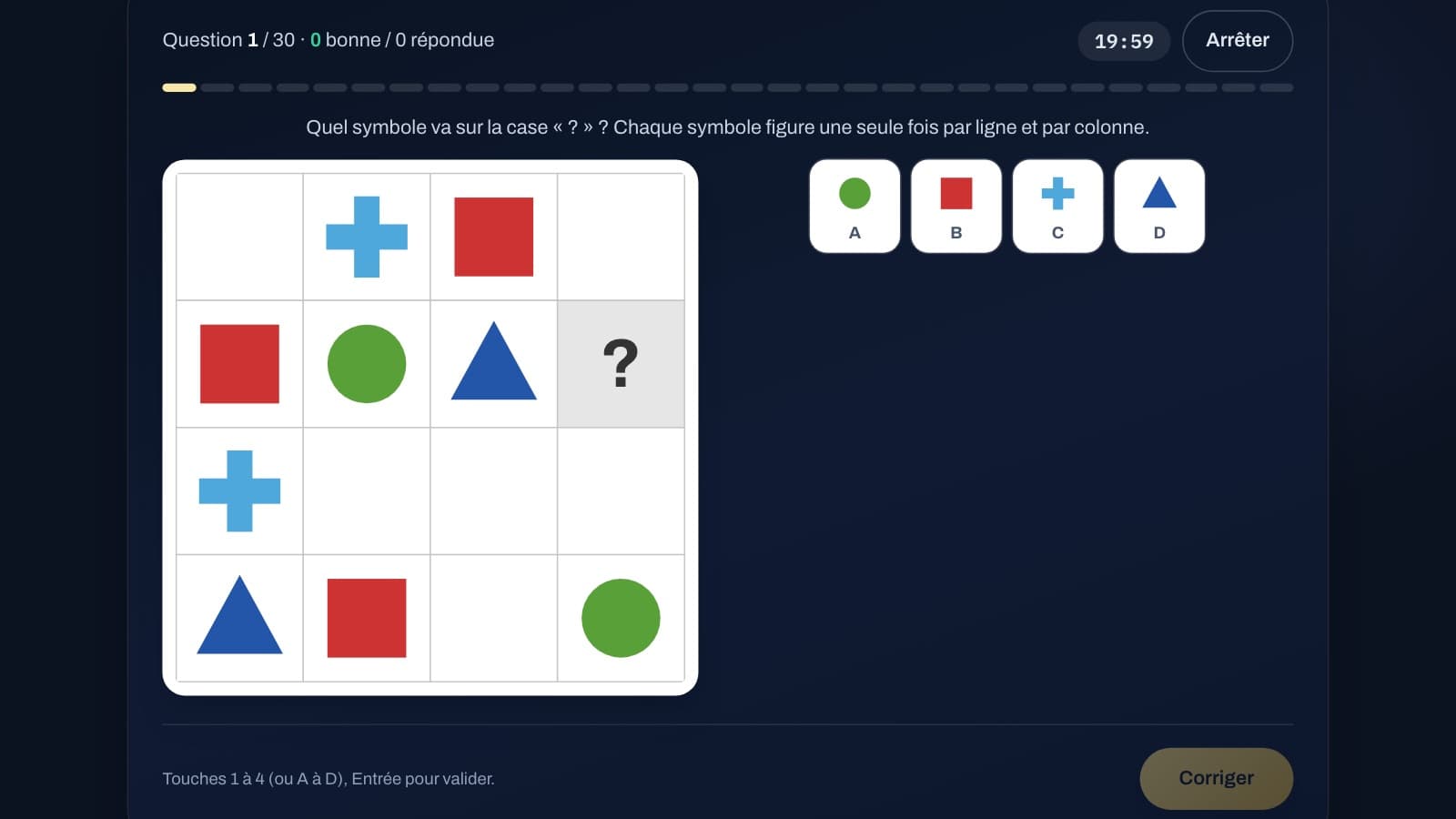
A four-by-four or five-by-five grid, partly filled in, one cell marked with a question mark, and a single rule: each symbol appears only once in each row and each column. The deductive reasoning exercise works like a small sudoku of symbols, without the blocks, and above all calls for a method: eliminate options with reasons, without trying to guess.
The rule that does all the work
In every row and every column, each symbol (circle, cross, star, triangle, diamond, square) appears exactly once. In a four-by-four grid, four symbols are used; in a five-by-five grid, five. The answer choices are all the symbols in the grid: the correct answer is the symbol that the "?" cell must take for the rule to hold everywhere.
Nothing is left to guesswork: the grid is built so that the "?" cell can take only one symbol. Your job is to eliminate the others, with reasons.

Direct elimination: row and column
Start with the "?" cell itself. Note the symbols already present in its row and in its column: they are excluded. If only one symbol remains, that is the answer. On the shortest questions, especially early in the set, it really is that simple: just count the missing symbols by looking at the cell's row, then its column.
Do this methodically, in the same order for every question: row first, then column, then keep only the symbols missing from both. One mistake to avoid is looking only at the row, or failing to spot a symbol hidden in the column, at the far end of the grid.
When several candidates remain: going through a neighbouring cell
If several symbols are still possible, look for an empty cell in the same row or column that has only one candidate. Fill it in mentally: this adds a symbol to the row or column of the "?" cell and may rule out one more candidate. Repeat with another neighbouring cell until only one candidate remains: this is chained deduction, one cell, then the next, up to the "?" cell.
Choose the neighbouring cell with the fewest candidates: it is the one that can be solved at a glance. In the longest questions, you need to chain at least three cells before reaching the "?" cell, sometimes more; keep in mind the symbols you have just placed by repeating them to yourself.
The symbol method
A second way of reasoning is to take one symbol and look at where it can go. In a four-by-four grid, if a symbol already appears three times, its fourth place is forced: it is the cell where the row and the column that lack that symbol cross. For the "?" cell, ask yourself which symbol has no other possible place left in its row or column: a place is possible only if the symbol is in neither the row nor the column of that cell.
The two methods complement each other: cell-by-cell elimination is faster on heavily surrounded cells, the symbol method faster when a symbol is almost complete. Alternate according to the grid, and if the symbol method gets you nowhere, go back to cell elimination: on ForAllPilots, every grid is built to be solved that way.
Speed and checking
With the timer on, thirty questions have to be handled in twenty minutes: you have about forty seconds per grid on average. The first, shorter ones should be cleared in a few seconds to keep time for the last, longer ones, because when time runs out, the answer chosen on the current question counts and the remaining questions are marked wrong. To move on, you must choose an answer: the button stays inactive otherwise. Do not check every answer in detail; check only when several candidates still seem possible to you.
When you get one wrong, look at the correction: it shows the deduction cell by cell, which teaches you which cell should have served as your stepping stone. With the "Show corrections" option, on by default, the "Check answer" button displays it after your answer and the timer stops while you read it; at the end of the set, your mistakes are reviewed again with their deduction. On ForAllPilots, the deductive reasoning exercise generates grids with a single answer, taking longer and longer to deduce over the 20 four-by-four grids, then the 10 five-by-five grids. It is included in the ATPL subscription: it is practice, not an official test.