Aviation news
Contrails: the Falcon Test Flight
By ForAllPilots · Published · 3 min read
Reviewed and approved by the site's editor before publication. Our method (FR)
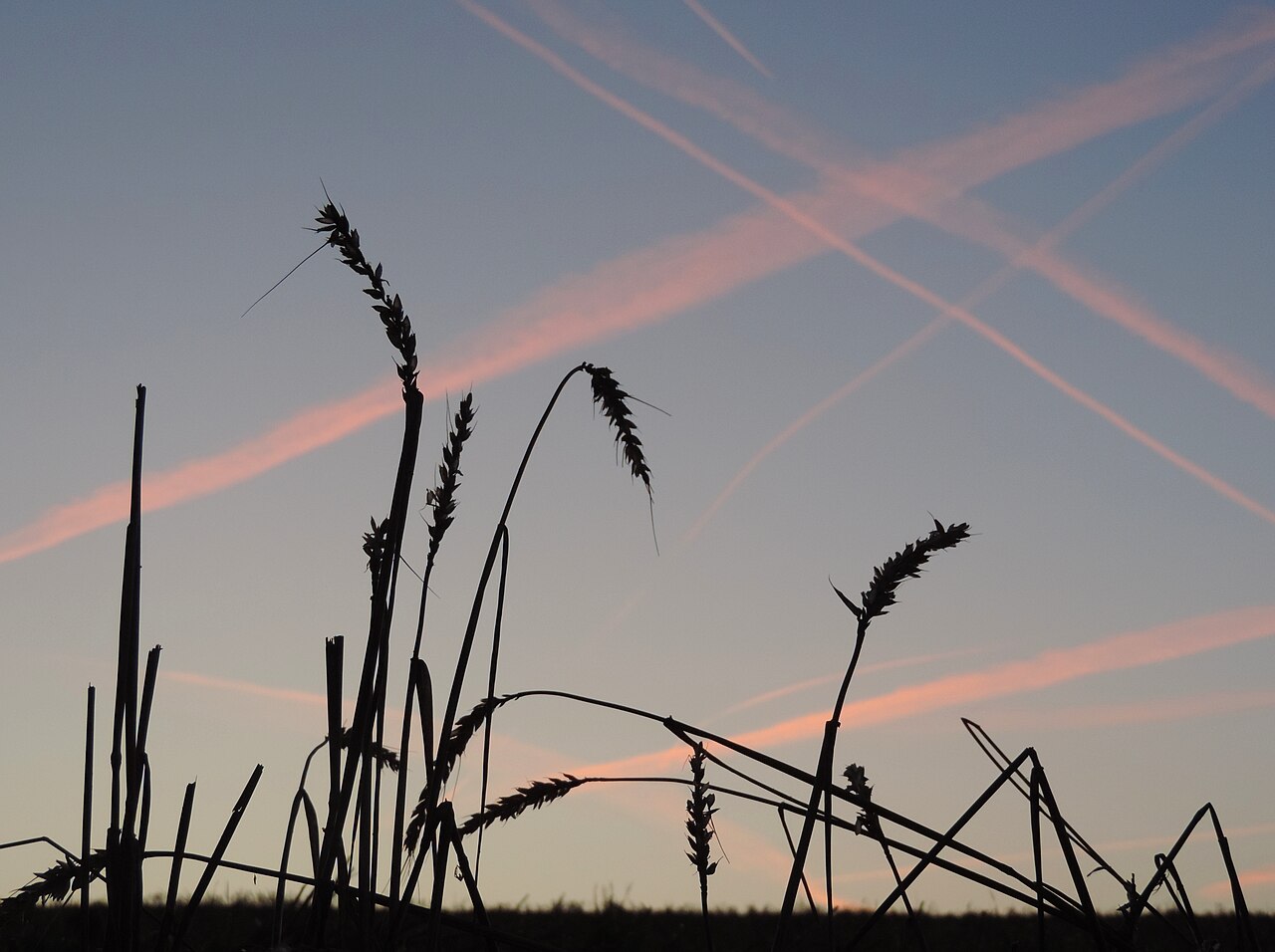
Photo: Kilyann Le Hen, CC BY-SA 4.0, Wikimedia Commons

A Falcon research aircraft flew just 30 metres from an Embraer E195-E2 over Germany to study the effect of fuel on condensation trails. According to Air Journal, initial measurements show fewer sulphur particles with the test fuel. This is a good opportunity to look at what these trails actually are, and why they matter just as much to the meteorology as to the aerodynamics taught in pilot training.
What the Flight Test Reveals
The experiment described by Air Journal paired an Embraer E195-E2 flying normally with a specially instrumented Falcon aircraft, flying at very close range to sample the engine plume directly. The aim is to compare the effect of different fuels on the composition of the white trails that sometimes appear behind an aircraft at altitude. According to Air Journal, initial measurements point to a reduction in sulphur particles with the test fuel — an encouraging but still partial result.
This type of protocol — a target aircraft closely shadowed by a measurement aircraft — is a classic method in atmospheric research applied to aviation. It allows researchers to capture the composition of exhaust gases before they disperse into the surrounding air, at a stage where the influence of the fuel can still be measured precisely. This is raw data, which then needs to be interpreted in light of cloud physics and climate science.
As the Air Journal article points out, the question that remains open is whether fewer sulphur particles really translate into fewer ice crystals, and therefore a reduced warming effect. In other words, a laboratory result only counts as climate progress if it holds up at the scale of the full phenomenon.
Why a Contrail Forms
A condensation trail, or contrail, appears when the warm, moist air expelled by jet engines meets ambient air that is very cold and already close to water vapour saturation. The water vapour produced by burning kerosene then condenses almost instantly into tiny droplets, which freeze immediately into ice crystals due to the very low temperatures found at high altitude, often below minus forty degrees.
The particles emitted by the engine, particularly soot and sulphur compounds, act as condensation nuclei: they provide a surface onto which water vapour can attach more easily. The fewer and less active these nuclei are, the less readily the contrail forms, or the less dense it is. This is exactly what the test reported by Air Journal is about — finding a fuel that limits this phenomenon.
These concepts come straight from the meteorology syllabus for the BIA and the PPL, where students study cloud formation through the condensation and freezing of water vapour. Understanding a contrail means applying the same mechanisms that explain the natural formation of cirrus clouds at high altitude.
A Climate Issue Beyond CO2
For a long time, most of the attention paid to aviation’s climate impact focused on carbon dioxide emissions. Condensation trails, when they persist and turn into artificial cirrus clouds, have a radiative effect of their own, trapping some of the infrared radiation reflected back from the Earth. This phenomenon, known as non-CO2 radiative forcing, is receiving growing attention in aeronautical research.
The value of work like that carried out in Germany is therefore twofold: reducing particle emissions at the source, while also seeking to better understand the precise atmospheric conditions under which a contrail turns into a persistent cloud. Parameters such as relative humidity, temperature and cruising altitude all come into play, which also opens up the possibility of simple route or altitude adjustments to avoid the areas most prone to persistent contrails.
For a future pilot, bearing in mind that aviation’s climate impact isn’t just about fuel burned is a good way to understand why decarbonisation in the sector is advancing on several fronts at once — fuel, flight trajectory and engine technology.
What This Means for Your Revision
Part of why this news story has drawn attention is that it connects two subjects often studied separately in aeronautical theory: meteorology and engine knowledge. A BIA or PPL multiple-choice question could easily ask about contrail formation from the angle of air saturation, while an ATPL question on environment or propulsion could focus on the link between fuel composition and emissions.
To make progress on this kind of cross-cutting topic, it’s best to revise meteorology and flight mechanics while keeping their points of overlap in mind, rather than studying them in isolation. On ForAllPilots, the quiz sets cover these concepts by subject and by licence, with flashcards to help you memorise key mechanisms such as condensation or the freezing of water vapour.
If a concept still feels unclear, such as the difference between a condensation nucleus and simple saturation, the AI Instructor lets you ask your question in writing and get an explanation tailored to your level, without waiting for your next lesson. It’s a way of turning a technical news story into a concrete revision opportunity.