Aviation news
Royal Brunei chooses Rolls-Royce for its 787s
By ForAllPilots · Published · 3 min read
Reviewed and approved by the site's editor before publication. Our method (FR)
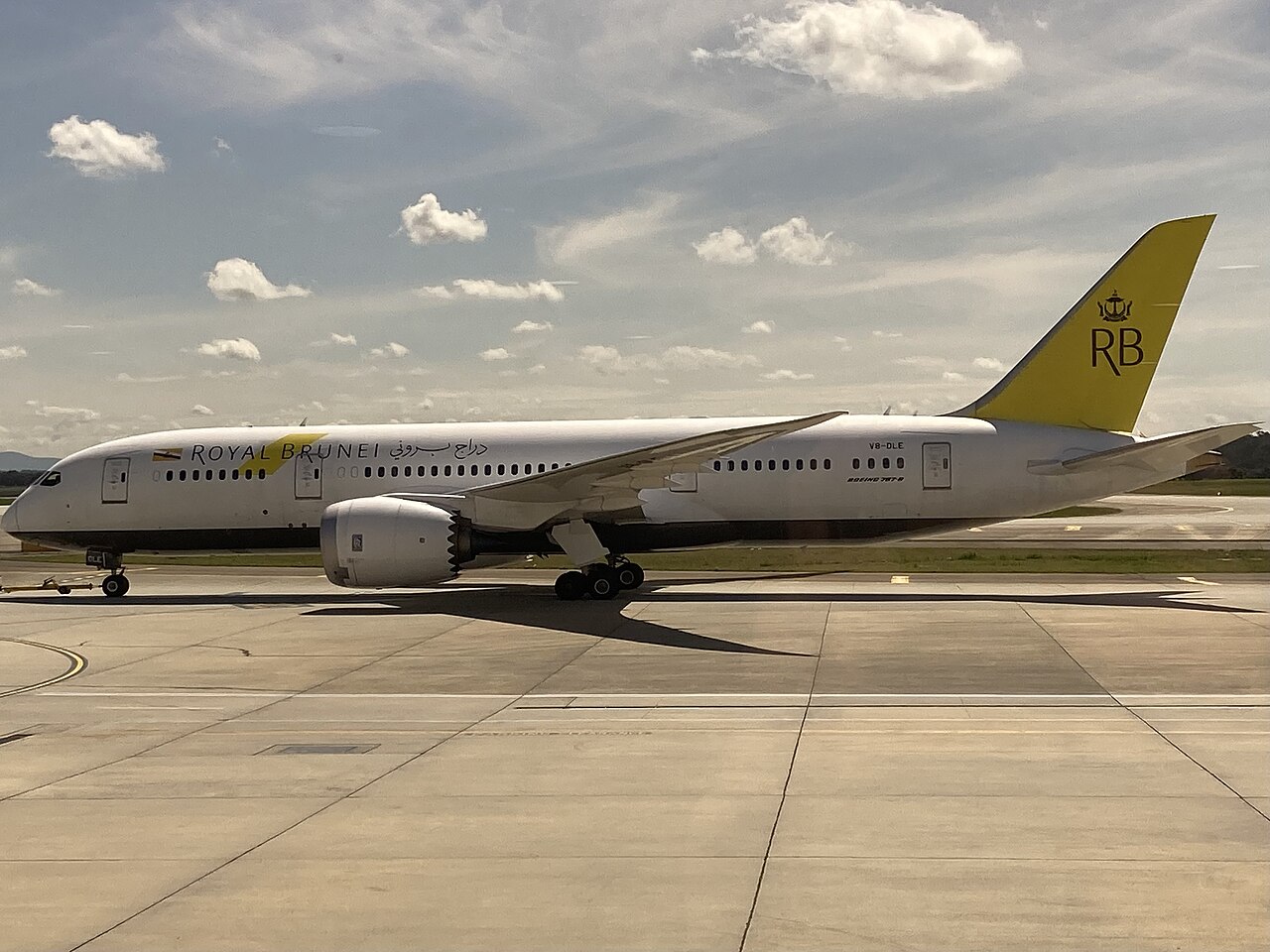
Photo: DaHuzyBru, CC BY-SA 4.0, Wikimedia Commons

Royal Brunei Airlines has confirmed its choice of Rolls-Royce as engine manufacturer for its new Boeing 787 fleet, with an order for Trent 1000 XE engines. An industrial decision that may seem trivial to the public, but it illustrates a principle every student pilot must master: the same aircraft type can fly with different engines, and that choice is never neutral.
What Rolls-Royce announced
According to the Journal de l'Aviation, Rolls-Royce announced that Royal Brunei Airlines had placed an order for eight Trent 1000 XE engines, an updated version of the Trent 1000 family already in service on other Boeing 787s around the world. This order accompanies the renewal of the long-haul fleet of the airline of the Sultanate of Brunei, which serves Asia and Australia in particular from its hub at Bandar Seri Begawan.
The choice was by no means automatic. The Boeing 787 Dreamliner is in fact one of the few airliner programmes to offer two competing powerplant options from the design stage: the Rolls-Royce Trent 1000 and the General Electric GEnx. An airline ordering a 787 therefore has to choose between the two, and that decision carries consequences that go well beyond a simple commercial choice.
One aircraft, two engine families
For a student preparing for the ATPL, or discovering the mechanics of flight at PPL level, this case is a good illustration of a simple but often misunderstood notion: the airframe and the powerplant are certified together, but are not permanently tied to one another. Airbus and Boeing design their programmes to accept several engine manufacturers, leaving each airline to choose the one that best suits its route network, its existing fleet, or its maintenance contracts.
This freedom of choice comes at a cost: it complicates training for both pilots and engineers, since a type rating on a Trent-powered Boeing 787 does not automatically transfer all the systems knowledge needed for a GEnx-powered 787. The engine parameters displayed on the flight deck, the failure procedures, and certain limitations are not identical between the two. This is one of the reasons why the Type Rating for a modern aircraft always includes the specific engine variant operated by the airline training the pilot.
Why this choice matters for an airline
Choosing an engine manufacturer commits an airline for several decades. It determines maintenance contracts, spare parts availability, ground technical crew training, and sometimes even the aircraft's resale value on the second-hand market. A fleet with a consistent engine type also simplifies spare parts inventory management and the mobility of engineers between aircraft.
For an airline the size of Royal Brunei, which operates a small fleet, this technical consistency often outweighs the initial purchase price of the engines. Sticking with the same engine manufacturer from one aircraft generation to the next, or aligning with the one already familiar to its maintenance teams, reduces the hidden costs linked to training and spare parts logistics.
What to take away for your revision
If you're preparing for the PPL or ATPL, focus on the general principle rather than the specific details of this particular order. In the Airframe, Engine and Systems subject, questions often focus on the certification logic of a turbofan engine, its monitored parameters (N1, N2, EGT depending on the type) and the associated limitations, without requiring you to know the list of engine manufacturers available on each aircraft programme.
On the other hand, understanding that a Boeing 787 or an Airbus A350 can exist in several engine variants helps you avoid over-generalising information read about one aircraft type to every example in service. This is a useful distinction both for theoretical multiple-choice questions and for the general aviation knowledge expected of a future airline pilot during a selection interview.
Practising the Airframe, Engine and Systems subject
On ForAllPilots, the Airframe, Engine and Systems subject is covered through sets of multiple-choice questions and flashcards organised by topic, whether you're preparing for the PPL or the ATPL. Timed mock exams then let you check that you can apply these concepts under conditions close to the real exam, with progress tracking by topic.
If a point about turbofan engines or aircraft systems remains unclear after a set of questions, the AI Instructor lets you ask your question in writing and get an explanation suited to your level, any time of day. It's a useful complement for revisiting a specific point without waiting for a session with an instructor at a club or flying school.