BIA, PPL & ATPL revision
PPL: revising Performance and Flight Planning
By ForAllPilots · Published · 4 min read
Reviewed and approved by the site's editor before publication. Our method (FR)
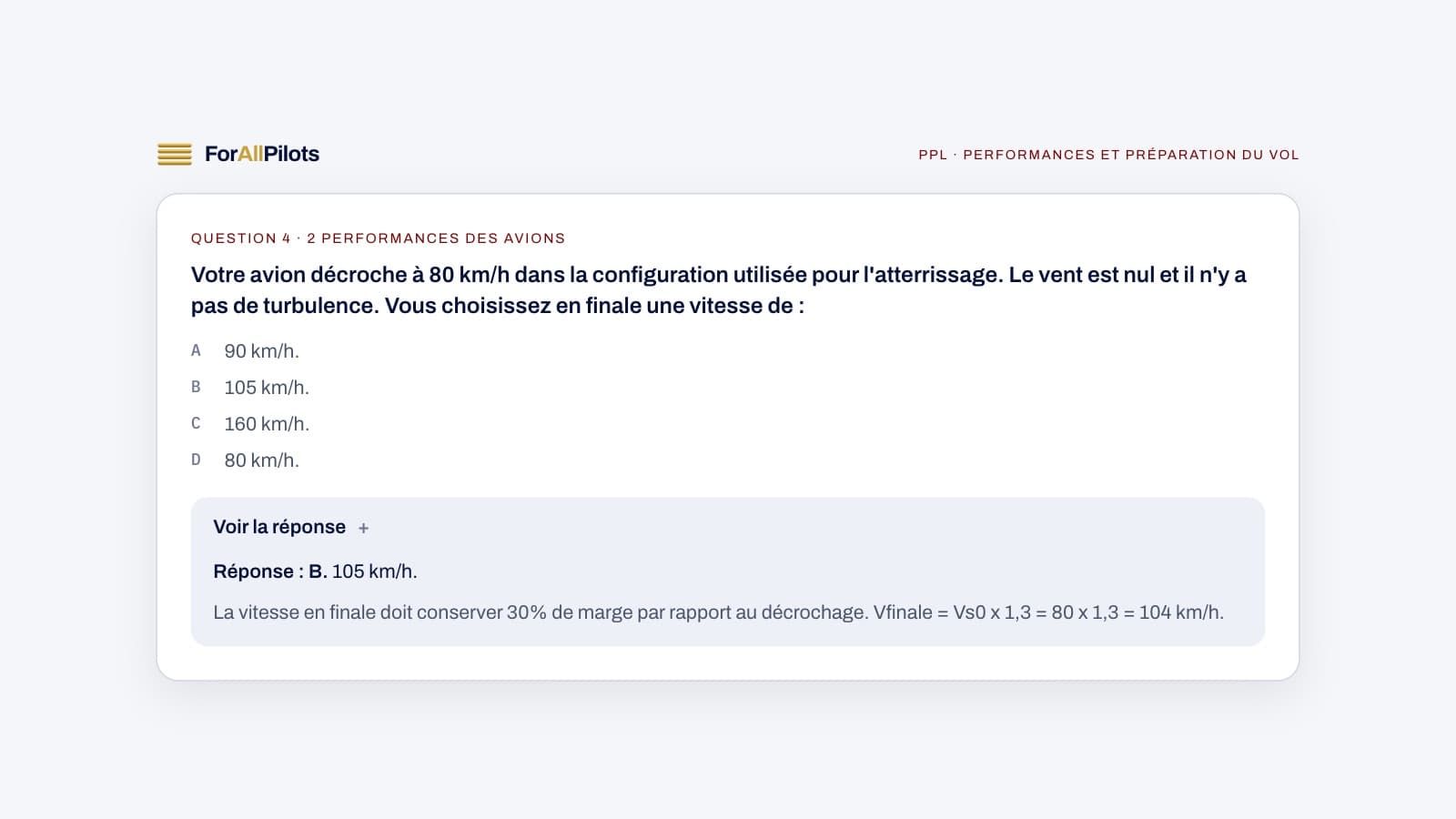
Performance and Flight Planning is a pivotal subject in the PPL theory syllabus: it ties together aerodynamics, mass and balance, and navigation into one concrete task — preparing an actual flight. Here's how to approach it without getting lost in tables and charts.
What this subject really covers
This subject covers two main areas. On one side, aircraft performance: take-off and landing distances, characteristic speeds, rate of climb, service ceiling, endurance and range. On the other, flight preparation itself: mass and balance calculations, fuel planning, choice of cruising altitude, and checking that the aircraft can safely complete the planned flight under the day's conditions.
The common thread is that nothing is ever fixed. The performance figures published by the manufacturer in the flight manual correspond to precise reference conditions: altitude, temperature, mass, runway state. Your job is to correct these reference values according to the actual conditions on the day of the flight.
This is what sets this subject apart from a simple table-reading exercise: it requires understanding why take-off distance increases with altitude or temperature, not just knowing where to read the figure. Once this principle is internalised, performance charts become logical tools rather than a source of anxiety.
The concepts most often confused
The first common confusion concerns altitudes. Pressure altitude, density altitude, and temperature-corrected density altitude are not the same thing, yet all three come into play when reading performance charts. Failing to convert correctly between them throws off the entire reasoning that follows, including take-off distance or rate-of-climb calculations.
The second confusion concerns mass. Empty mass, basic empty mass, take-off mass and maximum take-off mass follow one another in a mass and balance calculation, but each corresponds to a different step of the process. Many candidates mix up the order or forget to include diversion fuel in the final calculation.
Finally, the relationship between wind and runway distances is often misunderstood. A headwind shortens the required distance, a tailwind lengthens it, but the effect isn't symmetrical: a tailwind penalises performance more than an equivalent headwind improves it. Remembering this imbalance helps avoid a frequent MCQ mistake.
Common training mistakes
The first mistake is memorising a formula without understanding the variables that make it up. Faced with a question that presents a chart from a slightly different angle than one already seen, a candidate who has only learned a method by rote gets stuck, while one who has understood the underlying physical logic can find their way back.
The second mistake concerns units. Knots, kilometres per hour, feet, metres, litres, kilograms: a mass and balance calculation or a distance calculation often mixes several systems, and a single forgotten conversion is enough to throw off the whole answer. Get into the habit of systematically checking the required unit before answering.
The third mistake is overlooking safety margins. A question may ask for the required take-off distance with a regulatory margin applied, not the raw distance read off the chart. Reading the question through to the end, and identifying exactly what is being asked, avoids many of the classic traps in this subject.
A progressive revision plan
Start by consolidating vocabulary and basic definitions: pressure altitude, density altitude, reference masses, characteristic speeds. The site's glossary is useful at this stage to check a definition without having to reopen an entire course, and it remains freely accessible throughout your preparation.
Continue with targeted MCQ sets on take-off and landing performance, then on mass and balance calculations. Work through each set calmly, noting recurring mistakes rather than chasing speed. Flashcards are particularly well suited here to help you retain the formulas and regulatory thresholds you'll need to recall quickly on exam day.
Once both areas are mastered separately, practise complete cases that combine performance and flight preparation, as in a real-world situation involving mass and balance, fuel calculation and distance checks. Finish your preparation with timed mock exams, which reproduce time pressure and force you to prioritise calculation steps without dwelling too long on any single point.
How to train effectively with ForAllPilots
On ForAllPilots, the PPL's Performance and Flight Planning subject is covered by a bank of exam-format practice questions, with themed sets to help you progress block by block. The results shown after each set help you identify the sub-topics where you're still struggling, whether that's take-off distances, balance, or fuel calculations.
If a correction isn't enough to understand why an answer is correct, the AI Instructor lets you ask your question in writing and get a detailed explanation, any time of day. This is especially useful for questions that combine several concepts, where you need to understand the chain of reasoning rather than memorise an isolated result.
Keep in mind that the ultimate goal isn't just to pass a set of MCQs, but to know how to prepare a flight under real conditions. Timed mock exams help you measure whether you're able to carry out this complete reasoning process within the allotted time — an essential condition for success on exam day.