BIA, PPL & ATPL revision
PPL: revising Human Performance
By ForAllPilots · Published · 4 min read
Reviewed and approved by the site's editor before publication. Our method (FR)
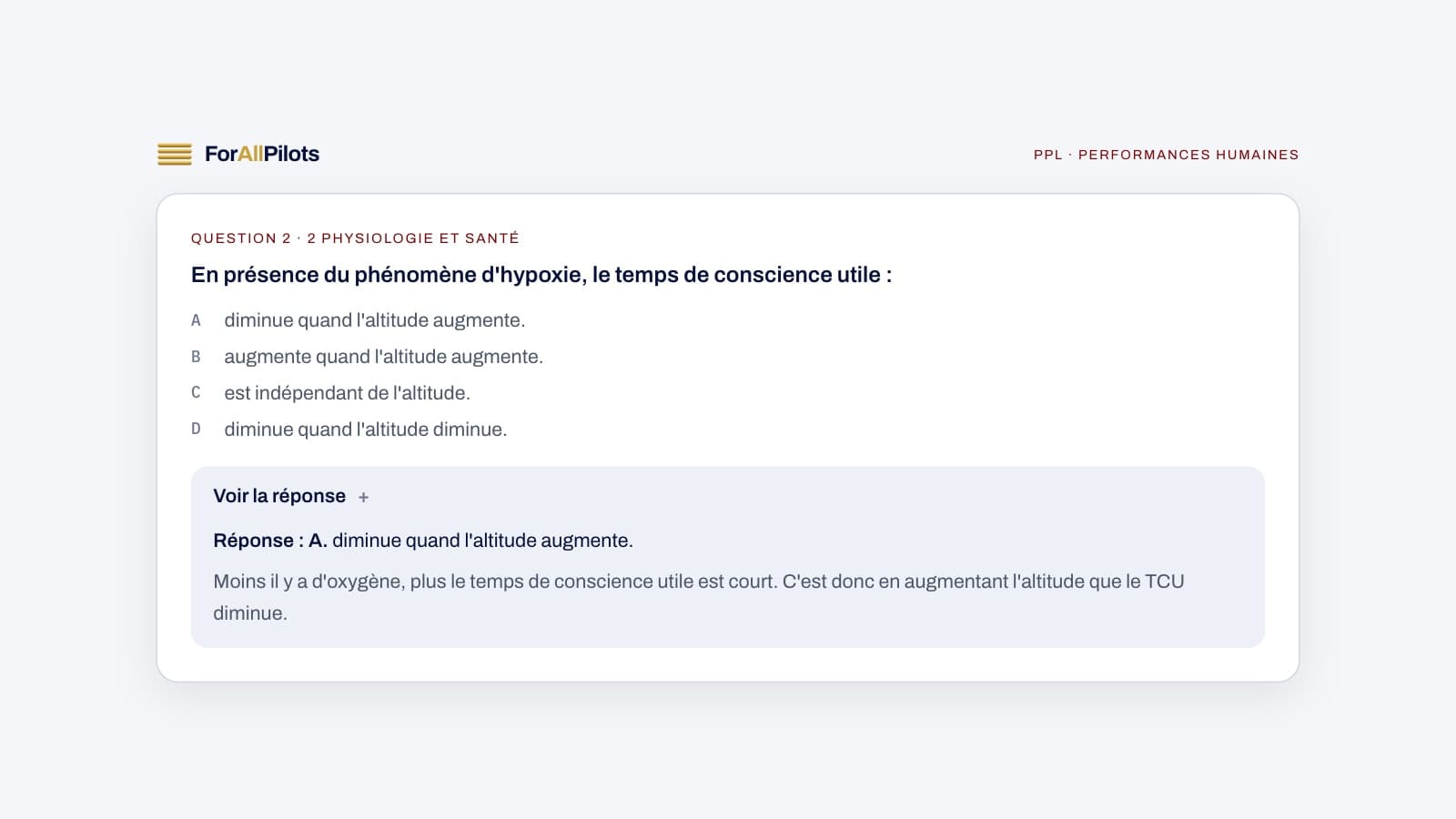
Human Performance is a subject apart in the PPL theoretical syllabus: there are no formulas to apply, just concepts from physiology and psychology that need to be understood and linked together. It's often under-revised, even though it comes up regularly in the exam and sheds light on very concrete in-flight situations. Here's how to structure your revision, avoid the classic pitfalls, and train effectively.
What the subject covers
Human Performance covers everything related to how a pilot's body and mind function in flight. It includes the basic physiology linked to altitude: hypoxia, the effects of pressure, and the role of oxygen and blood circulation. Added to this are the senses involved in flying, particularly vision and the inner ear, whose limitations explain much of the sensory illusions encountered in flight.
Another part of the subject deals with the factors that degrade performance: fatigue, stress, workload, alcohol, medication, as well as sleep and its cycles. Finally, the subject covers decision-making, error management and the basics of human factors, sometimes grouped under the term CRM, even though the PPL only requires a simplified approach to it. Altogether, this forms more of a conceptual foundation than a calculation-based one, which changes the way you should learn it.
This subject also stands out for being cross-cutting: it sheds light on points covered elsewhere, such as decision-making in navigation or managing a deteriorating situation. Understanding Human Performance therefore indirectly helps you better grasp other chapters of the PPL syllabus.
The concepts most often confused
The first classic mix-up is between hypoxia and hyperventilation. Both can occur in flight, sometimes with similar signs such as dizziness or a feeling of being unwell, but their mechanisms and the responses they require are different: one is a lack of oxygen, the other an excess elimination of carbon dioxide caused by breathing too fast. Confusing the two leads to remembering the wrong course of action.
Sensory illusions are another tricky area. The somatogravic and somatogyral illusions, for example, are often mixed up because both involve the inner ear and both create a false sensation of movement. It's worth clearly distinguishing what results from linear acceleration from what results from rotation, since the flight situations that trigger them are not the same.
Finally, many candidates mix up acute fatigue and chronic fatigue, or underestimate the role of positive stress as opposed to negative stress. Yet these nuances are tested regularly, because they correspond to real situations where the expected response depends precisely on the type of fatigue or stress involved.
Common revision mistakes
The first mistake is to treat this subject as a simple exercise in memorising definitions, without trying to understand the mechanism behind each concept. Yet an exam question often rephrases a concrete situation rather than asking for a bare definition. Learning by rote without understanding the “why” makes these rephrased questions hard to handle.
Another common mistake is overlooking the links between concepts. Hypoxia, fatigue and stress interact with one another and together degrade decision-making: artificially isolating them makes it harder to understand situations where they combine. Likewise, some candidates leave this subject until last, thinking it's secondary, when in fact it needs time to “sink in” so that the closely related concepts mentioned above can be properly told apart.
Finally, many candidates simply reread their notes without ever actively testing themselves. Human Performance lends itself particularly well to self-assessment, since the pitfalls mainly come from confusion between neighbouring concepts — something a simple reread doesn't always reveal.
A progressive revision plan
Start with the physiology related to altitude and oxygenation, as it underpins several other chapters, notably sensory illusions. Take the time to properly understand the mechanisms before memorising the symptoms associated with each condition.
Next, move on to the senses and sensory illusions, building comparison tables for each pair of closely related concepts. This is the stage where confusion is most common, so it deserves the most time and the most spaced repetition.
Then move on to the factors that degrade performance: fatigue, stress, sleep, substances. Finish with decision-making and the basics of human factors, which naturally tie together everything covered before. Splitting the subject into four blocks like this lets you revise progressively without feeling overwhelmed by the range of concepts.
How to train with ForAllPilots
In the app, start each block with a set of MCQs targeted at the Human Performance subject, to quickly spot which concepts are still shaky. Flashcards are particularly well suited here, as they let you work on the pairs of concepts that get confused — such as the two types of sensory illusions or the two forms of fatigue — until the distinction becomes automatic.
The glossary, which is free, is a good habit to fall back on whenever a term feels unclear: it lets you check a definition without interrupting your revision session for long. Once you've built a solid foundation, move on to timed mock exams to get used to answering quickly on questions that mix several concepts from the subject, just as they will on exam day.
If a concept still resists after several rounds of flashcards, the AI Instructor lets you type out the exact point you're stuck on and get a tailored explanation before going back to the MCQ sets. Finally, check your results regularly to track your progress on this specific subject and adjust your revision time based on your remaining weak points.