BIA, PPL & ATPL revision
ATPL: Revising the Instrumentation Subject
By ForAllPilots · Published · 3 min read
Reviewed and approved by the site's editor before publication. Our method (FR)
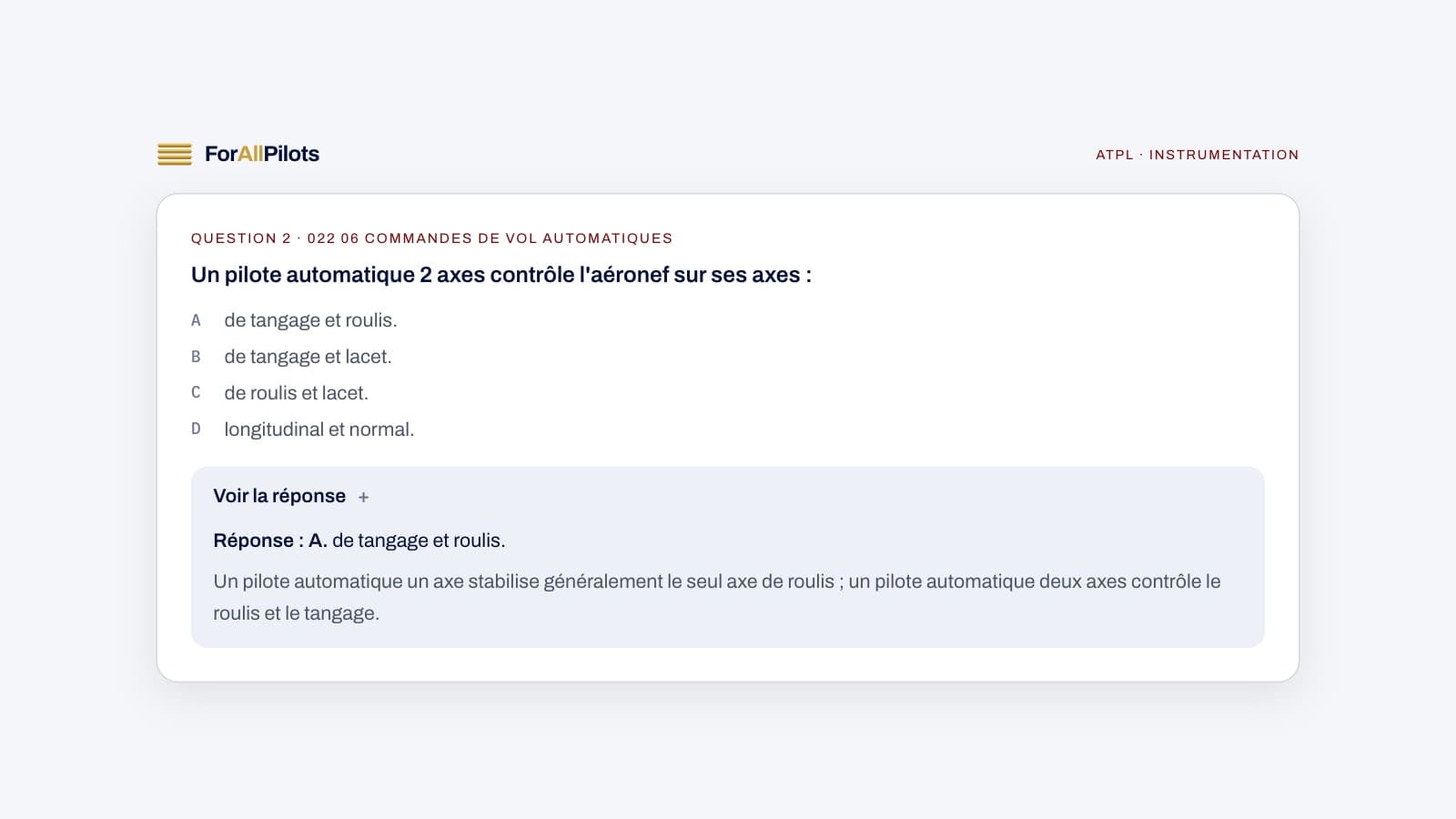
Instrumentation is an ATPL theoretical subject that can be confusing due to its blend of physics, electronics and system logic. It requires understanding how sensors work just as much as how the displays that present their data work. Here's how to structure your revision and train effectively.
What the Instrumentation subject covers
Instrumentation covers the onboard instruments used to fly and monitor the aircraft: pitot-static instruments (airspeed indicator, altimeter, vertical speed indicator), gyroscopic instruments (attitude indicator, heading indicator), engine parameter measurement systems, and modern electronic flight display architectures. It also includes the sensors that feed these instruments, such as static and dynamic pressure probes, as well as the associated electrical and pneumatic circuits.
This subject also covers the physical principles that explain how each instrument works: gyroscopic effect, pressure differential, electromagnetic induction. Understanding why an instrument displays a given value, not just how to read it, is what sets solid revision apart from simple rote learning.
Finally, part of the syllabus deals with classic failures, their causes and their effects on the display. This aspect is essential, since many practice questions focus specifically on identifying a fault from an instrument's unusual behaviour.
The concepts most often confused
The first classic point of confusion concerns pressure sources. Many candidates mix up the role of the static port and that of the pitot (dynamic) port, which prevents them from understanding why a given instrument reacts in a certain way in the event of a blockage. Each pitot-static instrument should be clearly linked to the pressure source(s) it depends on, rather than memorising isolated cases.
The second point of confusion concerns gyroscopic instruments. The principles of rigidity in space and precession are often reversed or misapplied, making it difficult to understand pitch, bank or turn errors. It's helpful to go back to the gyroscope's two fundamental properties before tackling the errors specific to each instrument.
Another frequent source of error involves redundant systems and their power sources. Knowing that an instrument exists isn't enough: you also need to know what it depends on to function, and what happens in the event of a partial loss of electrical or pneumatic power.
Common mistakes when training
The first mistake is learning about instruments one by one, without linking them together. Yet many practice questions require reasoning about the connections between several instruments, for example to identify a common fault from several symptoms that are consistent with one another.
The second mistake is neglecting the physics in favour of purely functional description. Knowing that an altimeter indicates an altitude isn't enough if you can't explain why a change in temperature or atmospheric pressure alters that reading. Practice questions often test this kind of reasoning, not just the recall of a definition.
Finally, many candidates underestimate the technical vocabulary specific to this subject. Terms related to sensors, circuits and failure modes come up regularly under closely related wordings, and a mix-up in vocabulary is often enough to tip an answer the wrong way.
A progressive revision plan
Start with the physical fundamentals: atmospheric pressure, gyroscopic effect, basic electrical principles. This stage determines your understanding of everything that follows, even though it may seem far removed from the cockpit.
Then move on instrument by instrument, systematically linking physical principle, power source and possible errors. Treat the pitot-static instruments as one coherent group, then the gyroscopic instruments as a second group, before moving on to more modern display architectures.
In a third stage, focus on failures and their signatures: which abnormal behaviour corresponds to which cause. This is often the most rewarding part of revision towards the end, since it draws on everything you've learned so far.
Finish with a cross-cutting synthesis phase, linking the instruments together and reviewing the technical vocabulary that still gives you trouble. An aviation glossary, available for free on ForAllPilots, is useful at this stage to clarify the terms that come up most often.
How to train effectively
The MCQ series on ForAllPilots let you train subject by subject, using banks of practice questions in the exam format. For Instrumentation, work through small series focused on one group of instruments before mixing topics together, so you can check that you're not just reasoning by elimination.
Flashcards are particularly well suited to fixing the physical principles and technical definitions, which are numerous in this subject. Timed mock exams come next, to get you used to the pace of the actual exam and to check that you can hold up across the whole syllabus, not just on the points you already master.
If a concept remains unclear after several attempts, the AI Instructor lets you ask precise questions and get targeted explanations, alongside your own revision. The results, available after each series, also help you spot which groups of instruments you still need to work on before moving on to the final synthesis.