BIA, PPL & ATPL revision
BIA: Revising Aircraft Studies
By ForAllPilots · Published · 4 min read
Reviewed and approved by the site's editor before publication. Our method (FR)
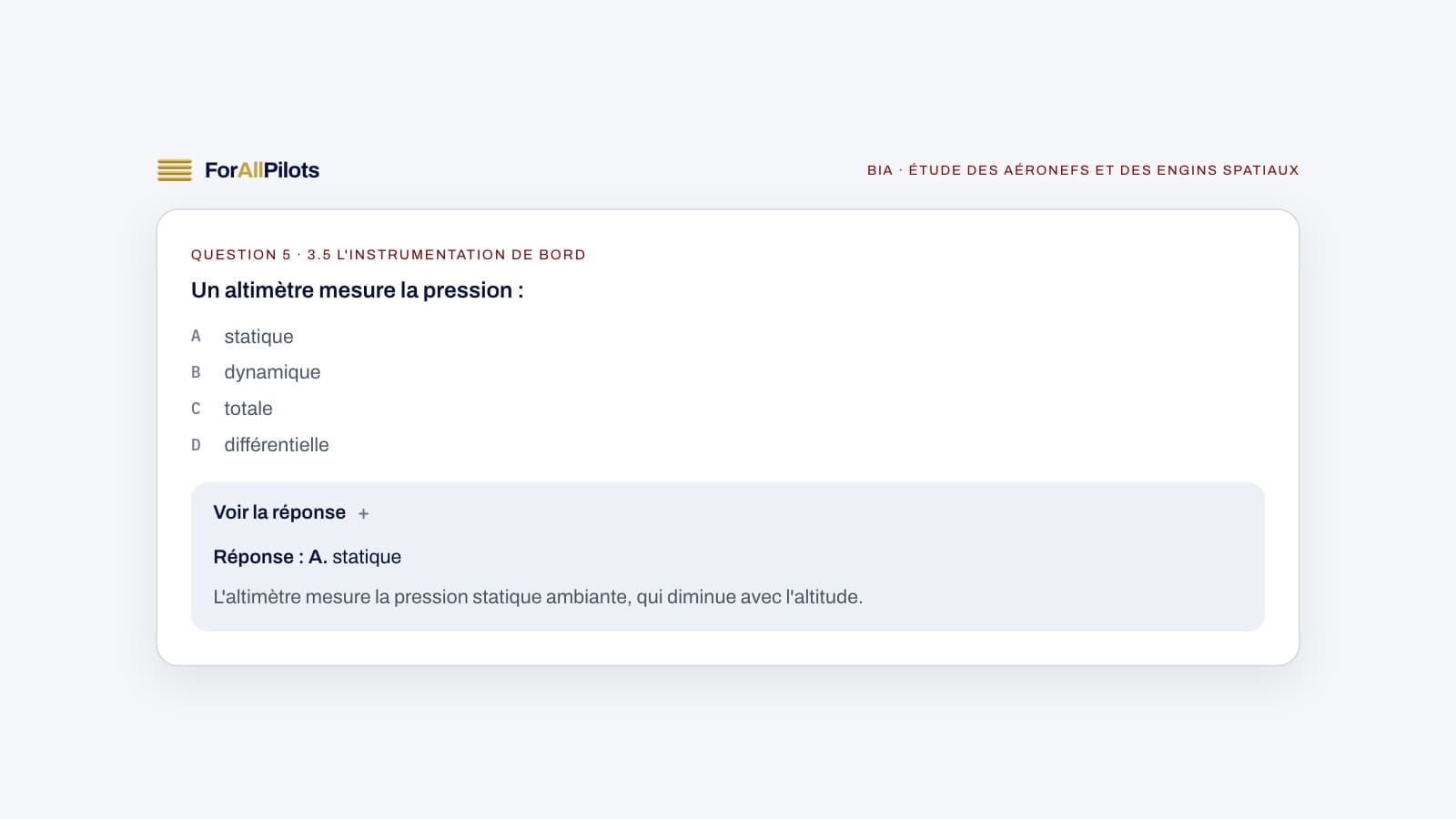
Aircraft and spacecraft studies is one of the most concrete subjects in the BIA, but also one where concepts get mixed up most easily. Here's how to structure it, avoid classic mix-ups, and train effectively right up to the exam.
What this subject covers
This BIA subject covers a broad field: the major aircraft families (aeroplanes, gliders, helicopters, balloons, microlights), their general structure, the materials used in aeronautical construction, the different types of propulsion, as well as an introduction to spacecraft and the principles that allow a launcher or a satellite to function. It's a descriptive subject as much as a technical one.
It differs from aerodynamics and flight mechanics, which focus on forces and their balance. Here, the emphasis is on design: why a particular wing, material, or engine type was chosen for a particular use. Understanding this distinction helps you avoid confusing the two subjects when a question addresses both the shape of a wing and its aerodynamic role.
The syllabus also clearly distinguishes aircraft, which operate within the atmosphere, from spacecraft, which operate beyond it. This boundary determines the physical principles at play: lift and drag on one side, thrust and orbital velocity on the other. Keeping this distinction in mind structures the whole subject and prevents you from applying aerodynamic reasoning to a space object.
Concepts that are often confused
The first common mix-up concerns aircraft families and their methods of lift generation. A glider and an aeroplane share a similar architecture, but their relationship to propulsion is completely different. A helicopter, meanwhile, generates lift through the rotation of its main rotor rather than through a fixed wing, which entirely changes its flight logic. Confusing these lift-generation principles is a classic mistake early in revision.
The second mix-up concerns engine types. Piston engines, turbojets, turboprops and turbofans differ not only in power but in their operating principle and their field of application. Many candidates memorise names without linking each engine to its typical use, which makes synthesis questions harder to handle.
Finally, on the space side, launchers and satellites are often confused, as are low orbit and geostationary orbit. Yet these concepts are simple once you link them to a concrete purpose: a launcher is used to place something into orbit, and a satellite then stays there to carry out a mission. Linking each term to its function, rather than just its definition, helps you retain it in the long run.
Common mistakes in revision and in the exam
The first mistake is trying to memorise everything by rote without building logical reference points. This subject contains a lot of technical vocabulary, and mechanical learning without understanding quickly falls apart under exam pressure. It's better to understand why a structure or material is used than to memorise an isolated list.
The second mistake is neglecting precise vocabulary. A test question can hinge on a subtle nuance between two similar terms, for example between a spar and a frame, or between a horizontal stabiliser and a vertical stabiliser. Without a clear mental picture of each element, these distinctions remain vague and cost avoidable points.
Third mistake: underestimating the space section because it seems marginal. It represents a genuine part of the syllabus and deserves the same level of attention as the aircraft section. Finally, many candidates revise this subject in isolation without linking it to aerodynamics or propulsion, even though these subjects complement and illuminate one another in the exam.
A progressive revision plan
Start with the major aircraft families and their general characteristics: aeroplane, glider, helicopter, balloon, microlight. Build simple visual reference points for each family before going into the details of their structures. This foundation serves as a guiding thread for the rest of the subject.
Continue with structure and materials: wings, fuselage, tail assembly, traditional and composite materials. Then take the time to clearly distinguish the types of propulsion, linking each engine to a concrete example of use rather than just a definition. Finish with the spacecraft section, connecting it wherever possible to what you've already covered on propulsion and structures.
Once you've been through this sequence once, go back over the subject as a whole, cross-referencing themes: compare, for example, the structure of an aeroplane with that of a launcher, or the propulsion of a jet aircraft with that of a rocket. This cross-referencing consolidates understanding and better prepares you for questions that combine several concepts.
How to train effectively
On the ForAllPilots app, start with flashcards to fix the technical vocabulary in place: names of aircraft parts, engine types, terms related to spacecraft. They're well suited to this subject, which is rich in precise definitions, and let you repeat terms until they become automatic.
Follow up with targeted MCQ sets by theme to check your understanding before moving on. The glossary, which is free, is useful for clarifying a definition without interrupting your revision session. When you get stuck on a concept, the AI Instructor lets you ask a precise question and get a written explanation that rephrases the point you misunderstood.
Once you've made good progress through the subject, move on to timed mock exams to get used to the real pace of the test and the way subjects alternate. Then review your results to spot recurring problem areas, whether structure, propulsion, or the space section, and go back over the corresponding flashcards before doing another set.