BIA, PPL & ATPL revision
Aerodynamics and Flight Mechanics: How to Revise This Subject from BIA to ATPL
By ForAllPilots · Published · 3 min read
Reviewed and approved by the site's editor before publication. Our method (FR)
Aerodynamics scares a lot of candidates, often because it seems abstract and packed with formulas. Yet it's a subject that builds up in layers, and it becomes logical as soon as you understand the basic principles. Here's how to approach it without getting lost, whatever licence level you're working towards.
Why this subject seems harder than it actually is
Aerodynamics and flight mechanics have a reputation for being a complicated subject, even though they're mostly based on physical principles that link logically to one another. The problem often lies in the revision method: many candidates try to learn formulas or diagrams by heart, without understanding the reasoning that connects them.
As a result, as soon as a question strays slightly from the usual format or is phrased differently, rote memorisation simply isn't enough. The right approach is to first understand the why behind each phenomenon before memorising the how. Once that logic is in place, the concepts naturally follow on from one another.
Building the fundamentals before adding complexity
Whether you're preparing for the BIA, PPL or ATPL, the subject always follows the same structure. Everything starts with lift and drag, which explain why an aircraft flies and why it encounters resistance to forward motion. Once these two concepts are understood, you can move on to the stall, which is simply a direct consequence of exceeding the critical angle of attack.
Next come the concepts related to aircraft stability, the effects of flight controls, and then more specific flight regimes such as turning flight or high angle-of-attack configurations. By following this logical order, you avoid skimming over advanced concepts without having consolidated the fundamentals first — the most common mistake among candidates in a hurry.
Adjusting the depth of study to the licence you're targeting
The required level of depth naturally differs depending on the licence you're preparing for. For the BIA, the goal is to understand the broad principles qualitatively, without getting into complex calculations. It's mainly about being able to explain, in simple words and with clear diagrams, why an aircraft flies, turns or stalls.
For the PPL, the subject becomes denser, with more precise concepts such as load factors, the effects of centre of gravity position, and aircraft performance under varying conditions. For the ATPL, the required level rises further still, covering more technical topics such as compressibility effects and the finer points of high-speed flight mechanics. Adjusting your revision time to match the expected level of depth keeps you from wasting time on details outside the syllabus, or conversely, from staying too superficial.
Using diagrams as a memorisation tool
Aerodynamics is a highly visual subject, and diagrams are often more effective than lengthy written explanations. Get into the habit of redrawing the force diagrams, lift curves or flight control effects yourself, rather than simply looking at them in a course. The act of drawing helps fix the logic of the phenomenon in your memory.
This practice of redrawing is especially useful for concepts that build on one another, such as the effects of flap deflection on lift and drag at the same time. By redoing the diagrams several times, a few days apart, you strengthen long-term retention far more effectively than by passively re-reading course material.
Practising with varied questions before the exam
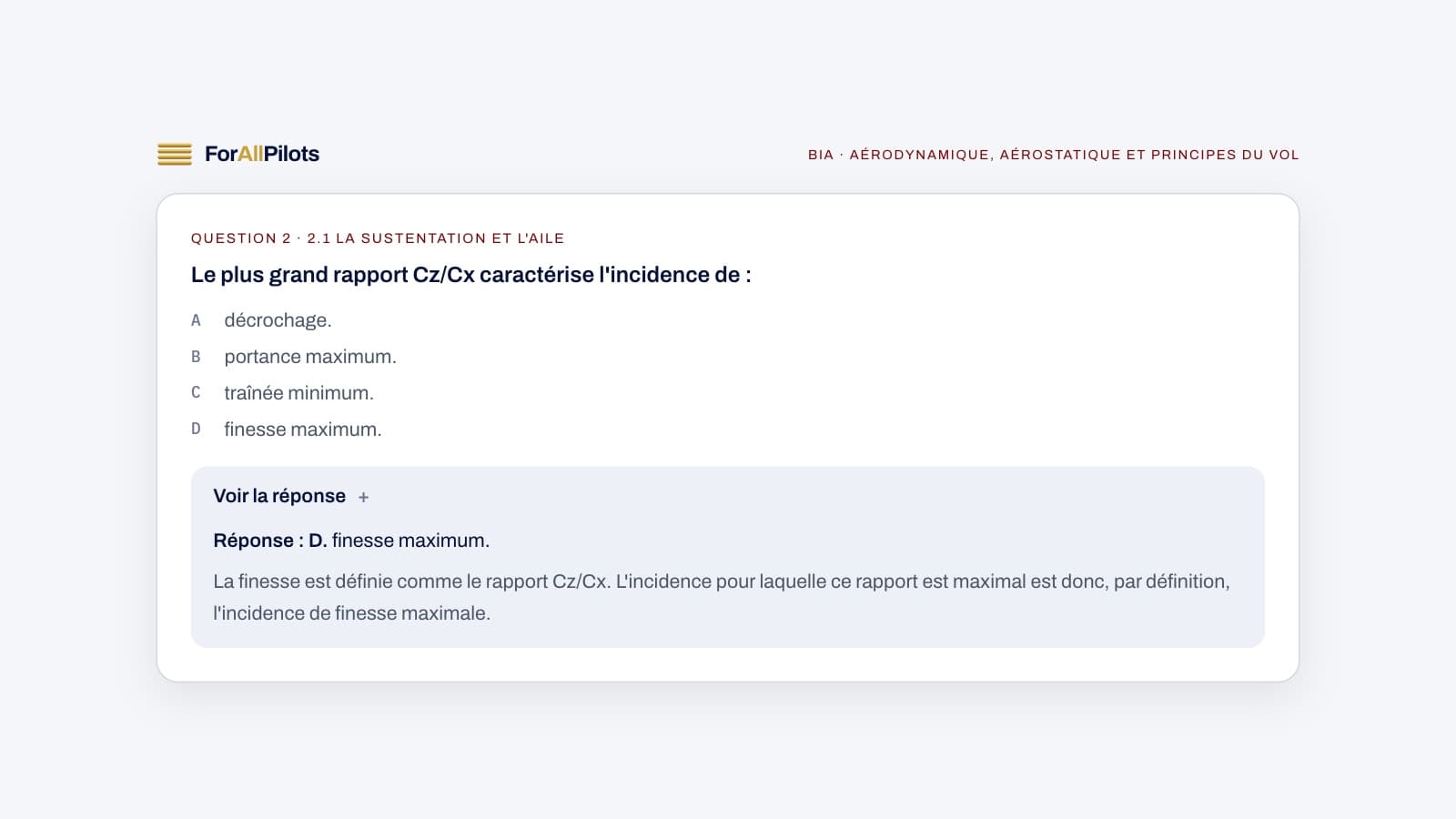
Once the fundamentals are understood, practising with sample questions remains essential to confirm your understanding. The goal isn't to memorise answers, but to check that you're able to apply the reasoning to situations phrased differently. Regularly vary the question format so you're not simply recognising a question you've already seen.
If a particular concept keeps giving you trouble after several attempts, always go back to the underlying physical principle rather than learning the answer by heart. It's this solid grasp of the fundamentals that will keep you at ease on exam day, even when faced with an unusual question.