BIA, PPL & ATPL revision
How to Plan Your Revision Schedule for the BIA, PPL or ATPL
By ForAllPilots · Published · 3 min read
Reviewed and approved by the site's editor before publication. Our method (FR)
Revising for an aviation theory exam is, above all, a question of organisation. Without a clear schedule, you risk spending too much time on one subject and not enough on another, or worse, starting too late. Here's how to structure your revision depending on the licence you're preparing for.
Why a schedule changes everything in your preparation
BIA, PPL and ATPL theory each cover several very different subjects: meteorology, navigation, air law, aerodynamics, principles of flight, and sometimes aviation English or performance, depending on the licence you're aiming for. Without a roadmap, it's tempting to focus only on the subjects you enjoy or find easy, leaving the drier ones by the wayside.
A schedule allows you to spread your time evenly, spot your weak points early enough to work on them, and keep an overall view of your progress. It's also an excellent way to reduce stress as the exam approaches, since you know exactly where you stand and what still needs to be covered.
Adapting the schedule to the licence you're targeting
The BIA is usually prepared over a school year, at a lighter pace since the syllabus remains accessible and the exams are less demanding. You can afford to work through it subject by subject, spending a few weeks on each before moving on to cross-topic revision.
The PPL requires tighter organisation, as the number of subjects increases along with the level of difficulty. It helps to break your schedule into two- to three-week blocks per subject, while always keeping one core subject active in parallel — air law, for instance, which calls for ongoing revision rather than a one-off effort.
ATPL theory, with its thirteen subjects, requires a schedule spanning several months, or even a year depending on your pace. The key is to group subjects that overlap, such as navigation and instruments, or meteorology and performance, so as to build bridges between areas of knowledge rather than treating them as artificially separate.
Balancing your time between theory and question practice
A common mistake is spending too much time on coursework and not enough on exam-style questions, or vice versa. The ideal approach is to alternate: a phase of discovering or re-reading a chapter, quickly followed by a set of questions to check what has actually been understood and retained.
The closer you get to your exam date, the more the proportion of time spent on questions should increase. In the final weeks, it's normal to spend most of your time on timed question sets, focusing on the subjects where your pass rate is still too low. This gradual shift lets you ease into real exam conditions rather than facing them abruptly.
Planning for cross-revision and final review phases
A good schedule isn't just about working through subjects one after another in a straight line. You also need to build in phases where you go back over subjects you've already covered, several weeks after finishing them, to check the knowledge has stuck. Memory needs repetition spaced out over time, not just a single intensive session.
In the last two to three weeks before the exam, shift into a final revision phase covering all subjects, with particular emphasis on those you're least comfortable with. This is the time to ramp up mock exams under conditions as close to the real thing as possible, to get your mind used to the pace and pressure of exam day.
Using digital tools to track your progress
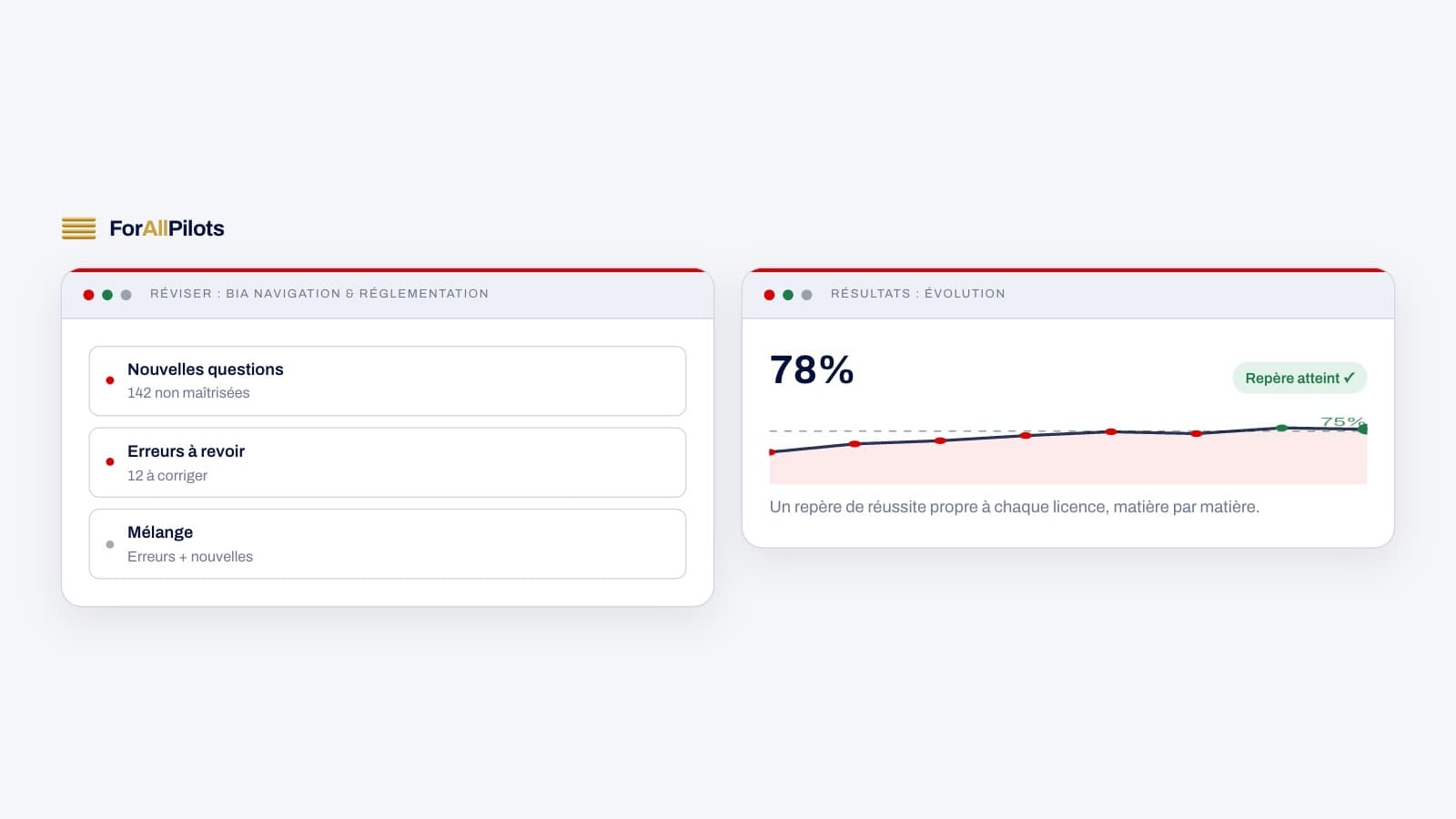
A paper schedule has its limits, particularly when it comes to seeing precisely where you stand in each subject. Online revision platforms such as ForAllPilots let you track your pass rate subject by subject, automatically identify topics that need more work, and adjust your schedule based on real data rather than gut feeling.
This precise tracking stops you wasting time on subjects you've already mastered and pushes you towards the ones that genuinely need attention. Combined with a well-thought-out schedule, it's one of the best ways to arrive at your theory exam with an even level across the whole syllabus, rather than a few strong points overshadowed by glaring weaknesses.