BIA, PPL & ATPL revision
BIA: revising Aviation English
By ForAllPilots · Published · 4 min read
Reviewed and approved by the site's editor before publication. Our method (FR)
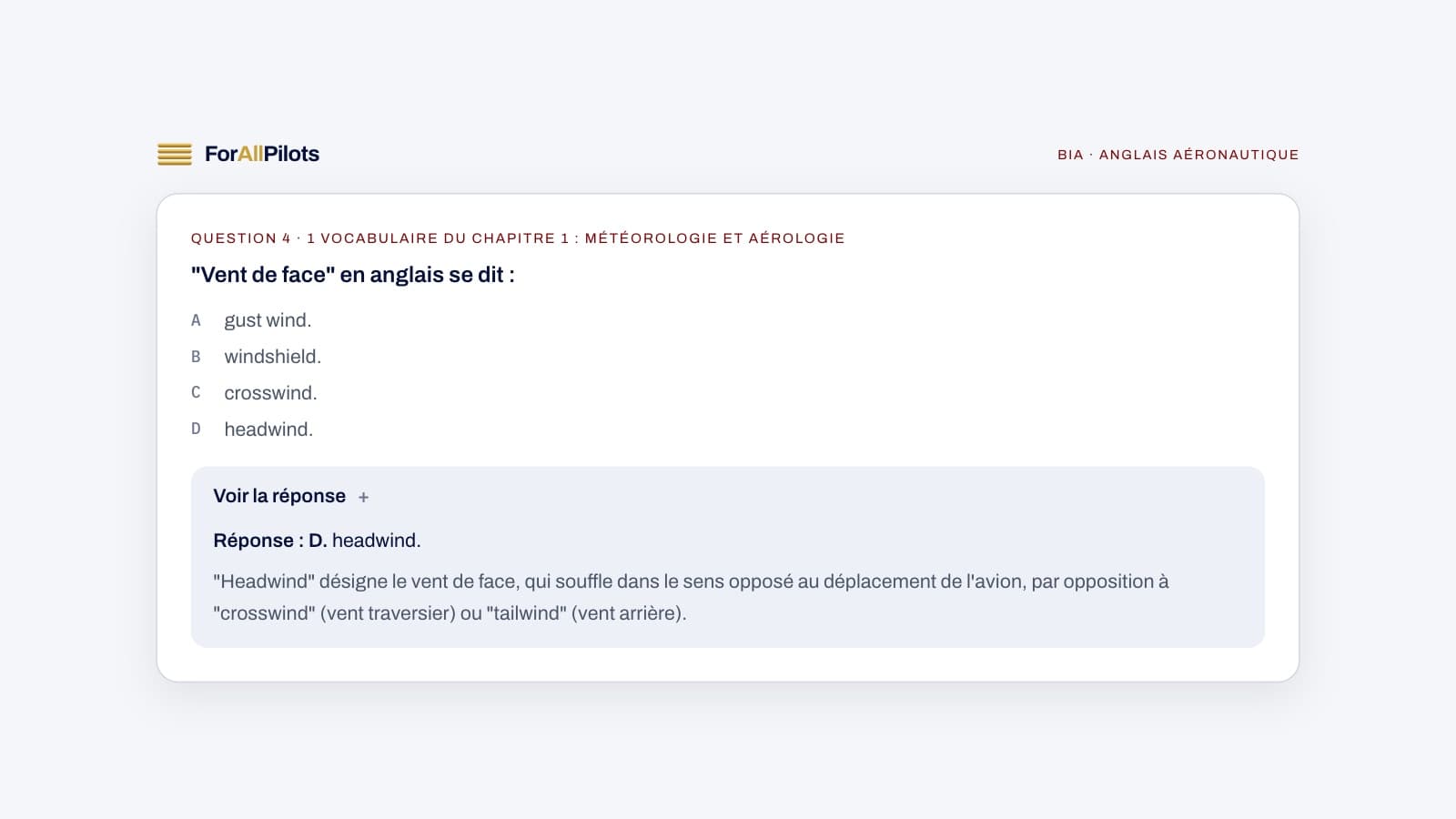
Aviation English is a BIA subject often taken lightly, because candidates assume they already speak some English. Yet it involves precise technical vocabulary, with its own pitfalls, and it needs to be prepared just like any other subject. Here’s how to structure your revision effectively.
What this subject actually covers
The BIA’s Aviation English doesn’t test your ability to hold a general conversation — it tests your knowledge of specific aviation-related vocabulary: aircraft parts, cockpit instruments, phases of flight, weather conditions, and the main principles of navigation and safety. This is functional English, built around a recurring lexicon rather than complex grammar.
This subject naturally overlaps with others you’re revising: aircraft study, aerodynamics, meteorology. Many technical words you come across in French reappear in English in a similar form — sometimes identical, sometimes misleading. Understanding a term in one language often helps you fix it more firmly in the other, as long as you make the connection consciously instead of learning them in separate silos.
The expected level remains accessible: you don’t need to master the radiotelephony English used by air traffic controllers or professional pilots, but rather to recognise and understand basic illustrated vocabulary, often accompanied by diagrams or short sentences. The challenge, then, is the methodical memorisation of a bounded lexicon, not the acquisition of an entire language.
The most common mix-ups and mistakes
The first mistake is revising this subject “by instinct”, relying on general knowledge picked up at school. Aviation vocabulary is full of false friends and terms that aren’t used the same way in everyday English. A word you think you know may mean something different in this specific context — or, conversely, a technical-looking word may have a very simple French equivalent.
The second classic pitfall: confusing similar-sounding terms that refer to different parts of the aircraft or different stages of flight. Airframe parts, control surfaces and cockpit instruments have specific English names that can’t always be worked out from a literal translation of the French. Learning these words in isolation, without linking them to a diagram or their function, tends to cause confusion on exam day.
Finally, many candidates neglect weather vocabulary and flight-phase vocabulary, considering them less “visual” than aircraft parts. Yet they come up just as often in the questions. Under-revising a sub-topic because it seems less concrete is a common mistake, and it often costs avoidable points.
A progressive revision plan
Start by grouping vocabulary into broad themes rather than learning it in the order you happen to come across it: aircraft parts, cockpit instruments, phases of flight, weather, safety. Organising it by theme lets you revise one coherent block at a time, and makes it easier to spot words that look alike or could be confused with one another.
Next, systematically link each word to a mental image or diagram, rather than just its French translation. For aircraft parts, for example, visualising where the element is located helps you retain the English term far better than a list of isolated words would. For weather vocabulary, connect it to the concepts you’re already revising in BIA meteorology, so the two reinforce each other.
Finally, plan for review sessions spaced out over time rather than a single intensive session. Vocabulary sticks through repetition spread across several days, not through compact cramming the night before the exam. Go back over themes you’ve already covered regularly, even briefly, to consolidate what you’ve learned before adding new vocabulary.
How to train in practice
On ForAllPilots, flashcards are particularly well suited to this subject: they let you work on vocabulary in short, regular sessions, both from English to French and French to English, which reinforces memorisation in both directions. Alternating the two directions stops you from simply recognising a word without being able to recall it from its definition.
MCQ sets then let you check that you can actually apply this vocabulary in the context of a question, not just recite it. This is an important step, since the exam presents terms within sentences or situations, not as an isolated list. Question banks designed to match the exam format put you directly in that kind of situation.
Once you feel the basics are solid, timed mock exams help you train yourself to recall a word quickly under time pressure, without overthinking it or being thrown off by an unfamiliar phrasing. Finally, the site’s free glossary is useful for checking a specific term or clarifying a definition on the spot, as a complement to your flashcards — not a substitute for active learning.
Keeping the connection with other subjects
Aviation English is best revised alongside BIA aircraft study and meteorology, rather than in isolation at the end of your programme. Every time you learn a technical concept in French in another subject, make it a habit to check its English equivalent: this double approach reinforces memorisation on both sides and saves you revision time overall.
If you have a lingering doubt about a term or its correct use in a sentence, the AI Instructor can help you clarify the point in writing, at your own pace, including by dictating your question if you prefer. It’s a useful complement when you’re stuck on a fine distinction between two similar words, without having to wait for your next lesson.